Honduras
---
COKE IRAN CONTRA
---
---
LONG
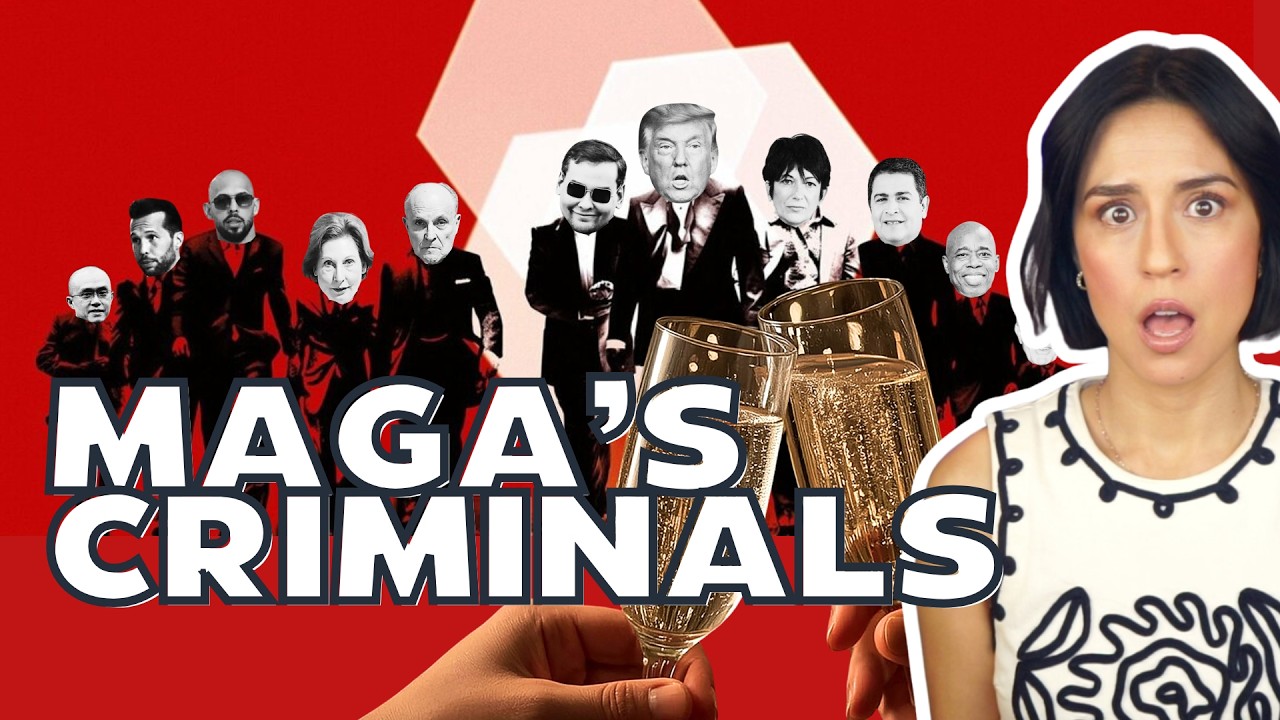
Is this how Pardons work now?
HONDURAS GIL DURAN STONE AT MAL CRISH SOCIALISM AND SAVE FREEDOM CITY PROSPERA TECH BROS
The Bitchuation Room (with Francesca Fiorentini)
242K subscribers
15,571 views Dec 28, 2025
In his first year in office of his second term, Trump has pardoned a whopping 2,000 criminals who have committed all kinds of horrible acts and are still menaces to society. We’re talking Jan 6 rioters who have abused children, killed people while driving drunk, and threatened other federal workers. Mind you, these are crimes they committed AFTER being pardoned! Surely they can expect new pardons for these crimes any day now, right?
---
BIZZARELY SAME TIME AS 2X TAP BOAT STRIKE HEGS 12 25
12/02/25
12/02/25 12:15 PM EST
- ### Tim Pool: “Trump seems to be going a little bit into the neoliberal. You know, neocon-neoliberal.”
12/02/25 12:05 PM EST
12/01/25
Roger Stone claims Trump announced pardon for Juan Orlando Hernández “three hours after” he sent Trump a letter from the former Honduran president
Ana García de Hernández to Stone: “We also want to express our helpful gratitude for the support that you had given … to my husband and the father of my daughters. Since you start speaking about this case, you made such a huge difference.”
Written by Media Matters Staff
Published 12/01/25
November 30, 2025
Audio
From the November 30, 2025, edition of WABC's The Roger Stone Show
ROGER STONE (HOST): For many months, at least six months, I have written extensively about the persecution of former Honduran President Juan Orlando Hernández, who I believe was framed for drug trafficking on the basis of really no evidence whatsoever in a politically motivated act of lawfare by the Biden administration. These are the exact same tactics that were used against President Donald Trump himself by the illicit and unconstitutional investigation of Jack Smith. And I had great sympathy for President Hernández, who was framed not because there was evidence that he was actually involved in drug trafficking, but framed to get him out of the way to make way for the narco-Marxist regime to take power in Honduras. There's an election in Honduras today, but that's not what I'm really here to talk about.
On Friday, I got from the investigative journalist Shane Trejo a letter that President Hernández wrote to President Trump. It was a extraordinarily compelling nine-page letter, which frankly broke my heart because I have been where President Hernández was. I know what it is to be persecuted and have the full power and the unlimited financial and legal capacity of a corrupted, politicized Justice Department come after you, as well as the complicity of the mainstream media who never wants to pick apart the charges against him and just takes everything for granted.
...
STONE: I was delighted about three hours after I sent a copy of this letter to President Trump to read on Truth Social that he had announced the full and unconditional pardon for Juan Orlando Hernández. I think this is fitting. This is justice. Now the [unintelligible] — the US-based media has gone completely insane because they refuse to look at the facts regarding the persecution and trial of Juan Orlando Hernández. And to them, they say, “Well, why is Trump pursuing the Venezuelan dictatorship over drug trafficking at the same time that he's releasing a drug trafficker?” To which I say, there is no shred of evidence other than the testimony of convicted drug traffickers, people that Juan Orlando Hernández himself's government prosecuted, that would tie the former president to drug trafficking. He is an innocent man who was a target and victim of lawfare. And anyone who will examine his trial and the charges against him and the sham trial that they ran in New York would realize that.
Joining us now is the former first lady of Honduras, Ana García de Hernández, President Hernández's daughter, Ana Daniela Hernández, and his other daughter, Isabella Hernández. I want to welcome you to The Roger Stone Show, and I want to tell you how incredibly proud I am to have played just a small role in the justice that has now been meted out for your father and for your country and for your family.
...
ANA GARCÍA DE HERNÁNDEZ (FORMER HONDURAN FIRST LADY): Oh, thank you, Mr. Stone. This is Ana. We are so grateful because of what’s happening to our family. We’d like to say thank you for you for hosting us on your radio show today. It’s truly a pleasure speaking with you.
We also want to express our helpful gratitude for the support that you had given to our — to my husband and the father of my daughters. Since you start speaking about this case, you made such a huge difference. Because as you say, you suffered the same that my husband is suffering or was suffering before President Trump decided to give him a full pardon. So thank you, because — thank you to your efforts, in part Juan Orlando would be [unintelligible] free man, an innocent man has been pardoned and will finally be reunited with our family. So we are really deeply grateful with that.
//
A comprehensive guide to Trump ally Roger Stone, a racist, sexist conspiracy theorist
05/09/16
---
---
https://www.bbc.com/news/science-environment-58508001
no lnx pix
Record number of environmental activists murdered
By Claire Marshall
BBC Environment & Rural Affairs Correspondent
Published 13 September
image captionSouth African environmental activist Fikile Ntshangase was shot dead in her own home
A record number of activists working to protect the environment and land rights were murdered last year, according to a report by a campaign group.
227 people were killed around the world in 2020, the highest number recorded for a second consecutive year, the report from Global Witness said.
Almost a third of the murders were reportedly linked to resource exploitation - logging, mining, large-scale agribusiness, hydroelectric dams and other infrastructure.
The report called the victims "environmental defenders" killed for protecting natural resources that need to be preserved, including forests, water supplies and oceans.
Since the Paris Agreement on climate change was signed in 2015, the organisation says on average four activists have been killed each week.
It said this "shocking figure" was likely to be an underestimate because of growing restrictions on journalists and other civic freedoms.
Logging was the industry linked to the most murders with 23 cases - with attacks in Brazil, Nicaragua, Peru and the Philippines.
Indigenous peoples, most often on the frontline of climate change, accounted for a further one third of cases. Colombia had the highest recorded attacks, with 65 people killed last year.
'Unbearably heavy burden'
A senior campaigner for Global Witness, Chris Madden, called on governments to "get serious about protecting defenders." He said companies must start "putting people and planet before profit' or he warned that "both climate breakdown and the killings" would continue.
"This dataset is another stark reminder that fighting the climate crisis carries an unbearably heavy burden for some, who risk their lives to save the forests, rivers and biospheres that are essential to counteract unsustainable global warming. This must stop''.
The organisation called on governments to formally recognise the human right to a safe, healthy and sustainable environment, and ensure commitments made at November's UN climate change conference, COP26, integrate human rights protections.
In response, COP26 president Alok Sharma told the BBC he had "prioritised meeting people on the front line of climate change," to ensure the voices of all are heard."
'Shot dead in her living room'
Those murdered includedSouth African Fikile Ntshangase, 65, who was involved in a legal dispute over the extension of an opencast mine operated by Tendele Coal near Somkhele in KwaZulu-Natal province. She was shot dead in her own living room.
Her daughter, Malungelo Xhakaza, 31, said her "mother's struggle lives on." She said: "To this day no arrests have been made in the investigation into my mother's murder. There has been no accountability. It seems to me that someone wants this mine expansion and the extraction to go ahead, no matter the cost."
Petmin Limited, which owns the Somkhele mine through its subsidiary Tendele Coal Mining, told Global Witness that it "acknowledges community tensions may have been a factor in Fikile's death." The company said it "strongly condemns any form of violence or intimidation" and has offered full co-operation with the police.
Óscar Eyraud Adams
image captionÓscar Eyraud was killed in his home in Mexico in 2020
The killings also included Óscar Eyraud Adams, who was murdered in Mexico in September 2020. He was working to help the indigenous Kumiai community in Baja California have better access to water.
Global Witness said activists still under threat included communities in Guapinol in Honduras, where dozens of people have been protesting against an iron oxide mining concession that was granted by the central government in a protected area. Campaigners believe the Guapinol river, a vital water source, is threatened. The organisation says "many community members remain incarcerated."
---
---
US Trained Honduran Police Get Medieval as Political Prisoner Edwin Espinal Released
The Honduran corruption canard keeps the focus on police resources and individuals rather than on the pangs of privatization, and so it is often the line favored by the U.S. State Department.
mint press
==
Honduras: the deadliest country in the world for environmental ...
https://www.globalwitness.org › campaigns › environmental-activists › hon...
1.
cuba, venez and honduras related targets
https://insideclimatenews.org/news/08072019/climate-change-migration-honduras-drought-crop-failure-farming-deforestation-guatemala-trump
---
https://news.ucsc.edu/2019/07/frank-honduras-book.html
ucsc dana frank book
New book by Dana Frank tells personal story of resistance, terror, and U.S. policy in Honduras
July 26, 2019
UC Santa Cruz history professor Dana Frank, reporting on protests in Honduras on the anniversary of the June 29, 2009 military coup.* The Long Honduran Night* is the latest book by UC Santa Cruz emerita professor of history, Dana Frank. One of the top academic experts on Honduras in the United States, she tells the dramatic story of life in that country after the military coup that ousted President Manuel Zelaya in June 2009.ana Frank (center) speaking on local televsion in Saba, Honduras, discussing women's projects in the banana unions of Honduras.
Told in part through first-person experiences, interwoven with lucid political analysis, it is a story about the repressive regime that was launched with the coup, the ways in which U.S. policy has continued to support that regime, and the Honduran resistance movement that is growing with help from a new solidarity movement in the United States.
“The book is about one-third my personal stories of what I witnessed, and was eventually involved in, during the nine years following the coup that deposed the democratically-elected president of Honduras.,” said Frank. “It's not just a horror story, though. It deliberately tries to balance the story of repression with the joys and commitments of the Honduran resistance, and how Hondurans continue to seize life amidst terror.”
“The book is very deliberately transnational--crossing back and forth between Honduras and Washington D.C.,” Frank added. “And it very deliberately counters the mainstream media narrative about Honduras, which casts Hondurans as merely suffering victims with no political movements or opinions.”
Tracking U.S. policy as it developed year by year after the coup, the book shows how that policy has been instrumental in supporting a brutal regime for a decade and helping to create some of our most pressing problems today--including the so-called border crisis. By 2012, Honduras had the highest homicide rate in the world with 86 murders per 100,000 residents. The victims have included journalists, union leaders, human rights defenders, as well as leaders of poor farming communities.
“President Trump and his allies have called it a border ‘crisis’ to fan the flames of racism and immigrant-bashing,” said Frank. “But for Hondurans, and other Central Americans, the crisis in their own countries is very real. Mainstream media coverage tells us that Hondurans are fleeing ‘violence and poverty’ but misses the glaring fact that the violence and poverty are the direct result of U.S. policy--which has been, and remains, providing support for the vicious post-coup regime, and especially the dictatorship of Juan Orlando Hernández.”
“U.S. funds continue to shore up his police and military, which continue to use live bullets to kill peaceful protesters,” she added. “And a great range of growing evidence documents that the Honduran military, police, and president are involved in drug trafficking--yet the U.S. continues to celebrate its partnership with Honduras in fighting drug trafficking!”
Frank has been commenting on the volatile situation in the region since the 2009 military coup for media ranging from the New York Times and Washington Post to National Public Radio, and the Associated Press. She has consistently questioned U.S. foreign policy toward Honduras in an effort to stop the administration from supporting, funding, and perpetuating human rights abuses.
She has also testified in Congress about Honduras, as well as in the California State Assembly about the treatment of refugees from Central America.
In a 2013 appearance before the Tom Lantos Human Rights Commission in the U.S. House of Representatives, Frank began her testimony by noting:
“I have been asked to address U.S. policy in Honduras, and that will be the focus of my statement here today…Before doing so I would like to reiterate the enormity and breadth of the human rights crisis the other speakers have identified.
I just returned from Honduras yesterday. When I arrived a few days before, I spoke with a young father in his early 30s. He is not particularly involved politically, but quite well-informed. When I told him I was going to testify in the U.S. Congress about human rights in Honduras, he volunteered--without any further words on my part: 'There are no human rights in Honduras. ‘They don’t exist.’”
Frank has spent the last few months doing numerous interviews for her new book in a variety of media venues, while still being tapped by reporters from major news outlets for comments on current events such as the recent migrant caravans.
“When journalists contact me, it's usually about breaking news—such as when the Honduran dictator, Juan Orlando Hernández, stole the 2017 presidential election and turned the police and military on protesters,” said Frank. “In other cases, it's investigative journalists, who are looking for insights into a specific dynamic, as when the Associated Press documented that the National Director of Police had been moving cocaine.”
But she also continues to travel to Honduras and Washington D.C. in her decade-long effort to help change U.S. policy toward Honduras. And her message is loud and clear.
“The U.S. should immediately suspend all security aid to Honduras, and stop treating the narco-dictatorship as a friendly partner,” said Frank. "’Humanitarian’ or ‘development’ aid should be carefully evaluated too. USAID funds have a long history of being used to create and nurture fake ‘civil society’ groups loyal to the U.S. and designed to serve U.S. interests. Agricultural ‘aid’ has long been used to create export and import dependencies. All this aid is called ‘soft power’ for a reason.”
“We need, instead, to listen to what the independent social movements and human rights groups in Honduras have to say--to their own ideas about democracy, free and fair elections, and social justice--rather than deploy new forms of imperialism in the name of ‘helping’ poor victims.”
==
icn 719
Ravaged by Drought, a Honduran Village Faces a Choice: Pray for Rain or Migrate
https://insideclimatenews.org/news/08072019/climate-change-migration-honduras-drought-crop-failure-farming-deforestation-guatemala-trump
==
https://theconversation.com/how-us-policy-in-honduras-set-the-stage-for-todays-migration-65935
nevens
Hondurans fleeing poverty and violence – who make up most of the participants of a “caravan” estimated at between 7,000 and 8,000 people – are slowly moving through Mexico in the hope of reaching the United States and receiving refuge.
President Trump has responded by characterizing the caravan as, among other unflattering things, “an onslaught” and “an assault” on the United States. Trump’s statements, which do not accurately characterize the makeup and motivations of the migrants, have pushed many media outlets to rebut his false claims.
The mainstream narrative of such movements of people often reduces the causes of migration to factors unfolding in migrants’ home countries. In reality, migration is often a manifestation of a profoundly unequal and exploitative relationship between countries from which people emigrate and countries of destination.
As I have learned through many years of research on immigration and border policing, the history of relations between Honduras and the United States is a prime example of these dynamics. Understanding this is vital to making immigration policy more effective and ethical.
U.S. roots of Honduran emigration
I first visited Honduras in 1987 to do research. As I walked around the city of Comayagua, many thought that I, a white male with short hair in his early 20’s, was a U.S. soldier. This was because hundreds of U.S. soldiers were stationed at the nearby Palmerola Air Base at the time. Until shortly before my arrival, many of them would frequent Comayagua, particularly its “red zone” of female sex workers.
U.S. military presence in Honduras and the roots of Honduran migration to the United States are closely linked. It began in the late 1890s, when U.S.-based banana companies first became active there. As historian Walter LaFeber writes in “Inevitable Revolutions: The United States in Central America,” American companies “built railroads, established their own banking systems, and bribed government officials at a dizzying pace.” As a result, the Caribbean coast “became a foreign-controlled enclave that systematically swung the whole of Honduras into a one-crop economy whose wealth was carried off to New Orleans, New York, and later Boston.”
By 1914, U.S. banana interests owned almost 1 million acres of Honduras’ best land. These holdings grew through the 1920s to such an extent that, as LaFeber asserts, Honduran peasants “had no hope of access to their nation’s good soil.” Over a few decades, U.S. capital also came to dominate the country’s banking and mining sectors, a process facilitated by the weak state of Honduras’ domestic business sector. This was coupled with direct U.S. political and military interventions to protect U.S. interests in 1907 and 1911.
Such developments made Honduras’ ruling class dependent on Washington for support. A central component of this ruling class was and remains the Honduran military. By the mid-1960s it had become, in LaFeber’s words, the country’s “most developed political institution,” – one that Washington played a key role in shaping.
The Reagan era
This was especially the case during the presidency of Ronald Reagan in the 1980s. At that time, U.S. political and military policy was so influential that many referred to the Central American country as the “U.S.S. Honduras” and the Pentagon Republic.
As part of its effort to overthrow the Sandinista government in neighboring Nicaragua and “roll back” the region’s leftist movements, the Reagan administration “temporarily” stationed several hundred U.S. soldiers in Honduras. Moreover, it trained and sustained Nicaragua’s “contra” rebels on Honduran soil, while greatly increasing military aid and arm sales to the country.
The Reagan years also saw the construction of numerous joint Honduran-U.S. military bases and installations. Such moves greatly strengthened themilitarization of Honduran society. In turn, political repression rose. There was a dramatic increase in the number of political assassinations, “disappearances” and illegal detentions.
The Reagan administration also played a big role in restructuring the Honduran economy. It did so by strongly pushing for internal economic reforms, with a focus on exporting manufactured goods. It also helped deregulate and destabilize the global coffee trade, upon which Honduras heavily depended. These changes made Honduras more amenable to the interests of global capital. They disrupted traditional forms of agriculture and undermined an already weak social safety net.
These decades of U.S. involvement in Honduras set the stage for Honduran emigration to the United States, which began to markedly increase in the 1990s.
In the post-Reagan era, Honduras remained a country scarred by a heavy-handed military, significant human rights abuses and pervasive poverty. Still, liberalizing tendencies of successive governments and grassroots pressure provided openings for democratic forces.
They contributed, for example, to the election ofManuel Zelaya, a liberal reformist, as president in 2006. He led on progressive measures such as raising the minimum wage.He also tried to organizea plebiscite to allow for a constituent assembly to replace the country’s constitution, which had been written during a military government. However, these efforts incurred the ire of the country’s oligarchy, leading to his overthrow by the military in June 2009.
Post-coup Honduras
The 2009 coup, more than any other development, explains the increase in Honduran migration across the southern U.S. border in the last few years. The Obama administration has played an important role in these developments. Although it officially decried Zelaya’s ouster, it equivocated on whether or not it constituted a coup, which would have required the U.S. to stop sending most aid to the country.
Secretary of State Hillary Clinton, in particular, sent conflicting messages, and worked to ensure that Zelaya did not return to power. This was contrary to the wishes of the Organization of American States, the leading hemispheric political forum composed of the 35 member-countries of the Americas, including the Caribbean. Several months after the coup, Clinton supported a highly questionable election aimed at legitimating the post-coup government.
Strong military ties between the U.S. and Honduras persist: Several hundred U.S. troops are stationed at Soto Cano Air Base, formerly Palmerola, in the name of fighting the drug warand providing humanitarian aid.
Since the coup, writes historian Dana Frank, “a series of corrupt administrations has unleashed open criminal control of Honduras, from top to bottom of the government.” The Trump administration’s recognition, in December 2017, of President Juan Orlando Hernández’s re-election—after a process marked by deep irregularities, fraud and violence. This continues Washington’s longstanding willingness to overlook official corruption in Honduras as long as the country’s ruling elites serve what are defined as U.S. economic and geopolitical interests.
Organized crime, drug traffickers and the country’s police heavily overlap.The frequent politically motivated killings are rarely punished. In 2017, Global Witness, an international nongovernmental organization, found that Honduras was the world’s deadliest country for environmental activists.
Although its once sky-high murder rate has declined over the last few years, the continuing exodus of many youth demonstrates that violent gangs still plague urban neighborhoods.
Meanwhile, post-coup governments have intensified an increasingly unregulated, free market form of capitalism that makes life unworkable for many by undermining the country’s limited social safety net and greatly increasing socioeconomic inequality. Government spending on health and education, for example, has declined in Honduras. Meanwhile, the country’s poverty rate has risen markedly. These contribute to the growing pressures that push many people to migrate.
What will happen to the thousands of people now moving northward? If the recent past is any indication, many will likely stay in Mexico.
What the Trump administration will ultimately do with those who arrive at the U.S. southern border is unclear. Regardless, the role played by the United States in shaping the causes of this migration raises ethical questions about its responsibility toward those now fleeing from the ravages its policies have helped to produce.
==
---
https://www.lawg.org/delahunt-mcgovern-resolution-on-honduras/
We ask you to join us in co-sponsoring the resolution below condemning the coup d'état in Honduras, demanding that Honduran President Manuel Zelaya be returned to office, and welcoming the mediation efforts of Costa Rican President Oscar Aria
many sigs
8/15
https://www.peoplesworld.org/article/amid-scandal-u-s-lawmakers-oppose-funding-honduran-government/
As a massive scandal involving corruption and abuse of power by the administration of Honduran President Juan Orlando Hernandez envelops this impoverished Central American country, a group of 21 Democratic members of the U.S. House of Representatives have sent a letter to Secretary of State John Kerry calling for the suspension of projected U.S. aid to Honduran police.
The money for aid to the Honduran police is part of an appropriation for fiscal year 2016 that the Obama administration has requested to fund the “Alliance for Prosperity.” The appropriation, of $1 billion, would fund aid to social welfare systems but also to the security services of the three northernmost countries of Central America: Guatemala, El Salvador and Honduras. The Congressional letter, dated Wednesday August 19, addresses itself to the fact that President Hernandez has been pursuing a policy of militarizing the functions of the Honduran police, leading to multiple complaints of violations of human rights.
Hernandez and his administration are also accused of massive corruption, and have been the target of huge demonstrations, calling for his resignation since April.
Hernandez, of the National Party, was elected president in 2013 in an election that was marred by accusations of fraud and the murder of a number of members of the left-wing LIBRE party of former president Manuel Zelaya and his wife, Xiomara Castro,who was LIBRE’s candidate in that election and had been expected to win. Since then, it has been found that the previous administration of President Porfirio Lobo, also from the National Party had diverted funds intended for health care of poor Hondurans and used them to illegally support Hernandez’ election.
Hernandez, who had been head of the National Congress before his election, had also manipulated judicial appointments to smooth his way to power.
Lobo, in turn, had been elected with U.S. support in a deeply flawed election after President Manuel Zelaya had been overthrown in a military coup in June of 2009.
As early as 2010 Congress members have been writing to the State Department expressing concern about what is going on in Honduras.
In 2013, 108 members signed a similar letter. Again in 2014, another, similar letter was signed by 106 lawmakers.
Both of those letters asked Secretary of State Kerry to look into stories of human rights violations, including killings of oppositionists and electoral fraud, by the successive right wing Honduran governments of Presidents Porfirio Lobo and Juan Orlando Hernandez.
The new letter, however, goes further and calls for the suspension of aid under the $1 billion “Alliance for Prosperity” plan announced by the Obama administration after last years’ so called “child migration crisis” was manipulated by the Republican Party for its own opportunistic and partisan purposes.
The Congressional letter points out that the “Military Police” established by Hernandez, in apparent violation of the Honduran constitution, now numbers 3,000 members who are under the command, not of civilian authorities, but of the army.
“According to the Comité de Familiares de Detenidos y Desaparecidos en Honduras (COFADEHH)[in English, Committee of Relatives of Detained and Disappeared People in Hondurass], a leading human rights organization in Honduras, military personnel have been involved in human rights abuses, including assassinations and intimidation of opposition leaders, land activists, and peaceful protesters.”
The letter expresses concern that in May of this year, 300 U.S. military and FBI personnel were sent to Honduras to provide “rapid response” training to this abuse-riddled Honduran military-police amalgam.
The letter emphasizes: “We want to make sure those taxpayer dollars are not used for military-style policing activity that could, in fact, be one of the causes [of the child migration to the United States] as it exacerbates violence in the country.” The 21 congresspersons also asked that Kerry assure them that the aid to Honduras does not violate the Leahy Law, which prohibits U.S. aid to repressive military forces.
Signatories of the letter, all Democrats, include Hank Johnson, Jan Schakowsky (Illinois),James McGovern (Massachusetts), Raul Grijalva (Arizona), John Conyers (Michigan), Sam Farr (California), Luis Gutierrez (Illinois), John Lewis (Georgia), Marcy Kaptur (Ohio), Mark Pocan (Wisconsin), Keith Ellison (Minnesota), Maxine Waters (California), Michael Honda (California), Rosa DeLauro (Connecticut), Gwen Moore (Wisconsin), Barbara Lee (California), Karen Bass (California), Zoe Lofgren (California), Danny K Davis (Illinois), Michelle Lujan Grisham (New Mexico), and José Serrano (New York).
Readers who would like to ask their own congressional representatives to support the position taken by this letter can find Congressional contact information at the official U.S. Congress website.
==
==
Abortion in all instances, including rape, is illegal in Honduras. Any woman who has an abortion, and anyone found to have helped her, can be charged with a crime and imprisoned.
Here’s the thing: Research from around the world has shown that when abortion is banned, women don’t have fewer abortions – they just have riskier ones, where they put their health, and sometimes even their lives, at risk.
No one knows exactly how many women and girls have clandestine abortions in Honduras, but one Honduran nongovernmental organization (NGO) estimated somewhere between 50,000 and 80,000 abortions occur each year.
==
==
https://en.wikipedia.org/wiki/Allegations_of_CIA_drug_trafficking
United States Central Intelligence Agency (CIA) has been accused of involvement in drug trafficking. Books and investigations on the subject that have received general notice include works by historian Alfred McCoy; professor and diplomat Peter Dale Scott; and journalists Gary Webb, and Alexander Cockburn, as well as by writer Larry Collins. These claims have led to investigations by the United States government, including hearings and reports by the United States House of Representatives, Senate, Department of Justice, and the CIA's Office of the Inspector General. The subject remains controversial.
Following is a summary of some of the main claims made by geographical area.
...
Mexico
See also: Mexican Drug War
In October 2013, two former federal agents and an ex-CIA contractor told an American television network that CIA operatives were involved in the kidnapping and murder of DEA covert agent Enrique Camarena, because he was a threat to the agency's drug operations in Mexico. According to the three men, the CIA was collaborating with drug traffickers moving cocaine and marijuana to the United States, and using its share of the profits to finance Nicaraguan Contra rebels attempting to overthrow Nicaragua's Sandinista government. A CIA spokesman responded, calling it "ridiculous" to suggest that the Agency had anything to do with the murder of a US federal agent or the escape of his alleged killer.[17]
Honduras
The Honduran drug lord Juan Matta-Ballesteros was the owner of SETCO, an airline which the Nicaraguan Contras used to covertly transport military supplies and personnel in the early 1980s.[18] Writers such as Peter Dale Scott and Jonathan Marshall have suggested that the U.S. government's desire to conceal or protect these clandestine shipments led it to close the DEA office in Honduras when an investigation began into SETCO, allowing Matta-Ballesteros to continue and expand his trafficking.[19]
Nicaragua
Main article: CIA involvement in Contra cocaine trafficking
In 1986, the United States Senate Committee on Foreign Relations began investigating drug trafficking from Central and South America and the Caribbean to the United States. The investigation was conducted by the Sub-Committee on Terrorism, Narcotics, and International Operations, chaired by Senator John Kerry, so its final 1989 report was known as the Kerry Committee report. The Report concluded that "it is clear that individuals who provided support for the Contras were involved in drug trafficking, the supply network of the Contras was used by drug trafficking organizations, and elements of the Contras themselves knowingly received financial and material assistance from drug traffickers."[20]
In 1996 Gary Webb wrote a series of articles published in the San Jose Mercury News, which investigated Nicaraguans linked to the CIA-backed Contras who had smuggled cocaine into the U.S. which was then distributed as crack cocaine into Los Angeles and funneled profits to the Contras. His articles asserted that the CIA was aware of the cocaine transactions and the large shipments of drugs into the U.S. by the Contra personnel and directly aided drug dealers to raise money for the Contras. The Los Angeles Times, The New York Times, and The Washington Post launched their own investigations and rejected Webb's allegations.[21]In May 1997, The Mercury News executive editor Jerry Ceppos, who had approved the series, published a column that acknowledged shortcomings in the series reporting, editing, and production, while maintaining the story was correct "on many important points."[21] Webb later published a book based on the series, Dark Alliance: The CIA, the Contras, and the Crack Cocaine Explosion.[22]
The 2014 movie Kill the Messenger depicted actor Jeremy Renner as Gary Webb.[23]
Panama
See also: Illegal drug trade in Panama
...
==
more caravan BS
https://www.foxnews.com/world/questions-arise-over-politics-motivations-of-caravan-organizers
oct 25 no lnx
Questions arise over politics, motivation of caravan organizers
Hollie McKay
By Hollie McKay | Fox News
What can US do to stop migrant caravans?Video
What can US do to stop migrant caravans?
President Trump vows to deploy troops to the border as migrants from Central America make their way toward the U.S.; insight from former ICE Acting Director Tom Homan and House Majority Whip Steve Scalise.
As several thousand Central Americans and Mexicans continue to march toward the United States in the migrant caravan, more questions are being asked about how the effort was brought together, who is behind it, and what prompted the movement to this point just weeks before critical U.S. elections.
While some claim the caravan began organically, others argue opponents of President Donald Trump's immigration policy have played a key role in the movement, with the aim of embarrassing the U.S. administration, and its supporters in Central American countries like Honduras.
“This caravan was initially organized by Bartolo Fuentes, a known leftist activist and former member of the national Congress in 2013, representing the political party of deposed Honduras president Manuel Zelaya," Johan Obdola, president of Latin America-focused global intelligence and security firm IOSI, told Fox News. "Now, this is not new, but is the first time it gets a high level of international media attention. And the reasons are beyond the political.”
Obdola argued it's in the interest of Honduran opposition members like Zelaya to “actively create violent acts and destabilization in Honduras," and said the caravans are part of a plan to keep the region "in constant chaos." He also argued the former Honduran leader – who served as president from 2006 to 2009 – is closely allied with the Venezuelan regime of Nicolas Maduro, and questioned that conflict-riddled nation’s role in fostering mass migration in an effort to embarrass the current, pro-U.S. Honduran President Juan Orlando Hernandez.
Honduras has been plagued by discord since its election last November of Hernandez, who defeated Zelaya. Many Zelaya supporters protested the results, claiming they were fixed in favor of a U.S-approved leader. The subsequent unrest has been cited as a key factor for Hondurans wanting to leave their country.
Fuentes, a former Zelaya government legislator and host of the migration-focused radio show “Without Borders,” is often characterized by Honduran government figures as a "coyote," or human trafficker. To others, he is a social activist. Fuentes himself last week was pulled from the main caravan group in Guatemala and deported back to Honduras.
Zelaya staunchly denied any link to the caravan, or any effort to push Hondurans toward the United States.
“This apocalyptic exodus is due to the disgraces that the people are living,” he told Fox News in an exclusive interview Thursday. “The caravan is a natural process of unity. It is self-summoned, and there is no organization assembling this quantity of immigrants in the country. It is a reaction from the people to the problems they are living in our countries.”
The former president also accused the U.S. of “maintaining a socialist dictatorship” in its support for the “illegitimate” Hernandez leadership, but denied any other governments – including Venezuela – were behind the caravan.
“No leftist government has come here to promote immigration to the U.S., nor has it financed it. No one needs to pay Honduras to leave. They leave voluntarily,” Zelaya continued, adding that while he has personally worked with Bartolo Fuentes in the past, immigration has long been his most important issue of advocacy.
“Fuentes has worked with the immigrant community for 20 to 30 years – well before entering politics – and that he receives no money for this work nor has he given out money to anyone,” Zelaya insisted.
The Honduras Embassy in Washington and Fuentes did not immediately respond to request for comment. Fuentes wrote on Facebook this week that the migrants are in need of basics like ointments for blisters, socks, shoes, diapers, and umbrellas. He thanked the help of pastors and churchgoers for food and other supplies.
While Fuentes had much to do with helping bring to life and expand the presence of the caravan, others contended he was not the first. Rather, social media platforms like Facebook and WhatsApp laid the first foundations that made it easy to draw in Hondurans looking for an easier path to the U.S.
“They had been unable to afford coyotes, so they viewed joining this caravan as their opportunity to flee turmoil in much of Central America,” said James Hyde, an analyst and member of the Electromagnetic Pulse Task Force on National and Homeland Security. “When Honduran TV picked up the posts and the reactions to it, the number of people swelled from hundreds to thousands.”
Hiring coyote smugglers for the perilous journey can cost up to $5,000, more than double what most Hondurans make in one year.
Central American migrants walking to the U.S. start their day departing Ciudad Hidalgo, Mexico, Sunday, Oct. 21, 2018. Despite Mexican efforts to stop them at the border, about 5,000 Central American migrants resumed their advance toward the U.S. border early Sunday in southern Mexico. (AP Photo/Moises Castillo)
Central American migrants walking to the U.S. start their day departing Ciudad Hidalgo, Mexico, Sunday, Oct. 21, 2018. Despite Mexican efforts to stop them at the border, about 5,000 Central American migrants resumed their advance toward the U.S. border early Sunday in southern Mexico. (AP Photo/Moises Castillo)
Small groups started to talk among themselves about making a journey last month, sources said, while Fuentes got on-board to help mobilize the migrants – just as he had with another caravan in April – this time urging the group to meet up at the San Pedro Sula bus station.
“It’s very well-organized by those who started the social media campaign. It gained momentum when Bartolo Fuentes got involved and the movement stirred up lawyers group funded with dark money, who teach those headed north what to say for asylum,” Hyde said. “Joining the massive group is simple. People decide to cast away their current lives and jump into the opportunity to join.”
Word spread with media attention and a local news coverage. And soon Hondurans from across the country, who saw it as an opportunity to relocate cheaply and under the guise of “safety in numbers,” allowing them safe passage from dangerous drug cartels and smugglers along the dangerous roads.
Estimates on the size of the current caravan vary. And while there are signs the Mexican government is taking steps to better control or reduce the number of migrants, El Salvador, Guatemala and Honduras seemed unwilling or unable to take much action. Some two-thirds of those in the caravan are Hondurans, according to estimates, with the remainder from other Central American countries and Mexico.
COLOMBIAN MOTHERS CHALLENGE 'BAD LUCK' TABOOS, TAKE THE LEAD EMERALD MINING
The motivations for those in the group also vary. Many are seeking better economic opportunities. Others are members of persecuted groups who say they're unable to live safely and openly in their home countries. Some were previously deported from the U.S., and are trying to get back to family members who remained behind.
“For most of these people trying to reach the USA, and fleeing violence and poverty, they are the ones paying the highest price as many of them are victims of crime, torture and sexual abuse," said Obdola. “There are some humanitarian and social groups assisting the caravan along the way. Some with only a humanitarian interest, some with more of a political interest who see the USA and Trump as the enemy.”
Sources said the caravan is being supported and nourished in part by an array of Mexican church and human rights organizations, as well as locals on the streets.
“It’s a weird mishmash of people involved. Small amounts of money have been handed out, but it is not clear from who and where,” said one Mexico-based law enforcement source. “It isn’t a cartel operation and cartels aren’t involved. The cartels are very nervous about what is happening, the last thing they want is attention on the border which only makes their job harder.”
Some have strongly argued the issue should be viewed in humanitarian rather than national security concerns.
VENEZUELAN OPPOSITION LEADER LAMENTS "GENOCIDE" IN HIS COUNTRY, REVEALS HIS ESCAPE FROM DETAINMENT
“We need to focus on the human aspect of this and consider what is driving this migration; violence, corruption, economic limits or degradation, and the effect of climate change,” said Michael Scadden, Geopolitical Risk and Corporate Security Advisor specializing in Latin America. “Food and water security is a major factor in many migrants’ decisions to take the risk of this journey.”
Others contend that whatever the legitimate asylum claims of those in group, international law dictates caravans should not make it to the United States border.
“International law on asylum is that the asylum seeker is supposed to present themselves to the authorities of the first international border they reach upon fleeing their countries," said Dennis Santiago, a global risk and foreign policy analyst. "For Central Americans fleeing north from their governments, that country is Mexico; specifically, the southern border of Mexico.”
Santiago explained that Mexico, with aid from the international community, should have set up refugee camps at the borders to handle the migrant flow. That would have then triggered the involvement of the U.N. High Commission on Refugees (UNHCR).
"It is from these camps that other organizations such as the U.S. Office for Refugee Resettlement are supposed to process persons to qualify eligible refugees for movement from the camps to a third host nation,” he said.
Santiago also asserted the U.S., Mexico and the U.N. have the money and resources to support the refugee camps.
"We’re talking 1,500 people per caravan, which is a drop in the bucket compared to the 11 million Syrians, Kurds and Yazidis displaced in the Middle East,” he continued. “But most of these people are refusing to go into camps and process as refugees. Somebody’s giving them a better deal than the internationally sanctioned solution set. Instead, they are marching towards the U.S. border. Are these people really legitimate refugees from their own governments?”
Joseph Fallon, a research associate for the U.K. Defense Forum, also argued that “if fear of violence in their country was their primary motive, they could have traveled to neighboring Costa Rica.”
Central American migrants, part of a caravan trying to reach the U.S., cross the Suchiate River to avoid the border checkpoint in Ciudad Hidalgo, Mexico, October 20, 2018. REUTERS/Edgard Garrido
Central American migrants, part of a caravan trying to reach the U.S., cross the Suchiate River to avoid the border checkpoint in Ciudad Hidalgo, Mexico, October 20, 2018. REUTERS/Edgard Garrido
Under pressure from the Trump administration, Mexican officials have been desperately urging caravan members to stay in Mexico and be processed there. Yet the vast majority have remained steadfast in their endeavor to get to the United States. Migrants in the past have complained that applying for asylum in Mexico is a demoralizing process, which can take more than a year, and even then routinely results in a rejection.
For the first time ever in 2016, Mexico deported double the number of Central Americans than did the United States. That has at least in part what has motivated many to head north.
Yet at least some of those seeking asylum also appear to have been "coached," according to several sources, and have memorized scripted stories that would make them more sympathetic to U.S. immigration officials.
Migrants bound for the U.S.-Mexico border wait on a bridge that stretches over the Suchiate River, connecting Guatemala and Mexico, in Tecun Uman, Guatemala, Friday, Oct. 19, 2018. (AP Photo/Oliver de Ros)
Migrants bound for the U.S.-Mexico border wait on a bridge that stretches over the Suchiate River, connecting Guatemala and Mexico, in Tecun Uman, Guatemala, Friday, Oct. 19, 2018. (AP Photo/Oliver de Ros)
“Caravans didn’t exist before 2010. Trips are carefully planned and coached. Aliens removed do share their experiences back home and that presents lessons learned for a return trip for others planning their first run,” Gabriel Ruiz, a California border-based deportation officer with the U.S. Immigration and Customs Enforcement (ICE), told Fox News. "Almost all have birth certificates and identity documents, but establishing the validity of those documents is time-consuming and difficult because a processing officer doesn’t have that sort of time to investigate identities in detail.”
Hollie McKay has a been a Fox News Digital staff reporter since 2007. She has extensively reported from war zones including Iraq, Syria, Yemen, Afghanistan, Pakistan, Burma, and Latin America investigates global conflicts, war crimes and terrorism around the world. Follow her on Twitter.
==
http://thejewishvoice.com/2018/10/31/meet-the-folks-who-are-really-behind-the-illegal-alien-caravan/
News about the caravan of illegal aliens from Central America who are making their way across Mexico in an attempt to breach the U.S. border has been shuttled to the sidelines thanks to the attempted bombing of prominent Democrats.
But they’re still coming. And as they approach the U.S. border, more questions are being asked about who organized the caravan in the first place.
Many on the right believe that George Soros is behind the effort. But an investigation by Fox News discovered that domestic Honduran politics was the impetus for forming the caravan and sending it on its way.
“This caravan was initially organized by Bartolo Fuentes, a known leftist activist and former member of the national Congress in 2013, representing the political party of deposed Honduras president Manuel Zelaya,”Johan Obdola, president of Latin America-focused global intelligence and security firm IOSI, told Fox News. “Now, this is not new, but is the first time it gets a high level of international media attention. And the reasons are beyond the political.”
Obdola argued it’s in the interest of Honduran opposition members like Zelaya to “actively create violent acts and destabilization in Honduras,” and said the caravans are part of a plan to keep the region “in constant chaos.” He also argued the former Honduran leader – who served as president from 2006 to 2009 – is closely allied with the Venezuelan regime of Nicolas Maduro, and questioned that conflict-riddled nation’s role in fostering mass migration in an effort to embarrass the current, pro-U.S. Honduran President Juan Orlando Hernandez.
Honduras has been plagued by discord since its election last November of Hernandez, who defeated Zelaya. Many Zelaya supporters protested the results, claiming they were fixed in favor of a U.S-approved leader. The subsequent unrest has been cited as a key factor for Hondurans wanting to leave their country.
Fuentes, a former Zelaya government legislator and host of the migration-focused radio show “Without Borders,” is often characterized by Honduran government figures as a “coyote,” or human trafficker. To others, he is a social activist. Fuentes himself last week was pulled from the main caravan group in Guatemala and deported back to Honduras.
Zelaya staunchly denied any link to the caravan, or any effort to push Hondurans toward the United States.
Zelaya’s supporters may be pulling the strings behind the scenes, but the group Pueblo Sin Fronteras, or “People Without Borders,” was heavily involved in organizing the caravan.
Capital Research Center:
Some left-leaning publications such as the New York Times have said that “no group has claimed responsibility for organizing [the most recent] caravan,” perhaps in order to stave off claims by President Trump and other conservatives that it is being aided by left-wing activists in the United States.
The Times, however, is only partially correct. While no single group has claimed control of the migrant caravan, at least two activists from Pueblo Sin Fronteras – Denis Omar Contreras and Rodrigo Abeja – are embedded in the caravan, according to the Los Angeles Times, the Washington Post, and the Mexican newspaper La Jornada. Contreras (sometimes spelled Contera or Contrera) reportedly helped lead the caravan to illegally enter Mexico, where he told migrants “Welcome to Tapachula!” (referencing a town near the Guatemala border). Abeja, too, was identified as one of the leaders of the April 2018 caravans, which were also supported by Pueblo Sin Fronteras.
On October 18, Irineo Mujica – director of Pueblo Sin Fronteras in Mexico and an American citizen – was arrested by Mexican officials for allegedly attacking immigration officials at a pro-illegal immigration protest near the Guatemala-Mexico border.
By: Rick Moran
(American Thinker)
---
==
https://www.democracynow.org/2019/5/1/economist_jeffrey_sachs_us_sanctions_have
Economist Jeffrey Sachs: U.S. Sanctions Have Devastated Venezuela & Killed Over 40,000 Since 2017
More than 40,000 people have died in Venezuela since 2017 as a result of U.S. sanctions, according to a new report by the Center for Economic and Policy Research co-authored by economists Jeffrey Sachs and Mark Weisbrot. The report examines how U.S. sanctions have reduced the availability of food and medicine in Venezuela and increased disease and mortality. We speak with Jeffrey Sachs in our New York studio. In the report, he writes, “American sanctions are deliberately aiming to wreck Venezuela’s economy and thereby lead to regime change. It’s a fruitless, heartless, illegal, and failed policy, causing grave harm to the Venezuelan people.”
---
Transcript
This is a rush transcript. Copy may not be in its final form.
AMY GOODMAN: This is Democracy Now! I’m Amy Goodman. Our guests are Miguel Tinker Salas, a Venezuelan professor at Pomona College in California; Jeffrey Sachs is with us here in New York, leading economist and director of the Center for Sustainable Development at Columbia University. He’s recently co-authored a report for the Center for Economic and Policy Research headlined “Economic Sanctions as Collective Punishment: The Case of Venezuela.”
So much is being used against the presidency of Maduro, saying he’s brought the country to an economic standstill. You make a different case, Jeffrey Sachs.
JEFFREY SACHS: Well, it’s not an economic standstill. It’s a complete economic collapse, a catastrophe, in Venezuela. There was a crisis, for sure, before Trump came to office, but the idea of the Trump administration, from the start, has been to overthrow Maduro. That’s not a hypothesis. Trump was very explicit in discussions with presidents of Latin America, where he asked them, “Why shouldn’t the U.S. just invade?” He said that already in 2017. So the idea of the Trump administration has been to overthrow Maduro from the start. Well, the Latin leaders said, “No, no, that’s not a good idea. We don’t want military action.” So the U.S. government has been trying to strangle the Venezuelan economy.
It started with sanctions in 2017 that prevented, essentially, the country from accessing international capital markets and the oil company from restructuring its loans. That put Venezuela into a hyperinflation. That was the utter collapse. Oil earnings plummeted. The earnings that are used to buy food and medicine collapsed. That’s when the social, humanitarian crisis went spiraling out of control. And then, in this year, with this idea, very naive, very stupid, in my view, that there would be this self-proclaimed president, which was all choreographed with the United States very, very closely, another round of even tighter sanctions, essentially confiscating the earnings and the assets of the Venezuelan government, took place.
NowVenezuela is in complete, utter catastrophe, a lot of it brought on by the United States deliberately, creating massive, massive suffering. We know there’s hunger. We know there’s a incredible shortage of medical supplies. We can only imagine, because we won’t know really until the dust settles and careful studies are done, how much excess mortality there is, but, surely, in a context like this, this is a catastrophe largely created by the U.S., because, as was said earlier, this is an all-or-nothing strategy. What the U.S.—what Trump just doesn’t understand and what Bolton, of all, of course, never agrees to, is the idea of negotiations. This is an attempt at an overthrow. It’s very crude. It’s not working. And it’s very cruel, because it’s punishing 30 million people.
AMY GOODMAN: How did you come up with the number 40,000 dead as a result of these crippling U.S. sanctions?
JEFFREY SACHS: Let me be clear: Nobody knows. This was a very basic, simple calculation based on estimates of universities in Venezuela that mortality had increased by a certain proportion after the sanctions. I don’t want anyone to think that there is precision in these numbers. What is certain, though, staring us in the face, is that there is a humanitarian catastrophe, deliberately caused by the United States, by what I would say are illegal sanctions, because they are deliberately trying to bring down a government and trying to create chaos for the purpose of an overthrow of a government.
AMY GOODMAN: Why?
JEFFREY SACHS: Why are they doing that? This is normal U.S. right-wing foreign policy, nothing different. This is the same foreign policy that we saw throughout Latin America in the 20th century. It’s the same foreign policy that we saw catastrophically in the Middle East. This is Mr. Bolton. This is Mr. Bolton’s idea of diplomacy. This is Trump’s idea of diplomacy. You punch someone in the face. You crush your opponent. You try whatever way you can to get your way. It’s very simpleminded. It’s very crude. And, Amy, it never works. It just leads to catastrophe.
AMY GOODMAN: I want to bring Miguel Tinker Salas back into this conversation, professor at Pomona College. As these protests were taking place in—or this coup attempt was taking place in Venezuela, in Honduras there were massive protests against privatization, also huge demonstrations in Paris. You certainly don’t get the same kind of coverage.
MIGUEL TINKER SALAS: No, you don’t. And the reality is that what’s happening in Honduras is fundamental. You have an effort at privatization. You have layoffs of doctors and of professors and of teachers. And there’s massive street protests happening in Tegucigalpa and all the major cities. And the attention is all on Venezuela. And the same thing is happening, in other contexts, for Central America, the immigration that’s happening as a result of failed U.S. policies. As a colleague was saying earlier, the reality is this was tried elsewhere. The regime change that’s being tried in Venezuela has been tried elsewhere in Latin America and has led to humanitarian crisis throughout Central America—Honduras, Guatemala, El Salvador, in Mexico until very recently. So, again, we know the formula. We know it doesn’t produce the change that most people want. And what it does is it aggravates conditions for the majority of the population. So, you have, in the case of Venezuela, mistakes made by the Maduro administration that are now exacerbated by the sanctions and that take a toll on humans and on the population of the country.
AMY GOODMAN: We’ve been showing, for our radio audience, video, just to let you know, of the tear-gassing of people in Paris and Honduras right now. Of course, Honduras is a U.S. ally. We’re not getting as much coverage of this. Finally, I wanted to ask Jeffrey Sachs about this issue you raise of collective punishment, and saying that collective punishment of a civilian population, as described by both the Geneva and Hague international conventions, to which the U.S. is a signatory—in that way.
JEFFREY SACHS: And, I would say, of the OAS also, which explicitly prohibits this kind of hostile action against another country. U.S. sanctions are now being imposed to bring down governments everywhere. You have, similarly in Iran yesterday, a big announcement of the collapse of the Iranian economy, and the IMF attributed it to U.S. sanctions. So, this is what the Trump administration is trying to do also vis-à-vis Nicaragua. Trump said yesterday, total blockade on Cuba, if they don’t smart up. This is pure bullying. It is completely against international law. It creates havoc. It’s hard enough to achieve economic progress, but when the U.S. is using its political power to break other countries, the results absolutely can be devastating.
And we see it in Venezuela, that it was the kick that pushed Venezuela into this catastrophic, spiraling decline and hyperinflation. It’s always blamed in our press on Maduro, but people don’t even look and understand how the U.S. has the instruments of sanctions blocking access to financial markets, pushing enterprises into default, blocking trade, confiscating the assets owned by the Venezuelan government, precisely to and with the design of creating this kind of crisis, because the idea is, if the pain is enough—in the thinking of people like Bolton—then there will be a military overthrow. So they’re trying to create absolute disaster.
Well, what’s so stupid about these American policies, these neocon policies, is they do create disaster, but they don’t achieve even the political goals of these nasty people like Bolton. It’s not as if they’re effective and nasty; they’re completely ineffective and totally nasty at the same time. But Congress, in our country, nobody looks. It’s unbelievable that you have this basically one-man show of Trump doing damage, rampaging around the world. There is no oversight at all. And in the international institutions, like the IMF, the Inter-American Development Bank, people are scared to even say the truth, that this bully, of the United States, especially with the kind of president we have right now—no one wants to speak the obvious facts of how much damage is being done, how many lives are being lost, how much suffering is being created, how many refugees are being created—deliberately. And then, of course, you get The New York Times or someone else saying it’s Maduro’s whatever, because they don’t even look at the obvious process.
AMY GOODMAN: And you Democratic leaders, as well, in Congress saying the same thing. And so, we’re going to turn right now to a Democrat in Congress. We want to thank Jeffrey Sachs, who is a leading economist, director of the Center for Sustainable Development, Columbia University. We’ll link to your report that you put out with the Center for Economic and Policy Research headlined “Economic Sanctions as Collective Punishment: The Case of Venezuela.” And, Miguel Tinker Salas, thanks for joining us, professor at Pomona College in California.
==
---
omg
https://www.alternet.org/2019/02/how-elliott-abrams-found-himself-at-the-center-of-a-dark-reagan-era-conspiracy-to-spring-a-cia-linked-trafficker/
When U.S. policymakers needed to spring a convicted CIA-connected drug trafficker doing hard time in federal prison, who did they call?
Trump’s infamous appointed special envoy to Venezuela, Elliott Abrams, according to a September 1986 National Security Council email, written by NSC staffer Oliver North.
In a U.S. House Committee hearing on Thursday, Rep. Ilhan Omar (D-MN) scorched Abrams for his covering up of the infamous El Mozote massacre and lying to Congress during the Iran-Contra conspiracy in the 1980s.
Her interrogation drew rebuke from Max Boot, the apostate conservative, and a chorus of right-wing media commentators. Boot described Omar’s comments as a “disgraceful ad hominem attack.”
Actually, the impertinent congresswoman from Minneapolis could have gone much further about Abrams’ untrustworthy behavior. One of the most revealing stories comes from an impeccably right-wing source, Oliver North, former Republican senatorial candidate and Fox News talking head.
Bagman
The year was 1986. Abrams served as assistant secretary of state for Latin America under President Reagan. He was a 39-year-old lawyer and foreign policy polemicist who qualified as neoconservative royalty. (His wife was the daughter of Norman Podhoretz, the perfervid editor of Commentary magazine.) Even then his perennial scowl managed to make him look furtive and self-righteous at the same time.
The Iran-Contra conspiracy was in full swing. The conspiracy, permissively labeled “a scandal,” was a Reagan White House plot to subvert the U.S. Congress’ powers of the purse. North was the coordinator of what can fairly be described as an unconstitutional covert operation, while Abrams played the role of bagman.
To bypass the so-called Boland Amendment, Abrams took payments from the Sultan of Brunei, a petroleum potentate from South Asia, and passed them to the leaders of Reagan’s counter-revolutionary army in Nicaragua. When questioned under oath, Abrams lied. He later pleaded guilty to two counts of deceiving Congress.
As part of the conspiracy, Abrams also put in a good word for a convicted drug trafficker, General Jose Bueso Rosa. He was a Honduran general who had helped the U.S. government with “sensitive operations” in Central America. As Murray Waas and I wrote in the Washington Post, North did “a favor for a felon.”
So did Abrams.
‘Sensitive Operations’
As an episode of CIA-sanctioned drug trafficking, the Bueso story was typical. Bueso, it turns out, had helped put together a CIA-trained military intelligence unit known as Battalion 316, which served as death squad for U.S. policymakers. A Honduran government investigation found that Battalion 316 had captured, tortured and executed some 200 suspected leftists.
Bueso had also trafficked multi-kiloton shipments of cocaine. As CIA Inspector General Frederick Hitz documented in Volume 2 of his report on contra drug trafficking, the agency did business with more than 50 suspected drug traffickers in the 1980s.
(Lazy reporters sometimes say that the CIA was cleared of the allegation. They didn’t bother to read the Sections 800-1148 of Hitz’s report, which detailed how the agency took no action against four dozen suspected traffickers who aided Reagan’s—and Abrams’—anticommunist crusade.)
Investigating the story for the Post, I spoke on background with law enforcement officials familiar with Bueso’s case. A wiretap had picked up Bueso repeatedly talking about shipments of “flour” into central Florida, they said. Given Bueso’s connections, no one in the Reagan Justice Department cared to make a big deal of his cocaine shipments, no matter how hefty. They just wanted a conviction that would put him out of business. Bueso got a generous plea bargain. He would only have to serve five years.
Bueso, however, was led to believe his American friends would save him from serving any time all.
In his September 1986 email, later uncovered by Iran-Contra investigators, North worried Bueso might “break his longstanding silence.” He might disclose unpleasant truths about death squads and CIA drug trafficking.
So North “cabal[led] quietly” with Abrams, as well as top Pentagon, CIA and Justice Department officials. A presidential pardon was out of the question, but transfer to a comfortable “Club Fed” facility was arranged.
As time when U.S. prosecutors meted out 10-year sentences to young black men for the possession of a few ounces of cocaine, Abrams was part of a gang that thought a multi-kiloton trafficker should be treated leniently. Such was his advocacy of “human rights.”
Bueso got out of prison early—for “good behavior.” Abrams went on to a long career in U.S. foreign policy. Hundreds of thousands of black men remained in jails for years, if not decades.
Question
Rep. Omar could have asked an even tougher question of Abrams, namely, “Does Trump’s policy toward Latin America today involve protection of drug traffickers as Reagan’s policy did in the 1980s?”
...
==
https://www.alternet.org/2019/02/heres-what-trump-should-know-about-the-us-insidious-role-in-driving-migration-from-honduras/
Flor Del Campo (“Flower of the Field”) is one of the most dangerous areas in the Honduran capital, Tegucigalpa. Many taxi drivers refuse to go there. The murder rate is high, with gangs, military and the police all operating with impunity. I drove past a pool hall where my guide said that young men were routinely murdered. Few cars were on the roads.
We pulled up to a house with a colourful green fence. I was taken there by local activists who wanted me to understand the level of crisis in the country. Some children and a young woman were sitting opposite selling food. I entered the small property with green and white splotchy wallpaper, tin roof, red and white floor, electrical cables hanging across the ceiling, and young and old locals sitting and talking. Juan Hirnandez, a 64-year-old community leader wearing blue jeans and a red polo shirt, spoke the most.
“Life is always on the edge”, he said. “Last Saturday there was a massacre nearby at a local school. Five people were shot, three were people just walking past, and two died. The same day a taxi driver was kidnapped and his dead body dumped nearby.”
“The country is in economic crisis and many people live on US$1 a day,” he continued. “People need to feed their children and many want to work in construction but there are no jobs so they sell products on the street.”
Hirnandez explained that a so-called “war tax,” an obligatory charge pushed by gangs on local businesses to avoid being attacked or killed, was ubiquitous and made daily life close to impossible. “No one in Honduras hasn’t thought about migrating,” he told me. “People run away from here for two reasons: unemployment and violence.”
US Fuels Violence, Demonizes Refugees
The problems experienced by Flor Del Campo are widespread in Honduras. In the last decade—ever since a Washington-backedcoup in 2009—the whole country has been consumed byapocalyptic violence. The government claims that the murder rate has declined in the last years, to 42.8 per 100,000 people in 2017, though I was constantly told there that officials lie about these figures and ignore growing violence against women.
Due to insecurity, lack of jobs, and violence fueled by gangs, the drug trade and associated crackdowns, large numbers of citizens are fleeing and heading towards a better life in the US. The exact number of Hondurans fleeing the country is difficult to determine but in September 2018, US Border Patrol agents apprehended more than 41,000 unauthorised migrants, many of whom came from Honduras.
President Trump and his administration demonize these refugees—most recently at a February 11 “Make America Great Again” rally in El Paso, Texas—as economic migrants who bring violence to the US. In fact, it is US policies in El Salvador, Guatemala and Honduras over the last 40 years that have generated waves of poor men, women and children who can’t safely prosper in their own countries.
Honduran President Juan Orlando Hernandez was re-elected in a fraudulent election in 2017 but receives full backing from the White House. Protestors and critics are routinely harassed and imprisoned. One Honduran artist expressed the feeling of many locals by gunpowder-stuffed puppets of Trump and Honduran President Hernandez on New Year’s Day in Tegucigalpa.
Drug trafficking is a major factor behind the crisis. Although Honduras has been one of the main cocaine smuggling routes from South America to the US in recent years, nations in Central America are increasingly producing the drug on home soil. Corruption is rife: The Honduran political establishment is filled with politicians, police and military who sell and traffic drugs on an industrial scale.
I traveled across the entire country and saw many areas where Colombian and Venezuelan traffickers landed planes on isolated airstrips; cocaine was then transported by local gangs on its way towards the US. Cocaine use is rising across the US at a time when Colombia has never been growing more coca crops. This is also true in other parts of the world: Italian police recently seized two tonnes of cocaine at a Genoa port, destined for Barcelona, that had originated in Honduras.
The Honduran President’s brother, Juan Antonio Hernandez, was recently arrested and charged in Miami for trying to smuggle tons of cocaine into the US. Countless other high-level Honduran officials have been found guilty in US courts on drug offenses, though the vast majority of participants in the drug trade are left unmolested to pursue their activities. Washington has been willing to turn a blind eye to this situation for years, happy to maintain close relations with an authoritarian and compliant nation on its doorstep.
Opposition lawmaker and Libre party member Maria Luisa Borjas, the former head of internal affairs of the Honduran national police who was found guilty in early 2019 of defaming a powerful banker, told me in her office in Tegucigalpa that the country was collapsing under the weight of injustice. “Thirty thousand businesses have closed in Tegucigalpa because of the gang-driven ‘war tax,’” she said. “Gang extortion is a huge problem.”
The country was struggling to cope with the dead bodies, Borjas said. “In the major’s office, we give out caskets for the dead but we’ve run out of them [due to so many murders]. A woman recently came for a casket for her granddaughter who had been killed and soon enough her grandson was murdered. There were no more caskets to give her.”
The humanitarian issues engulfing Honduras are largely ignored in the US media. Although the so-called “migrant caravans,” often numbering in the many thousands, do receive extensive coverage, too few journalists travel to Honduras to report on what people are fleeing. People who consume cocaine in the US rarely consider the source of the substance and the suffering of Colombians, Hondurans and others in the region who work for little pay to produce the white powder.
Legalization’s Time Has Surely Come
Thankfully, there’s a growing movement to acknowledge these problems and advocate for fair trade and ethically sourced cocaine (the 2019 Global Drug Survey asked whether consumers would be willing to pay more for an ethical product).
The only reason the Honduran government continues to operate with impunity is because of the vast sums of money given to them by Washington. According to WOLA, the US-based NGO Washington Office on Latin America, the US gave $181,758,000 to Honduras in 2017 for borders and drug control, good governance programs and security.
It’s money that’s entrenching dictatorship in Honduras. Adam Isacson, director for Defense Oversight at WOLA, told me that the Trump administration should not be backing the Honduran government (though he favored civil society support). He would consider endorsing US funding for “small, hyper-vetted units doing drug interdiction or citizen security in the most dangerous neighborhoods and economic projects with some local governments are also OK.”
“Honduras is an important cocaine smuggling hub,” Isacson confirmed, “but its importance is about equal to Guatemala. Officials have told me, though I haven’t seen maps or data, that Costa Rica may have seen more maritime [drug] traffic in 2018 than Honduras.”
It’s wrong to blame US drug consumers for the chaos destroying Honduras. Yet the existence of an illegal drug market is a key factor in keeping Honduras at the mercy of criminal cartels.
Nonetheless, it was hard to find anybody in Honduras who supported the regulation and legalization of all drugs; many people I spoke with feared that more locals would consume marijuana, cocaine and other substances. But it’s a policy whose time has surely come.
Aside from the devastating effect of prohibition in Western nations—in terms of bloated and racially determined incarceration rates, and heightened risks to people who use drugs—the deaths and harm experienced by civilians in nations like Honduras and Colombia are proportionately far greater.
I’ve spent the last four years investigating the “war on drugs” in some of the most challenging places on the planet, from the Philippines to Guinea-Bissau in West Africa. What unifies all locations is the misguided and dangerous belief, held by supporters of prohibition, that illicit substances can be stopped or hugely curtailed. The last 45 years of Washington’s drug war have shown the fallacy of this belief.
Washington’s militarization of the drug war has involved Honduras and its neighbors since the 1980s. What the “war on drugs” is really about, too rarely acknowledged in the West, is exploiting land and people in poor nations for the production of crops and goods for Western capital. Honduras has been caught in the middle of this nightmare for too many years.
==
dana frank historian : https://webbrain.com/brainpage/brain/6950F840-FB80-FCB0-D505-8AB1FA685F08#-3362
over view honduras and central am
cf prev show on coup to now? [older let and pol show on el salvador?]
USS Hond b/c base for ops inclu arbenz 54
https://kpfa.org/episode/letters-and-politics-december-5-2018/
---
 STORYNOV 27, 2018
How a Climate Change-Fueled Drought & U.S.-Fed Violence Are Driving Thousands from Central America
Trump is urging Mexico to deport the thousands of Central American migrants who are at or approaching the U.S. border in an attempt to seek asylum, days after U.S. border authorities fired tear gas into a crowd of asylum seekers as some tried to push their way through the heavily militarized border near San Diego. Trump tweeted, “Mexico should move the flag waving Migrants, many of whom are stone cold criminals, back to their countries. Do it by plane, do it by bus, do it anyway you want, but they are NOT coming into the U.S.A. We will close the Border permanently if need be. Congress, fund the WALL!” This comes just days before Andrés Manuel López Obrador is sworn in as Mexico’s new president. López Obrador’s incoming government has denied it made any deal with the Trump administration to force asylum seekers to remain in Mexico while their U.S. asylum claims are processed. We speak with John Carlos Frey, Emmy Award-winning investigative reporter and PBS NewsHour special correspondent. He recently returned from reporting trips in Guatemala, Mexico City and Tijuana, where he was documenting the migrant caravan.
Transcript
JUAN GONZÁLEZ: To take a broader scope on this issue, you have traveled throughout Mexico and trying to deal with how—and to report on how these caravans and Central American migrants and refugees have developed. I’m wondering if you could talk about two aspects that don’t get very much attention in terms of what drives the migrants and the refugees. One is the issue of the growingdrought recently in Central America.And two is also this whole issue of the deportation of felons who were convicted in the United States, maybe raised in the United States, but were originally from El Salvador or Guatemala or Honduras, and have been deported in recent decades.
I think The Washington Post reported El Salvador alone, over a 20-year period, 95,000 people were deported from the U.S. after getting out of prison, back to El Salvador. That is 1.5 percent of the entire population of El Salvador—people that were deported back to the country after serving time here in the U.S. The impact of these criminals then going down to their countries where maybe they were born in but they don’t really know and developing the kinds of drug gangs that then force people to flee?
JOHN CARLOS FREY: You bring up two very good reasons for people to leave Central America. And the one that you were just mentioning, we have a program in California and now in the United States, where we will deport people who have Green Cards, people who are in the country legally, if you are a gang member. And it really doesn’t matter if you have been in the United States most of your life. It also doesn’t matter necessarily what crimes you may have committed. If you are a gang member, we’re going to deport you. We have every right to rescind your legal status, and we’re going to send you back to the country of origin, even if you came to the United States as a child.
That is exactly what we have done. That number, 95,000, is actually a bigger number than I even thought. But we have deported tens of thousands of gang members back to Central America, many of them back to El Salvador. And El Salvador just experienced its own civil unrest about 25, 30 years ago. We were deporting a criminal entity into a country that didn’t even have law enforcement. They were not stable. So what happened is these gangs reconstituted in El Salvador and they are now ruling the country. They joined back up in the prisons, and the criminal enterprise in El Salvador, also in Guatemala and Honduras, for the most part, are running the show. That is where the violence is coming from, a seed that we planted from the United States into countries that were not stable.
We didn’t even give any sort of a dossier or any sort of paperwork that allowed the countries to understand who and what we were deporting. We did not give them the crimes that they had committed, how much time they had served in prison or who these individuals were. We basically just said, “Here, you guys deal with this problem. We’re going to wash our hands of it.” Now we’re reaping the rewards of deporting this criminal element.
In addition to that, you mentioned the drought. There is a four- to five-year prolonged drought in Central America in a region known as the Dry Corridor. It encompasses parts of Honduras, Guatemala and El Salvador. This year was one of the worst years of the drought. In some regions, there was 90 to 100 percent crop failure. Eighty percent of the region of this Dry Corridor is rural. It relies solely on agriculture as the base of the economy. And if the crops fail, there are no other jobs, there is no other place to go and people are starving.
I’ve interviewed dozens if not more people who have left Central America who are part of this particular migrant caravan who are hungry. They cannot feed themselves or their families. They have lost their crops. They don’t have any other way to make a living. And they are coming to the United States basically for food. I talked to a woman who was 25 years old. She was with her two-year-old. She was living on one tortilla a day. That’s all she could afford, and she came because there was just no other way for her.
So we’re not dealing with these factors that are sending people here. Putting concertina wire up at the border is not going to solve someone’s poverty, it’s not going to solve the violence in Central America and it’s certainly not going to put food on the table, which is why people are coming.
AMY GOODMAN: And you spent time just last week in Tijuana. Talk about the situation there, John.
...
==
==
DN dana frank emerita ucsc
It Is Not a Natural Disaster”: Dana Frank on How U.S.-Backed Coup in Honduras Fueled Migrant Crisis
STORYNOV 28, 2018
Honduras: As Berta Cáceres Murder Trial Nears End, Will True Perpetrators Be Brought to Justice?
==
https://www.alternet.org/news-amp-politics/how-us-policy-honduras-set-stage-mass-migration-today
==
---
https://www.alternet.org/right-wing/trump-endorses-criminal-conspiracy-crush-honduras-vote
Honduras is bleeding now, and Honduran blood runs from the hands of President Trump and Gen. John Kelly, long a vicar of American violence enforcing the imperial will. In their vicariously murderous way, Trump and Kelly are carrying on with a century-old, bipartisan American tradition of oppression and human disregard in the classic “banana republic” that the US Marines once kept safe for United Fruit. Trump and Kelly now are merely defending the corrupt military coup of 2009, sanctioned by President Obama and Secretary of State Hillary Clinton (who was OK with death squads). Obama and Clinton are the godparents of the present Honduran thugocracy and its unchecked death squads that together provoked the massive emigration of Hondurans seeking safety here, thereby helping to elect Trump in 2016.
Reliable reporting on the current outpouring of protest in Honduras is hard to come by, but it’s rooted in the Honduran presidential election in November. The incumbent Honduran president, Juan Orlando Hernandez, 49, of the National Party, is a direct beneficiary of the 2009 coup, which elevated him to the leadership of the National Congress. He is a businessman (coffee, hotels, media) with a master’s degree in public administration from the State University of New York. He was first elected president in 2013 (with 34% of the vote) in a corrupt process during which at least 18 opposition-party candidates and supporters were murdered. Additionally, charges of fraudulent voting and corrupt campaign contributions were ignored by authorities, to the benefit of Hernandez. Once he was president, he was barred by the Honduran constitution from running for a second term. This obstacle was removed by the Supreme Electoral Tribunal, which is controlled by the president. Hernandez has a long personal relationship with Gen. John Kelly. Going into the election, Hernandez was considered the favorite.
Opposing Hernandez was democratic socialist Salvador Nasralla, 64, of the Libre-PINU Party (the Opposition Alliance against Dictatorship), the party of the coup-deposed President Manuel Zelaya. Nasralla graduated with honors from the Catholic University of Chile as a civil engineer and later earned an NBA. He was CEO of Pepsi Honduras before starting a television career in 1981. Since then, he has been harshly critical of chronic corruption in Honduras, founding the Anti-Corruption Party in 2013, when he won 13% of the vote for president. He was not expected to win the 2017 election.
As it stands now, the winner may never be known, but more than likely Nasralla won the popular vote. Among election monitors, the Organization of American States (OAS) and the European Union (EU) have rejected the results, while the US Embassy has said everything is hunky-dory. Meanwhile, the US and other anti-democratic forces are on the verge of installing their puppet Hernandez as the re-elected president of Honduras. The timeline of this stolen election illustrates just how secure the dictatorship and its allies in the US feel in their brazen criminality:
November 26. Apparently, something like 57% of Hondurans vote for a field of nine candidates. The Supreme Electoral Council, controlled by Hernandez, closes the polls an hour earlier than in the past, likely suppressing the vote. At first the Electoral Council releases vote totals as they come in, as is customary. Then, with Nasralla surprisingly leading, the Electoral Council suspends the count for seven hours.
November 27. With 57% of the votes counted, the Election Council reports that Nasralla is leading Hernandez by 5 points, roughly 45-40. These totals apparently represent mostly voting machine votes and not paper ballots. The Election Council then suspends the count again, for another 36 hours, telling the public there might be no final results until November 30.
November 28. US Secretary of State Rex Tillerson signs off on State Dept. certification that Honduras has been improving on fighting corruption and supporting human rights, clearing the way for $644 million in US aid.
November 28-29. The Election Council issues sporadic new totals that claim Nasralla’s percentage is shrinking and that Hernandez is pulling ahead.
November 29. Nasralla and Hernandez sign “a document vowing to respect the final result after every disputed vote had been scrutinized,” a circumstance unlikely ever to be realized. When the Election Council again halts the count, claiming a computer glitch, Nasralla repudiates the agreement and urges his supporters to protest: “They take us for idiots and want to steal our victory.” Nasralla supporters in the thousands take to the streets across the country.
November 30. Nasralla accuses the Election Council of election fraud. The Election Council reports 94% of votes are counted, with Hernandez ahead by less than 2 points (42.92 to 41.42%). Nasralla supporters are in the streets. Riot police fire tear gas, pepper spray, and live ammunition at protestors.
December 1. The Election Council announces there will be no further results till all votes are counted. Hernandez declares state of emergency and announces a 6 p.m. to 6 a.m. curfew.
December 2. The Honduran National Roundtable for Human Rights denounces government action as state terrorism against civilians. The group also accuses the government of imposing the curfew as an act of repression to protect the electoral fraud it was perpetrating. By now government forces have killed at least 7 people and injured a score. The second night of curfew sees thousands of people banging pots and pans in protest (cacerolazos).
Substantial numbers of National Police defy the Hernandez government and refuse to enforce the curfew. A member of the elite Cobra riot police reads from a statement: “Our people are sovereign. We cannot confront and repress their rights.”
December 6. OAS observers cast doubt on the election results so far.December 5. US State Dept. announces certification of Honduran improvement on human rights so that Honduras can continue to get US military assistance.
December 9. Hernandez government lifts state of emergency and curfew. Radio Progreso, an independent community station defending democracy, is attacked and taken off the air. Journalists are arrested.
December 10. Thousands of Hondurans march on US Embassy in Tegucigalpa protesting US interference in election.
December 14. The Honduran Election Council, as required by law, begins reviewing some 125 official objections to the November 26 election, including four motions challenging the presidential election.
December 15. The Election Council has finished a recount of ballot boxes with irregularities, but has not declared a winner. Protests continue throughout the country. The death toll reaches 16, with 1,675 arrests.
December 17. The Organization of American States (OAS) denounces the Honduran election and calls for a new election in a statement saying: “Facing the impossibility of determining a winner, the only way possible so that the people of Honduras are the victors is a new call for general elections.”
Supporting the OAS conclusions is a detailed technical report on the election by Georgetown University professor Dr. Irfan Nooruddin who writes in conclusion: “On the basis of this analysis, I would reject the proposition that the National Party [Hernandez] won the election legitimately.”
At the same time, Nasralla has left Honduras to go to Washington to plead his case at the State Dept.
Taking advantage of that opportunity, the Election Council announces that Hernandez has beaten Nasralla by less than two points (42.95 to 41.42%) out of almost 3.5 million votes cast (3,476,419). There are about 6 million voters in the country of 9 million people.
Mexico recognizes Hernandez as winner, an announcement coordinated with the US. Nasralla and his supporters call for the population to keep mobilizingand keep protesting.
December 18. Honduran vice president Ricardo Alvarez rejects OAS (but not US) interference in Honduran affairs:
This is an autonomous and sovereign country. This is a country that is not going to do what anybody from an international organization tells it to do. I will say it again: The only other election this country will have, the next one, is on the last Sunday of November 2021. There’s not another election.
December 20. Three human rights experts (David Kaye, Michel Frost, Edison Lanza) from the United Nations and Inter-American Commission on Human Rights condemn the Hernandez government for the use of lethal force on protestors, and for violating basic human rights to life, free expression, and free assembly. They write:
“We are alarmed by the illegal and excessive use of force to disperse protests, which have resulted in the deaths of at least 12 protesters and left dozens injured. Hundreds of people have also been detained, many of whom have been transferred to military installations where they have been brutally beaten and subjected to torture and other forms of ill-treatment.”
December 21. Honduras is one of only eight countries at the UN voting not to denounce the US plan to move its embassy to Jerusalem.
December 22. US Secretary of State Rex Tillerson has the State Dept. issue a statement recognizing Hernandez as winner, adding the absurdly hypocritical caveat that “a significant long-term effort to heal the political divide in the country and enact much-needed electoral reforms should be undertaken.”
Congressman Jim McGovern, a Massachusetts Democrat, says the State Dept.’s action left him “angry and disturbed.” One of some 50 lawmakers who signed letters urging the US to support the OAS call for a new election in Honduras, McGovern states the obvious: “Very few Hondurans have confidence in the results, and the country remains deeply polarized.” McGovern then adds fairy dust: “For the U.S. government to pretend otherwise is the height of blind folly and it will surely harm our influence and undermine our priorities throughout the region.” This is real blind folly, unless McGovern or anyone else steps up to do anything about it.
Canada also recognizes Hernandez as the winner.
Why was the US so concerned about Nasralla? He opposes corruption, violence, law-breaking, dictatorship – are these views now seen as threats to US interests? The US doesn’t explain itself. It doesn’t have to, it’s the US. As reporter Allan Nairn said on Democracy NOW recently:
And at one point early in December, [acting US ambassador Heide] Fulton and John Creamer, who’s a senior State Department official and a former aide to General John Kelly of the White House, met with Nasralla. And he said that the U.S. officials were urging him to stop the protests. The protests were the one popular source of leverage against the electoral fraud, and the U.S. was trying to shut them down—without success—even though Nasralla made a point of saying he wanted to be a friend of the U.S., he wanted to be an ally of the U.S. He said he wasn’t going to touch the military base, he wasn’t going to touch the multinationals. He even said he would sign every U.S. extradition order without even reading them….
So, they decided even Nasralla, who was promising all those things to comply with the U.S., was not good enough, was not acceptable to them, because he would represent a voting out of the coup regime. The 2009 coup, which had backing from the Pentagon and from Secretary of State Hillary Clinton at the time, put in a series of presidents, of whom Hernández is the latest, who back the oligarchy, give the U.S. a blank check to do whatever they want militarily, and who have very little popular support.
Remember that Honduran constitutional ban on a Honduran president being able to run for a second term? The military coup in 2009 claimed then-president Zelaya was trying to change the constitution. Eight years later, stealing an election in which the Honduran president succeeds himself is justified by changing the constitution. As long as the US puppet wins, principles don’t matter any more to Trump and Tillerson than they did to Obama and Clinton.
William M. Boardman
==
see uber 1 on early hist, bananas
https://webbrain.com/brainpage/brain/6950F840-FB80-FCB0-D505-8AB1FA685F08#-2084
==
return civilian rule 1979
==
Authoritarian General Tiburcio Carias Andino controlled Honduras during the Great Depression, until 1948. In 1955—after two authoritarian administrations and a general strike initiated by banana workers—young military reformists staged a coup that installed a provisional junta and paved the way for constituent assembly elections in 1957. This assembly appointed Ramón Villeda Morales as President and transformed itself into a national legislature with a 6-year term.
In 1963, conservative military officers preempted constitutional elections and deposed Villeda in a bloody coup. The armed forces, led by Gen. Oswaldo López Arellano, governed until 1970. Popular discontent continued to rise after a 1969 border war with El Salvador, known as the "Soccer War". A civilian President—Ramón Ernesto Cruz of the National Party—took power briefly in 1970 but proved unable to manage the government.
In 1972, Gen. Lopez staged another coup. Lopez adopted more progressive policies, including land reform, but his regime was brought down in the mid-1970s by corruption scandals. The regimes of Gen. Juan Alberto Melgar Castro (1975–78) and Gen. Policarpo Paz García (1978–82) largely built the current physical infrastructure and telecommunications system of Honduras. The country also enjoyed its most rapid economic growth during this period, due to greater international demand for its products and the availability of foreign commercial lending.
Following the overthrow of Anastasio Somoza Debayle in Nicaragua in 1979 and general instability in El Salvador at the time, Hondurans elected a constituent assembly in 1980 and voted in general elections in 1981; the Liberal Partygovernment of President Roberto Suazo Córdova took office.
- 1The era of Tiburcio Carías Andino, 1932–1954
- 2Labor unrest and political transition 1954–1957
- 3Villeda Morales government, 1958–1963
- 4Military rule and international conflict, 1963–78
- 5Return to civilian rule, 1978–82
- 6References
The era of Tiburcio Carías Andino, 1932–1954
....
Post-war (1969-1972)
After the war, public support for the military plummeted. Although the air force had performed well the army had not. Criticism of the army was not limited to the public; junior officers were often vocal in their criticism of superiors, and a rift developed between junior and senior officers.
The war, however, led to a new sense of Honduran nationalism and national pride. Tens of thousands of Honduran workers and peasants had gone to the government to beg for arms to defend their nation. Local defense committees had sprung up, with thousands of ordinary citizens, often armed only with machetes, taking over local security duties. This response to the fighting made a strong impression on a sector of the officer corps and contributed to an increased concern over national development and social welfare among the armed forces.
The main key figure in the Salvadorian military victory was General Jose Alberto "Chele" Medrano. In charged and being main head of the National Guard (GN) he was the first to lead the wave of guards into Honduras. In order to infiltrate the Honduran government and reach the Honduran president Osvaldo Lopex Arellano, General Jose Alberto "Chele" Medrano disguised himself as a priest in order to have the Honduran president Confess with him. Disguised as a member of the Catholic Church with orders to go to the president himself he was able to gather information straight from the president himself, as the president confessed his intentions, struggles and fears to General Medrano. Once the information was gathered he returned to El Salvador with first hand information about the conflict, with those plans he was able to move quickly and where to move. Eventually He was the hero to the Salvadorian Military community and Salvadorian people.
The internal political struggle had been briefly suspended during the conflict with El Salvador, but by the start of 1970 it was again in full swing. T
---
no notes 3/16?
---
https://www.democracynow.org/2017/7/6/berta_caceress_daughter_survives_attempted_attack
==
UpR 7/12/16 100 activists KIA, another COPIN woman dump; mil relatuionship since 1954 ; 9 bases in 80's stuill 3; trianed CONTRAS FBI trains very corrupt cops
==
ucsc dana frank
==
http://ecowatch.com/2016/03/17/honduras-murder-nelson-garcia/
Another member of Berta Cáceres’ Indigenous rights group was brutally murdered by unidentified assailants on Tuesday, following a violent eviction of Indigenous people from their land.
Nelson Garcia, a father of five and community leader, was shot four times in the face—”gunned down in his home,” the Nation reported. His assassination occurred less than two weeks after Cáceres’, and only days following her funeral.
Local reports say that his death occurred shortly after the Honduran government’s dispatching of riot police and bulldozers to evict 150 Indigenous people from their homes in Rio Chiquito, where they had occupied ancestral land for two years in protest of the Agua Zarca megadam project.
TeleSUR reported:
“They said that they would be peaceful and they were not going to throw anyone out of their houses, but at midday they started to tear down the houses, they destroyed the maize, the banana trees and the yuca plantations,” said Tomas Gomez, a COPINH coordinator.
“When they finished the eviction, our companion Nelson Garcia went to eat in his house, they were waiting in the zone that the commission of COPINH pass, but it was diverted. Garcia arrived first and they killed him,” he added.
Garcia was a leader in the Rio Chiquito community, all of whom were members of the Civic Council of Popular and Indigenous organizations of Honduras (COPINH), the Indigenous rights group formed by Cáceres. COPINH has been instrumental in preventing the construction of the Agua Zarca megadam.
Drugs, dams, and power: the death of Honduran activist Berta Caceres. https://t.co/6ibPtjMKLs pic.twitter.com/Qa2gHlevMe
— Greenpeace (@Greenpeace) March 17, 2016
The megadam is to be built on the Gualcarque River, ancestral territory of the Lenca tribe—of which Cáceres was a member—and a critical water source for the Indigenous people.
Cáceres’ daughter, Bertha Cáceres, only yesterday told the Guardian in an interview that her mother’s death “is not the first assassination, but one of a series of assassinations of human rights defenders.”
“I don’t want another human rights defender to be assassinated,” Bertha said.
Garcia’s death “brings to 14 the number of COPINH members who have been murdered since the group was founded in 1993,” observed fellow activist Beverly Bell.
A witness to Cáceres’ murder and fellow Indigenous activist Gustavo Castro was blocked by the Honduran government from returning to Mexico last week and he is currently still being held by the Mexican Embassy in Tegucigalpa despite international pleas for the government to allow him to safely leave the country, DemocracyNow reported.
Honduras is suffering under a brutal regime put in place by a U.S.-backed coup supported by Hillary Clinton during her tenure as secretary of state. Since the coup, the country has maintained the highest murder rate in the world and many environmental and Indigenous rights activists have been killed under the military junta’s rule.
As @HillaryClinton celebrates, another politically motivated murder goes down in Honduras, a country she helped ruin https://t.co/R4Faa0RE8z
— Rania Khalek (@RaniaKhalek) March 16, 2016
After news of Garcia’s murder broke, the Europe-based development banks FMO and Finnfund announced that because of the violence and killings they would end their operations in Honduras entirely, which will mean pulling their funding for the Agua Zarca megadam.
TeleSUR reported that the U.S. Agency for International Development, on the other hand, is continuing to fund Agua Zarca in defiance of activists’ protests at the agency’s headquarters in Washington, DC earlier this week and despite the continued violence and murders of environmentalists and Indigenous activists in Honduras.
--
https://theintercept.com/2016/03/11/drugs-dams-and-power-the-murder-of-honduran-activist-berta-caceres/
EARLY IN THE MORNING on March 3, in La Esperanza, Honduras, unidentified men broke into the home of the environmental activistBerta Cáceres and murdered her. Cáceres was the cofounder of the Civic Council of Popular and Indigenous Movements of Honduras (COPINH) and the 2015 winner of the Goldman Environmental Prize,and her murder has prompted an international outcry as well as investigations supported by the United Nations and the FBI. The Mexican environmental activist Gustavo Castro, who was staying in Cáceres’s home in hopes of deterring violence against her, witnessed the murder and was subsequently detained by Honduran authorities. Amnesty International has warnedthat Castro, who was shot twice in the attack, is in “grave danger.”
Cáceres’s activism spanned several issues, including indigenous rights, feminism, LGBT rights, and environmentalism, but recently, “more than anything,” her sister Agustina Flores told me, “it was Agua Zarca,” a proposed hydroelectric dam project, which was to be built on the territory of the indigenous Lenca people.Flores, a retired teacher, says that Cáceres had received repeated death threats related to her work. The threats were so serious in recent months that the Inter-American Commission on Human Rights repeatedly called on the Honduran government to provide her with protection. Her sister said that protection was never provided. “We have feared for her life for a long time,” Flores said in a telephone interview, adding that in November, Cáceres told her she was being “seriously harassed” by three local politicians who she believed were acting at the behest of Desarrollos Energéticos, SA (DESA), the private energy company behind the Agua Zarca dam.
DESA is partially controlled by the controversial Honduran Atala family, whose members are involved in a variety of business ventures and suspected by many of having backed the 2009 coup. Best known among them is billionaire Camilo Atala, president of Banco Ficohsa, a regional bank that in 2014 acquired most of Citibank’s assets in the region, making it the largest bank in Honduras.
The Intercept requested comment from DESA, Agua Zarca, and the Atala family. DESA provided the following statement:
The board of directors of the company that is carrying out the Agua Zarca hydroelectric project has not given any declaration nor does it plan to do so until the authorities in charge of the investigation determine the causes and perpetrators of this regrettable incident that ended the life of the indigenous leader Berta Cáceres. This, as is logical, is in order to not provoke any more speculation than what already exists and which is spreading among public opinion around what happened.
Agua Zarca also received financing from the Central American Bank for Economic Integration. The original contractor hired to build the dam, supported in part by the World Bank, was one of the largest hydropower engineering companies in the world, Sinohydro Group. For more than a year, in 2012 and 2013, community members formed a human barricade to block construction of the dam, while COPINH led a national and international advocacy campaign to highlight the environmental and cultural destruction the dam would cause. DESA’s private security guards and the Honduran military responded with a campaign of violence and intimidation.
“The army has an assassination list of 18 wanted human rights fighters with my name at the top,” Cáceres told Al Jazeera in December 2013. “I take lots of care but in the end, in this country where there is total impunity I am vulnerable,” she continued. “When they want to kill me, they will do it.”
Eventually, both Sinohydro and the World Bank pulled out of the dam project and it is currently on hold.
Cáceres’s family strongly believes that someone involved with Agua Zarca ordered her execution. Her children have circulated a press release in which they name DESA, the various Agua Zarca funders, and the Honduran government for its failure to protect their mother. On March 3, Agua Zarca felt compelled to issue a statementdenying that it was involved in the murder. “Agua Zarca roundly affirms that there is no direct nor indirect connection between the project and the regrettable event that ended the life of the indigenous leader.”
Last year, the group Global Witness named Honduras as the world’s deadliest country for environmental activists. “There is a straight line between environmentalist activism and assassination in Honduras,” said Dr. David Wrathall, a United Nations University geographer who studies Honduras. Over the last decade, Central America has become awash in drug money, Wrathall says, which frequently ends up entangled in large-scale agriculture and development projects such as dams.
“Big public infrastructure works are the most corrupt sector in the global economy, even more than oil or the arms trade,” said Peter Bosshard, an expert in dams and corruption at International Rivers. Although Honduras does have laws on the books that require environmental impact analyses (EIA) to be performed before a dam project can go forward, practically speaking, these reports never recommend against a project. “You will never see an EIA that says, well, the impacts of this project are so severe that we recommend not going forward,” said Bosshard. “Even though that’s the point of the EIA.”
Marco Tulio Carrillo, a spokesperson for the Honduran Ministry of the Environment, which awards dam permits, said that he had “no knowledge with respect to the subject” and that “it should be under investigation.”
“Whereas powerful landowners, businesses, and politicians have resorted to violence against activists in the past, now these actors have more illicit enterprises and transactions to hide, coupled with unrestrained capital and a reserve army of hit men,” Wrathall said. “So it’s anti-environmentalism (literally) on drugs.”
==
coup:
http://www.alternet.org/world/ex-president-honduras-ousted-coup-supported-president-obama-and-hillary-clinton-speaks-out
In Honduras, as many as 25,000 people marched Friday demanding the resignation of Honduran President Juan Orlando Hernández. The protests come six years after a coup ousted Honduras’s democratically elected President Manuel Zelaya. In an exclusive interview, Zelaya talks about the new protest movement, the fallout from the 2009 coup, and Hillary Clinton’s role in his ouster. "On the one hand, [the Obama administration] condemned the coup, but on the other hand, they were negotiating with the leaders of the coup," Zelaya said. "And Secretary Clinton lent herself to that, maintaining that ambiguity of U.S. policy to Honduras, which has resulted in a process of distrust and instability of Latin American governments in relation to U.S. foreign policies." While the United States publicly supported Zelaya’s return to power, newly released emails show Clinton was attempting to set up a back channel of communication with Roberto Micheletti, who was installed as Honduran president after the coup. In one email, Clinton referenced lobbyist and former President Clinton adviser Lanny Davis. She wrote, "Can he help me talk w Micheletti?" At the time, Davis was working for the Honduran chapter of the Business Council of Latin America, which supported the coup. In another email, Thomas Shannon, the State Department’s lead negotiator for the Honduras talks, refers to Manuel Zelaya as a "failed" leader.
---
Hillary** Clinton Admits Role in Honduran **Coup** | Al Jazeera America
In a recent op-ed in The Washington Post, former Secretary of State Hillary Clinton used a review of Henry Kissinger's latest book, "World Order," to lay out ...
america.aljazeera.com/opinions/2014/9/hillary-clinton-hondurasl...
The **Hillary** Clinton Emails and the **Honduras Coup** | Common ...
Former U.S. Secretary of State Hillary Clinton with Honduras' then-President Manuel Zelaya in San Pedro Sula, Honduras, June 2, 2009. The Honduran military ...
commondreams.org/views/2015/09/24/hillary-clinton-emails-a...
Hillary** Clinton's Honduran Disgrace | The Progressive
Hillary Clinton continues with her hawkish ways, making Obama's foreign policy less distinguishable from Bush's every day. She just met with Honduran President ...
5 Things To Know About **Hillary** Clinton's Role In **Honduras** ...
5 Things To Know About Hillary Clinton's Role In Honduras Coup ... Here's five things to know about Hillary Clinton and the 2009 coup in Honduras. 1.
xpatnation.com/5-things-to-know-about-hillary-clintons-r...
Did Secretary of State **Hillary** Clinton Enable the **Coup** in ...
On June 28, 2009, when Hillary Clinton was Secretary of State, democratically elected Honduran President Manuel Zelaya was overthrown by a military coup.
huffingtonpost.com/robert-naiman/secretary-of-state-hillar_b...
Ex-President of **Honduras**, Ousted in a **Coup** Supported by ...
Hillary Clinton was secretary of state when Manuel Zelaya was removed as Honduras's democratically-elected president.
alternet.org/world/ex-president-honduras-ousted-coup-s...
Hillary** Clinton's Emails and the **Honduras Coup** | The Americas ...
Three batches of Hillary Clinton's emails have now been released and, though many emails are heavily redacted, we're starting to get a clearer picture of how ...
==
https://kpfa.org/episode/democracy-now-march-8-2016/
Honduran Activist Berta Cáceres Died in Gustavo Castro Soto’s Arms; Now His Life is in Danger
---