Lorentz transformation
The Lorentz transformation is a set of equations in physics that describe how the coordinates of space and time change between two inertial reference frames moving at a constant velocity relative to each other.
It was formulated by the Dutch physicist Hendrik Lorentz and later independently by Albert Einstein as part of the theory of special relativity.
The Lorentz transformation equations are as follows, where ( x, y, z, t ) are the coordinates in one reference frame, and ( x', y', z', t' ) are the coordinates in another reference frame moving with a velocity \(v=v_x\) relative to the first frame:
\[x' &= \gamma (x - vt)\]
\[y' = y\]
\[z' = z \]
\[t' = \gamma \ (t - \frac{vx}{c^2})\]
\(\gamma\) is the Lorentz factor, given by:
\[\gamma = \frac{1}{\sqrt{1 - \frac{v^2}{c^2}}} \]
c is the speed of light in a vacuum.
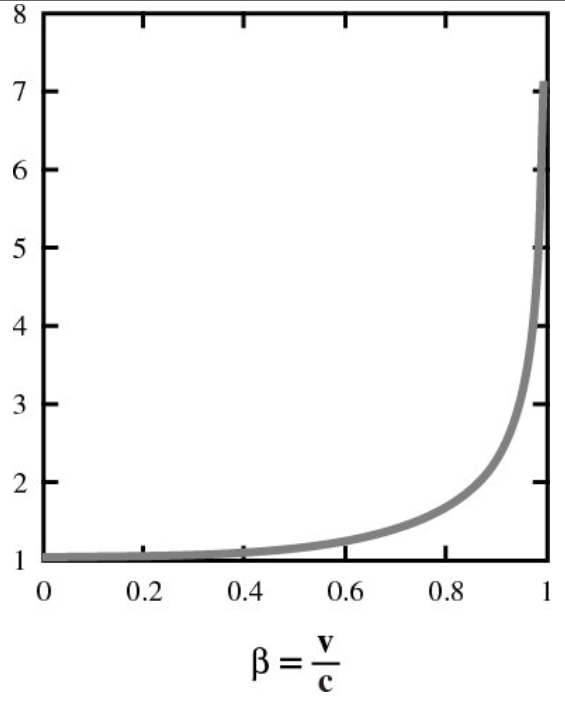
\(\gamma\) is close to unity for small velocities, and only becomes large when v is very close to c. This confirms the intuition that the results of special relativity should reduce to familiar everyday results when speeds are much less than c.
These transformations are necessary to reconcile the observations of space and time made by observers in different inertial frames and are foundational in understanding the effects of special relativity, such as time dilation and length contraction.
If v/c approaches unity, γ approaches infinity. This means that it takes an infinite amount of energy to accelerate an object with non-zero rest mass to the speed of light. This means that the speed of light is a limiting speed.
Some physicists have speculated on particles that can travel faster than light. These particles have been given the name tachyons. The trick is that these particles, if they exist, can never go slower than the speed of light. The speed of light would seem to be a barrier for them as well, only from above. If tachyons do exist they can interact with photons, and make their presence known. All experiments to look for tachyons have indicated that they do not exist.
Rotating Axes
The Lorentz transformation implies that the rules of geometry differ in space-time compared to ordinary space. Using a space-time diagram, events are represented with time running vertically and (for simplicity) one spatial coordinate (x). The Lorentz transformation introduces a rotation of the axes at an angle whose tangent is v/c. Notably, the x-axis and t-axis rotate in opposite directions, leading to non-perpendicular axes. This behavior becomes particularly interesting when v = c, where the transformation involves an infinite quantity, highlighting the peculiarities at the speed of light.
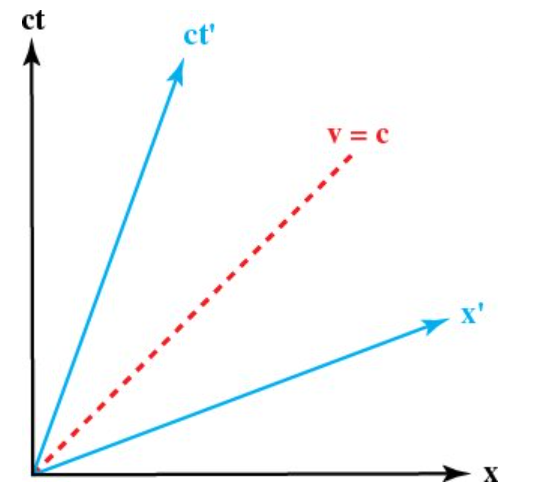
In ordinary three-dimensional space, rotations alter the coordinates of objects, but the lengths of objects remain unchanged. For two objects with separations given in one coordinate system as (Δx, Δy, Δz) and (Δx′, Δy′, Δz′) in another, the distance between them, calculated as the square root of the sum of the squares of the coordinate differences, remains constant during a rotation.
\[(\Delta x)^2+(\Delta y)^2+(\Delta z)^2=(Δx′)^2+(Δy′)^2+(Δz′)^2\]
the length is invariant under rotation.
Space-time Interval
In space-time, there is a corresponding concept to the rotation properties found in the Lorentz transformation. However, the invariant quantity, known as the space-time interval, is slightly different because the time axis rotates in the opposite direction to the space axes. The space-time interval is defined by:
\[(\Delta s)^2=(c\Delta t)^2-(\Delta x)^2-(Δy)^2-(Δz)^2\]
This is the quantity that is invariant under a Lorentz transformation.
In the context of space-time intervals, the choice of sign convention for the equation \((\Delta s)^2 = (c\Delta t)^2 - (\Delta x)^2 - (\Delta y)^2 - (\Delta z)^2\) is arbitrary and does not affect the underlying interpretation. The convention whether to use the positive or negative form of the equation is a matter of choice among authors, and as long as consistency is maintained within a particular discussion or framework, either convention is acceptable. Additionally, the designation of time as the 'zeroth coordinate' (when using the positive form) or the 'fourth coordinate' (when using the negative form) is a matter of preference and does not alter the physical interpretation of events in spacetime. Different authors may adopt different conventions, but the essential principles and relationships remain consistent.
The Lorentz transformation can be derived by assuming the invariance of the space-time interval and requiring linear transformations in the coordinates. This approach emphasizes that time dilation and length contraction are inherent aspects of the nature of space-time, not mere artifacts of specific measurements.
Physical meaning of Δs
consider an observer moving from one place to another in time Δt, as measured in the observer’s rest frame. This means that Δt is the proper time interval. In the observer’s rest frame, there is no change in position, so:
\[Δx = Δy = Δz = 0\]
This means that:
\[Δs = cΔt\]
Therefore, Δs is just the proper time interval (in units of length). Moreover, since it is an invariant, for any two events and any inertial reference frames Δs will always equal the proper time interval between the two events.
We can define three types of space-time intervals, depending on\((Δs)^2\) :
Spacelike\((Δs)^2<0\)
A photon cannot traverse the distance in the time given. Unless a signal can be sent faster than the speed of light, there is no way the one event could have caused the other.
Lightlike\((Δs)^2=0\)
Suppose the two events are the emission and absorption of a photon. A photon will move on the sphere whose surface is given by:
\[(Δx)^2 + (Δy)^2 + (Δz)^2 = (c Δt)^2\]
This means that \((Δs)^2=0\) for a photon traveling any distance in any direction. Such intervals are called lightlike.
Timelike\((Δs)^2>0\)
The positions are close enough in space that a photon would have had more than enough time to travel from the first event to the second. This means that the first event could have caused the second.
| Property | Lightlike Interval | Timelike Interval | Spacelike Interval |
|---|---|---|---|
| Invariant Quantity (Δs²) | Δs² = 0 | Δs² > 0 | Δs² < 0 |
| Observer Motion | Photon's trajectory | Observer's proper time | No physical observer motion |
| Causation | Events connected by light | Events could be causally connected | No causation (limited by speed of light) |
| Spatial Separation | No spatial separation | Limited spatial separation | Significant spatial separation |
| Examples | Light travel between emission and absorption | Events connected in time for a moving observer | Spatially distant events without causal connection |
the light cone
the surface of the extended space-time diagram to more dimensions, which is defined by:
\[(Δs)^2 = 0\]