Time Dilation
PHYSICS
In the context of relativity, time is relative, and the way a clock appears to two different observers depends on their relative motion.
The observer at rest with respect to the clock measures what is termed the "proper time," representing the time interval between two events at the same location.
Consider a simple clock where a light beam bounces between two mirrors separated by a distance ( L ). The time for the light pulse to complete a round trip:
1) In the rest frame of the clock
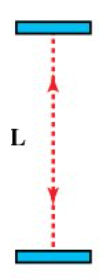 (the light bounces back and forth.)
the proper time is:
\[t_0 = \frac{2L}{c}\]
2) In the frame in which the clock is moving:
the light beam takes a longer path due to the motion.
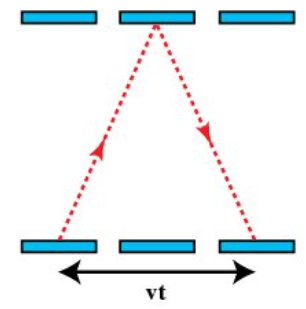
(In the laboratory frame, with the clock moving, the light beam travels a longer path.)
Since the speed of light is the same in both frames, the beam must take longer to make the round trip.
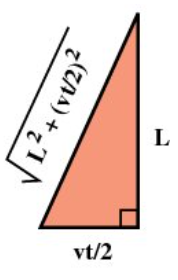 (Calculating the extra distance traveled.)
\[L’=2\sqrt {L^2+(vt/2)^2}\]
but:
\[t=L’/c\]
so:
\[t=(2/c)\sqrt {L^2+(vt/2)^2}\]
\[t^2=(2/c)^2 [L^2+(vt/2)^2]\]
\[t^2=(2L/c)^2 [1+(vt/2L)^2]\]
but \(t_0 = \frac{2L}{c}\) and \(2L=c\ t_0\):
\[t^2=t_0^2 [1+(vt/c\ t_0)^2]\]
\[t^2=t_0^2 [1+(vt/c\ t_0)^2]\]
\[t^2=t_0^2 +(v/c)^2t^2\]
\[t_0^2=t^2 -(v/c)^2t^2\]
\[t_0^2=t^2[1 -(v/c)^2]\]
Taking the square root of both sides and solving for t:
\[t=t_0 \frac 1\sqrt{1-(v/c)^2}\]
or:
\(t = \gamma\ t_0\) (Lorentz transformation)
This equation demonstrates that:
- the time interval measured in the moving frame is greater than that measured in the frame where the clock is at rest.
- Implying that a moving clock appears to run slower when observed from a stationary frame.
- The situation is symmetric, and observers in each frame perceive the other's clock as running slow.
Time dilation is not an artifact of the light clock. It applies to all clocks.
Implications:
Unstable elementary particles that move close to the speed of light should appear to live longer than the same particles at rest.
This is tested almost daily in particle accelerators around the world.
cosmic rays contain unstable particles which can decay as they pass through the Earth’s atmosphere. If we measure the flux of cosmic rays at high altitude and near the ground, we find that many more survive this trip than we would expect, unless we account for the effect of time dilation.
the twin Paradox, biological clocks:
Time dilation applies to biological clocks. A person traveling at a high speed will not age as fast as a person at rest. Of course, the situation must be symmetric. Each person sees the other age slower. This leads to the known puzzle, the twin paradox.
Two twins are on Earth. One is an astronaut who goes on a trip at a speed close to c. The other stays on the Earth. From the point of view of the one that stayed on Earth, the astronaut is moving and will not age as fast as the one on Earth. The astronaut will appear younger upon returning.
However, the astronaut sees the one on Earth moving away at high speed. Therefore the one on Earth should appear younger.
It is alright for two moving observers to see each other age slower. However, the problem is when bringing the twins together – both at rest. To see which one is really younger and decide which was really moving. This would seem to violate Einstein’s postulate.
However, if the twins start and end together at rest, then one twin must accelerate to get to very high speeds. That acceleration produces pseudoforces which can be felt by only one twin. This breaks the symmetry of the problem without any logical contradiction. (A pseudoforce is really an inertial response to an acceleration of the reference frame.)