A Pulsar
(astronomy) A rotating neutron star that emits radio pulses periodically
While in search of radio sources exhibiting scintillation, a phenomenon similar to the twinkling of stars but distinct from atmospheric effects, an unexpected and unique discovery was made. Instead of being influenced by the Earth's atmosphere, the scintillation observed was attributed to charged particles in interplanetary space. This accidental finding revealed a rapidly varying source characterized by a sequence of regular pulses. Subsequently, hundreds of similar pulsars have been identified, with the majority located near the plane of our galaxy. The concentration of pulsars near the galactic plane strongly suggests their location within our own galaxy, rather than being extragalactic.
properties of pulsar signals
include variability in each pulse and slight variations in the period from one pulse to the next. Despite these individual differences, comparing the averages of a sample of pulses with another samples reveals a notable consistency. Pulsars spend the majority of the time in an "off" state, with the pulse active for only a small fraction of the period. The duty cycle, representing the fraction of the pulse period when the pulse is active, is typically around 5% for most pulsars. Consequently, the peak brightness is approximately 20 times higher than the average brightness. Additionally, a less common feature observed in fewer than 1% of pulsars is the presence of an interpulse, a small pulse occurring in the middle of the cycle.
What are pulsars?
As additional pulsars were identified across various regions of the galaxy, the necessity for an explanation became apparent. The focus shifted towards determining the underlying clock mechanism, leading to concentrated efforts. Three fundamental mechanisms were explored, to determine if they apply with three catagories of objects. Three different types of objects were considered: (1) normal stars, (2) white dwarfs, (3) neutron stars.
fundamental mechanisms
(I) pulsation
The pulsation of stars, particularly radial oscillations, is well-understood, with the period roughly proportional to \((G\rho)^{-1/2}\), where \(\rho\) is the average density of the star.
However, the periods of pulsations in normal stars are relatively far bigger.
To achieve a relatively small period, a high density is required, significantly higher than that of a white dwarf but much lower than that of a neutron star. No known stellar object exhibits a density within the required range, thereby eliminating radial pulsations in stars as an explanation for pulsars.
(II) orbital motion
The period and radius of an orbit are related by
\[G\frac {m_1+m_2}{R^3}= \frac {4\pi^2 }{P^2}\]
\[\frac {R^3}{G(m_1+m_2)}= \frac { P^2}{4\pi^2}\]
\[R^3=\frac {G}{4\pi^2} { (m_1+m_2)P^2}\]
\[R=[\frac {G}{4\pi^2} { (m_1+m_2)P^2}]^{1/3}\]
To account for these relatively small pulsar periods, the presence of two neutron stars in orbit would be necessary. This approach has two problems:
(1) Increasing Periods
There is a problem with orbiting systems. The energy of the orbit is:
\[E=-\frac 12G\frac{m_1m_2}{R}\]
As the pulsar gives off radiation, to conserve energy, the orbital energy must decrease. This means that E becomes more negative, or the absolute value of E becomes larger. For this to happen, R must become smaller. As R becomes smaller the period must decrease, since \(P ∼ R^{3/2}\).
However, Observed pulsar periods tend to increase, rather than decrease.
(2) Orbital Periods
According to the general theory of relativity, a system like this is expected to rapidly lose energy through the emission of gravitational radiation. This loss of energy would manifest as a noticeable reduction in the orbital period, which could be detected.
(II) rotation
This leaves rotation as the mechanism for producing the regularity in the pulses. However, the rotation speed must be within a certain limit to prevent objects on the surface from losing contact. This constraint is determined by the balance between gravitational force and the force necessary to keep an object in a circular path. This restriction rules out rotating normal stars and rotating white dwarfs, leaving rotating neutron stars as the most plausible candidates for pulsars.
An analogy to a lighthouse is employed to describe pulsar emissions. Similar to a lighthouse beam, the radiation from a neutron star is continuously emitted, but it is visible to observers only when the beam points in their direction. This model suggests the presence of an emission point or "hot spot" on the star's surface, generating a focused beam of radiation. The emission mechanism might be influenced by the strong magnetic field associated with many neutron stars, with the magnetic axis likely misaligned with the rotation axis. This misalignment, if the radiation beam is collimated along the magnetic axis, would result in observable pulses when the beam is directed towards Earth. Two pulses may even be observed as opposite magnetic poles pass by.
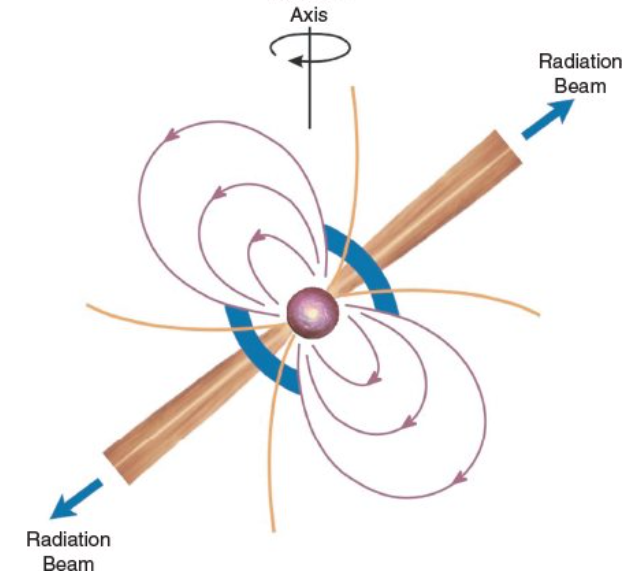
Role of a magnetic field in a pulsar emission mechanism. If the magnetic axis is not aligned with the rotation axis, then the magnetic axis can act like a searchlight beam.
The specific details of the mechanism behind pulsars remain unclear, but one hypothesis suggests that the combination of rotation and a strong magnetic field results in an observer near the surface perceiving a rapidly changing magnetic field. According to Faraday's law, this rapidly changing magnetic field can accelerate charged particles, causing them to emit synchrotron radiation as they spiral along the magnetic field lines.
The lighthouse analogy for pulsars has a consequence—the emitted beam traces out a cone in the sky. If an observer is not within that cone, the pulsar remains invisible to them. This limitation means that only a part of potential observers can see a given pulsar, implying that there are likely many more pulsars in our galaxy than what was observed.
The pulsar's optical pulsations were successfully observed using a technique that involved recording images during specific parts of its pulsing cycle, synchronized with radio signals.
The optical pulsations of the star are evident, with the star appearing brightest when it is "on" and completely invisible when it is "off." Normal photographs of the nebula capture only the average brightness of the star, with the duty cycle influencing the ratio of average brightness to peak brightness.
Period changes
Normal Changes in period
Despite astronomers initially considering pulsars as reliable celestial timekeepers, a significant revelation emerged—every pulsar is gradually slowing down. Furthermore, it was observed that the fastest pulsars exhibited the most rapid rates of period change, indicating that these faster pulsars must be younger. The increase in pulse period signifies a decrease in the star's rotation speed, leading to a reduction in the star's kinetic energy. This decrease in kinetic energy is consistent with the fact that the star emits energy in the form of pulses.
The energy of a rotating sphere is given by:
\[E=\frac 12I\omega^2\]
The rate of change of the energy is found by differentiating both sides with respect to time:
\[\frac{dE}{dt}=I\omega\ \frac {d\omega}{dt}\]
relating the fractional change in energy:
\[(\frac{dE}{dt})/E=(I\omega\ \frac {d\omega}{dt})/(\frac 12I\omega^2)\]
\[(\frac{dE}{dt})/E=2(\frac 1\omega)(\frac {d\omega}{dt})\]
The fractional change in energy is therefore equal to twice the fractional change in the frequency.
We can relate the change in frequency to the change in period:
\[\omega =\frac{2\pi}P\]
Differentiating:
\[\frac{d\omega}{dt} =-\frac{2\pi}{P^2}\ \frac{dP}{dt}\]
\[\frac{d\omega}{dt} =-\omega\frac{1}{P}\ \frac{dP}{dt}\]
\[\frac 1\omega\frac{d\omega}{dt} =-\frac{1}{P}\ \frac{dP}{dt}\]
The fractional rate of energy change then becomes:
\[(\frac{dE}{dt})/E=-2(\frac 1P)(\frac {dP}{dt})\]
Observing the rate at which a pulsar is slowing down provides a direct measure of its energy loss.
Pulsar energy loss
If a rotating neutron star has a rate of change of the period dP/dt.
kinetic energy
The energy for rotating neutron star is given by:
\[E=\frac 12I\omega^2\]
The rotational inertia for a sphere is:
\[I=\frac25MR^2\]
\[\omega =\frac{2\pi}P\]
\[E=\frac 12(\frac25MR^2)(\frac{2\pi}P)^2\]
\[E=\frac{4\pi^2}5MR^2P^{-2}\]
kinetic energy decreasing rate
If the period and the changing rate of the period are known, the rate of decreasing of the kinetic energy can be calculated by:
\[(\frac{dE}{dt})/E=-2(\frac 1P)(\frac {dP}{dt})\]
so:
\[\frac{dE}{dt}=-2(\frac 1P)(\frac {dP}{dt})E\]
or by:
\[\frac{dE}{dt}=-\frac{8\pi^2}5MR^2P^{-3}\ \frac{dP}{dt}\]
pulsar lifetime
the lifetime of the pulsar \(\Delta t\)if it loses energy at a rate \({dE}/{dt}\)is just the energy, divided by the rate at which it is being lost:
\[\Delta t=E/ (\frac{dE}{dt})\]
Pulsars have very short lifetimes by astronomical standards. (Actually, the loss rate is not constant, so such calculation actually gives an upper limit to the lifetime.)
Glitches
Pulsars exhibit a phenomenon known as glitches, involving sudden decreases in their periods, followed by a resumption of the normal slowdown. If angular momentum is conserved, the only way for the star's rotation to accelerate is if the star's size decreases. It is hypothesized that the intense conditions and rapid rotation exert tremendous strain on the solid crust, leading to periodic relief through quakes, after which the crust settles into a more stable configuration. While this explanation may account for small glitches observed in pulsars like the Crab pulsar, larger glitches in some other pulsars are believed to involve a transfer of angular momentum from the superfluid interior to the crust.
Rardius Change rate
The angular momentum is given by:
\[J=I\omega\]
but:
\[\omega =\frac{2\pi}P\]
\[I=\frac25MR^2\]
so:
\[J=\frac{4\pi}5\frac{MR^2}P\]
\[P=\frac{4\pi}5\frac{MR^2}J\]
Differentiating with respect to R gives:
\[\frac {dP}{dR}=\frac{8\pi}5\frac{MR}J\]
\[\frac {dP}{dR}=2\frac {P}{R}\]
This means that a small change in period, dP, will be caused by a small change in radius
\[\frac {dR}{R}=\frac12\frac {dP}{P}\]
The fractional variation in radius corresponds to half of the fractional change in period. Given that glitches result in minimal alterations in period, the associated changes in radius are also expected to be very slight.
Pulsars and Nebula
The rate at which the pulsar in the Crab Nebula is losing energy is equal to the rate at which the nebula itself is losing energy via synchrotron radiation. This solves the long-standing problem of the source of energy for the nebula. As the pulsar loses energy, somehow that energy ends up in the nebula. The connection between the pulsar and the nebula is probably the strong magnetic field. The radiation observed from the Crab Nebula is indirectly powered by the slowing down of the Crab pulsar.
Pulsars as probes of interstellar space
what happens to pulsar signals as they propagate through interstellar space?. The speed of the radiation depends on the index of refraction n, which is a function of wavelength λ. The speed of the radiation is given by:
\[c(n)=\frac cn\]
where c is the speed of light in a vacuum (where n = 1).
the speed as a function of wavelength:
\[c(\lambda)=\frac c{n(\lambda)}\]
two signals at wavelengths λ1 and λ2. Their speeds will be different. Their times t1 and t2 to travel a distance d are:
\[t_1=d\frac {n(\lambda_1)}c\]
\[t_2=d\frac {n(\lambda_2)}c\]
The difference between the two times is:
\[\Delta t=\frac {d}c[n(\lambda_1)-n(\lambda_2)]\]
The delay in signals at various wavelengths, known as dispersion, results in a time delay Δt. By knowing the wavelength-dependent index of refraction, denoted as n(λ), measuring Δt allows for the determination of the distance traveled by the signals (d). Once the distance (d) is known, measuring the time (t) provides information about the index of refraction.
The index of refraction for radio waves traversing interstellar space is determined by the interaction of the radio waves with electrons, and it is directly proportional to the density of interstellar electrons denoted as \(n_e\).
\[n(\lambda)-1\propto n_e\]
Then the time delay must be given by:
\[\Delta t\propto d\ n_e\]
Observing a pulsar at two different wavelengths reveals a time difference in signals due to interstellar dispersion. Measuring this time delay (Δt) allows the determination of the product of distance (d) and the average interstellar electron density \(n_e\). With known distances to certain objects, the average interstellar electron density is established as 0.03 cm⁻³. This information facilitates the measurement of Δt for other pulsars, providing a method to estimate distances d to pulsars that are otherwise difficult to measure.