Neutron Star
What happens to the core that is left behind in the supernova explosion. The core is compressed so that normal gas pressure cannot support it. If the mass is more than 1.44 \(M_{\odot}\) electron degeneracy pressure cannot support it. The collapse of the core continues beyond even the high densities associated with a white dwarf. As the density increases, electrons and protons are forced together to make neutrons. The resulting object is called a neutron star.
Neutron degeneracy pressure
Properties of neutron stars
Radius
Can be estimated from a mass–radius relationship, like that for white dwarfs. Neutron stars will be smaller than white dwarfs by a factor of about \(m_e/m_n\).
the mass–radius relation for a white dwarf is given by:
\[GRM^{1/3}= 2\frac { h^2}{4\pi ^2 m_e} {{[\frac Z{4Am_p}\ ]}^{5/3}} \]
In the case of a neutron star, there is no protons nor electrons, so;
\[A=Z\]
and for the same reason the mass of the electron has to be replaced with tha mass of the neutron which approximately equals the mass of the proton.
\(GRM^{1/3}= 2\frac { h^2}{4\pi ^2 m_p} {{[\frac 1{4m_p}\ ]}^{5/3}} \)\(RM^{1/3}= 2\frac { h^2}{4\pi ^2 G} {{[\frac 1{4m_p}\ ]}^{5/3}} \)
Density of a neutron star
the density of a neutron star is very close to that of a neutron. This means that the neutrons in a neutron star must be packed very close together, with very little empty space.
Pressure in a neutron star
Neutron degeneracy pressure in a neutron star compared with the electron degeneracy pressure in a white dwarf.
\[P_{ns}= 2(\frac { h}{2\pi})^2 \ \frac {n_n^{5/3}}{m_n\ }\]
\[P_{wd}= 2(\frac { h}{2\pi})^2 \ \frac {n_e^{5/3}}{m_e\ }\]
\rho=
\[\frac {P_{ns}}{P_{wd}}= (\frac { n_n}{n_e})^{5/3} \ \frac { m_e}{m_n}\]
but\(\frac { n_n}{n_e}=\frac { ρ_{ns}}{ρ_{wd}}\) so:
\[\frac {P_{ns}}{P_{wd}}= (\frac { ρ_{ns}}{ρ_{wd}})^{5/3} \ \frac { m_e}{m_n}\]
In a neutron star there are no free electrons, so neutron degeneracy pressure is the only prussure to support the star. Because the density of a neutron star is so much higher than that of a white dwarf, the neutron degeneracy pressure in a neutron star is greater than the electron degeneracy pressure in a white dwarf.
Acceleration of gravity on a neutron star
\[g=\frac {GM}{R^2}\]
\[M=\rho V=\frac 43\pi R^3\rho\]
so:
\[g=\frac 43\pi GR\rho\]
The acceleration is proportional with both the radius and the density, theis means that the the small radius would make the acceleration also small, but the high density would make it very big. The acceleration of gravity is so big on a neutron star.
tidal forces
Tidal forces arise due to variations in gravitational forces on opposite sides of an object. In the context of a neutron star, these forces become particularly pronounced owing to the extremely high acceleration due to gravity. Another intriguing aspect emerges from the rapid change in gravitational acceleration g concerning the star's radius R, given by the equation:
\[g = \frac{GM}{R^2}\]
When differentiating this expression, the resulting formula becomes:
\[\frac{dg}{dr} = -2\frac{GM}{R^3}\]
This means that if one were situated near the neutron star's surface, there would be a significant disparity in gravitational acceleration between the feet and the head. Consequently, the tidal forces would exert a much stronger pull on the feet, leading to a stretching effect on the body.
Thin Atmosphere
The substantial acceleration due to gravity results in another intriguing phenomenon. According to the equation of hydrostatic equilibrium, expressed as:
\[\frac{dP}{dr} = -\rho(r)g(r)\]
the rate at which atmospheric pressure decreases, denoted as (\(\frac{dP}{dR}\)), is directly proportional to (g). Consequently, the atmospheric pressure on a neutron star decreases rapidly, leading to an extremely thin atmosphere.
Rotation of neutron stars
In the process of the collapse of a core to become a neutron star, any original rotation of the core will be amplified. If the angular momentum of the core is conserved, the core must rotate faster as it becomes smaller. Since the core shrinks by a large amount, the rotation speed is increased by a large amount.
The angular momentum is given by:
\[J=I\omega\]
where I is the rotational inertia and ω is the angular speed. The rotational inertia for a uniform sphere is given by:
\[I=\frac 25 MR^2\]
so:
\[J=\frac 25 MR^2\omega\]
If the angular momentum of a neutron star is equal to that of the Sun. If the neutron star has a mass equal to one solar mass:
\[R_{\odot}^2\omega_\odot =R^2\omega\]
\[\frac {\omega}{\omega_\odot} =\frac {R_{\odot}^2}{R^2}\]
\[\frac {\omega}{\omega_\odot} =(\frac {R_{\odot}}{R})^2\]
so the rotation period of a neutron star:
\[P_{ns}=P_\odot(\frac {R_{\odot}}{R})^2\]
a neutron star might be rotating 1000 times per second
Magnetic fields of neutron stars
Faraday's law of electromagnetic induction:
\[\oint \vec{E} \cdot d\vec{l} = -\frac{d\Phi_B}{dt} \]
When the flux through the surface stays constant, so the flux is frozen into the material.
The flux is proportional to the strength of the magnetic field and the surface area:
\[BR^2=constant\]
The magnetic field should therefore be proportional to \(1/R^2\), just as the rotation rate is. There's uncertainty about the precise mechanism leading to the development of large magnetic fields, despite flux conservation arguments providing an approximate order of magnitude for the magnetic field strength (B). Various theories propose dynamo mechanisms, where rotation plays a crucial role in generating these magnetic fields.
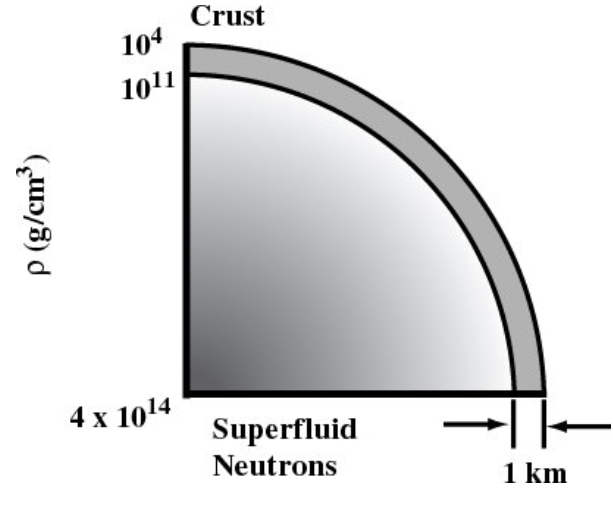
The interior of a neutron star is predominantly considered to be a superfluid, a fluid exhibiting no frictional resistance or viscosity due to certain quantum mechanical properties. However, the presence of vortices, akin to whirlpools, in the rapidly rotating fluid introduces some viscosity, facilitating the coupling of the fluid with the outer layers. Beyond the fluid lies a solid crust composed of heavy elements like iron. This combination of a superfluid interior and a solid crust contributes to the complex and fascinating nature of neutron stars.