A Photosphere
The sun’s Photosphere:
- The photosphere: The layer of the Sun where most of the visible light comes from.
- H− ions: Hydrogen atoms with an extra electron that are responsible for the continuum opacity in the photosphere. They can easily lose the extra electron when they collide with other free electrons.
- Continuum opacity: The ability of a material to block or scatter light of all wavelengths. It affects the spectrum of the Sun and the temperature of the photosphere.
Bound-free Process
The H− ion is a bound system. The final state has an H atom and a free electron.
When a photon \(\gamma\) with enough energy collides with an H− ion, it can remove the extra electron from the hydrogen ion, leaving behind a free electron and a neutral hydrogen atom. :
\[H^-+\gamma \rightarrow H+ e^-\]
The wavelength of the incoming photon is not restricted, so a continuous range of photon energies is possible. This process is responsible for most of the continuum opacity of the photosphere. The inverse process, where a free electron and a neutral hydrogen atom combine to form an H− ion, is responsible for the continuum emission.
Appearance of the photosphere
When observing the Sun, the light-gathering power of the telescope is not usually a problem. By spreading the image out over as large an area as possible, making it easier to see detailed structure. The optimal telescope for that must have a long focal length to give a large image scale.
Five minute Oscillation:
parts of the photosphere are moving up and down. This convection results from sound waves in the upper layers of the convection zone. This area of research is called solar seismology.
Sharpness of the solar limb: The Sun’s density falls off continuously as one moves farther from the center. There is no sharp boundary (like the surface of the Earth), but yet there is a definite edge on the Sun. Some lines of sight through the photosphere. As the line of sight passes farther from the center of the Sun, the opacity decreases because:
(1) the path length through the Sun is less
(2) it passes through less dense regions. Since the amount of light getting through is proportional to \(e^{-τ}\), the effect of τ changing from line of sight to line of sight is enhanced by the exponential behavior. Therefore the transition from the Sun being mostly opaque to being mostly transparent takes place over a region that is small compared with the resolution, and the edge looks sharp.
Temperature distribution
Limb darkening in the Sun is explained by an optical depth effect. Lines of sight toward the center of the Sun (line of sight 1) allow deeper visibility into the photosphere compared to those offset from the center (line of sight 2). This discrepancy in depth causes line of sight 1 to appear brighter, indicating hotter material. The base of the photosphere, where optical depth τ reaches unity along line of sight 1, defines the Sun's temperature. As one moves farther from the Sun's center, the photosphere cools, evidenced by limb darkening.
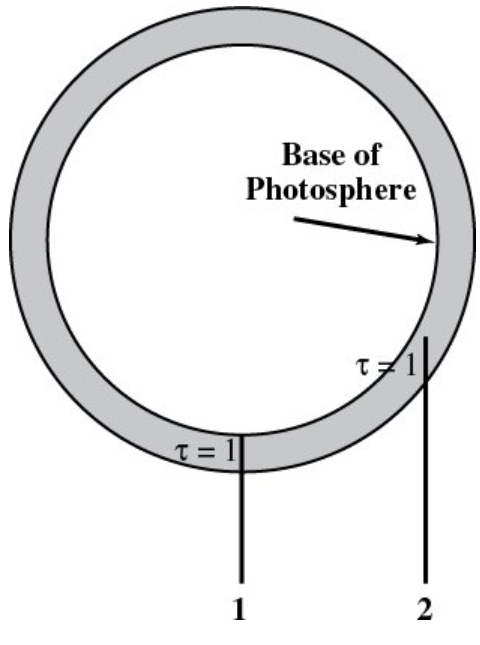
When observing the Sun, line of sight 1 appears brighter than line of sight 2, suggesting a temperature decrease away from the center. Studying the solar spectrum reveals strong absorption lines (labeled A through K by Fraunhofer), such as Hα for the first Balmer line, and lines belonging to sodium (NaI) and calcium (CaII). Despite their lower abundance, sodium and calcium exhibit absorption lines as strong as Hα, attributed to the combined effects of excitation and ionization.
Doppler broadening of spectral lines:
The broadening of spectral lines in a gas is caused by Doppler shifts resulting from the random motions of atoms and ions. If all the particles were stationary, the emitted photons from a specific transition would have a minimal spread in wavelength. However, due to random motions in various directions, there is a range of Doppler shifts, leading to line broadening, known as Doppler broadening. Higher temperatures intensify this effect, increasing the spread in speeds and broadening the spectral lines further. Additionally, if the particles have an overall motion that shifts the center wavelength of the line, the broadening remains unaffected.
the broadening can be estimated as a function of temperature. If \(v^2\) is the average of the square of the random velocities in a gas, and m is the mass per particle, the average kinetic energy per particle is \(\frac 12mv^2\). For an ideal 3/2 monatomic gas, this should equal (3/2)κT, giving:
\[\frac 12mv^2=\frac 32 kT\]
so:
\[v=\sqrt \frac {3kT}m\]
This gives an estimate of the range of the encountered speeds. (The range will be larger, since atoms can come toward or away from observer, and since some atoms will be moving faster than this average, but the radial velocity is reduced since only the component of motion along the line of sight contributes to the Doppler broadening.)
The actual wavelength range over which the line is spread out, can be derived from Doppler Shifts
\[\frac {\Delta \lambda}{\lambda_0}=\frac {v_r}{c} \ \ \ ;v_r <<c\]
\[\Delta \lambda =\frac \lambda c v_{rms}\]
\[\Delta \lambda =\frac {\lambda}{c}\sqrt \frac {3kT}{m}\]
In spectral lines, smaller Doppler shifts near the line center are more common than larger ones, leading to the highest optical depth at the line center and a decrease towards the sides. Variations in Doppler shifts allow observation in different depths into the Sun, with farther distances corresponding to shifts away from the line center. Studying line profiles provides insights into the physical conditions at different depths in the photosphere. Different spectral lines, with varying optical depths at the line center, enable us to probe distinct depths in the photosphere. Model stellar atmosphere calculations aim to predict spectrum features, including line strengths and profiles.