Stellar Structure
The basic philosophy of stellar structure studies, emphasizing the application of physics laws to predict and explain the structure of stars.
Stellar structure calculations, and the predictions of the theories must be comparable with observations.
Model Calculation
If star has s stellar mass equals to \(1M_\odot\), it must when put in model calculations, comes out with a star whose radius, temperature and luminosity match those of the Sun. Putting in different amounts of material in the model calculations should reproduce the main sequence.
Stellar models should help in predicting stellar evolution. They should also be able to tell how changes in composition lead to changes in structure.
By assumption the structure of a star is spherically symmetric, where temperature, density, and composition are solely contingent on the distance from the center and not the direction away from it.
1. Mass continuity
Mass continuity describes the relationship between the rate of change of the mass function M(r), representing the mass interior to a certain radius r, and the density at that radius. In spherical objects, the gravitational force on an object at a distance r from the center is solely determined by the mass function M(r).
\[\frac M{dr}=4\pi r^2 \rho (r)\]
2. Hydrostatic Equilibrium
The material within a shell at radius r experiences gravitational attraction from all mass inside the shell. To prevent collapse, the pressure difference between the bottom and top of the shell supports the matter. This hydrostatic equilibrium, is applicable not only to stars but also to Earth's atmosphere, oceans, and fluids in a glass of water, where the weight of each layer is sustained by pressure differences.
We can see how much of a pressure difference is needed by considering a small cylinder, of height dr and area dA. The mass of the cylindrical element is:
\[dm=\rho (r)dr\ dA\]
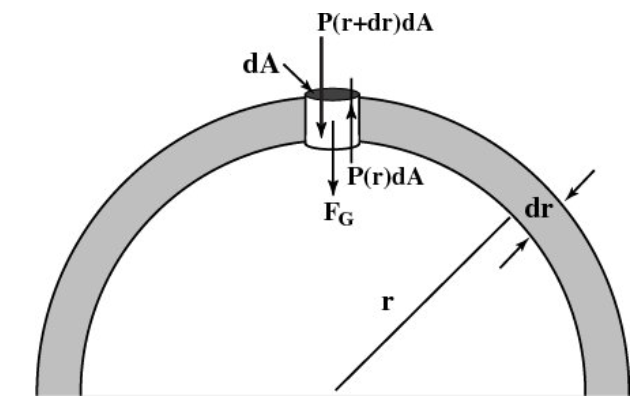
The gravitational force depends on M(r):
\[M(r)=4\pi\int_0^r\rho(r’)r’^2dr’\]
\[F_G = -\frac {GM(r)}{r^2} dm\]
\[F_G = -\frac {GM(r)}{r^2}\rho (r)dr \ dA\]
The minus sign (−) indicates that the force is directed downward.
The force exerted on the top and bottom of the cylinder by the pressure of the fluid. The difference between the upward force on the bottom and the downward force on the top is the buoyant force, \(F_b\). If P(r) is the pressure at the bottom of the cylinder and P(r + dr) is the pressure at the top, then:
\[F_B=P(r)-P(r+dr)dA\]
\[F_B=P(r)dA-P(r+dr)dA\]
\[F_B=[P(r)-P(r+dr)]dA\]
Defining that: \(dP=P(r+dr)-P(r)\)
the pressure will decrease as r increases (since the pressure at the bottom of the shell must be greater than the pressure at the top), so dP is a negative number.
\[F_B=\{P(r)-[P(r)+dP]\}dA\]
\[F_B=-dP\ dA\]
The condition for hydrostatic equilibrium is
\[F_G+F_B=0\]
So:
\[ -\frac {GM(r)}{r^2}\rho (r)dr \ dA-dP\ dA=0\]
\[ dP\ dA=-\frac {GM(r)}{r^2}\rho (r)dr \ dA\]
\[ \frac {dP}{dr}=-\frac {GM(r)}{r^2}\rho (r) \]
This is called the equation of hydrostatic equilibrium. We can rewrite it more simply by noting that the quantity is equal\(GM(r)/r^2\) to the local acceleration of gravity g(r), so:
\[ \frac {dP}{dr}=-\rho (r)\ g(r) \]
The equation of hydrostatic equilibrium indicates that the rate of change of pressure with respect to radius (P changes with r) is influenced by the density of the fluid. Denser fluids lead to a more rapid change in pressure with radius due to a higher mass shell and a stronger gravitational force. Additionally, a higher gravitational acceleration g(r) results in a greater force pulling the shell inward, requiring a faster rate of pressure change to maintain equilibrium.
Central pressure of the Sun
Using the equation of hydrostatic equilibrium to estimate the central pressure of the Sun by considering the whole Sun as one shell:
\[ dP=-\frac {GM(r)}{r^2}\rho (r)dr \]
\[P_C=\int_0^RdP\]
\[ P_C=-\int_0^R\frac {GM(r)}{r^2}\rho (r)\ dr \]
Using the mass M (the whole mass), and the average density \(\rho\); \(\rho\approx \frac M{R^3}\)
\[ P_C\approx-\int_0^R\frac {GM}{r^2}\frac M{R^3}\ dr \]
\[ P_C\approx-\frac {GM^2}{R^3}\int_0^R\frac {dr}{r^2} \]
\[ P_C\approx-\frac {GM^2}{R^3}[-\frac {1}{r}]_0^R \]
\[ P_C\approx\frac {GM^2}{R^4} \]
Using this equation for the sun yields a result that deviates from the actual value derived from stellar models.
3. Equation of State
The state of a gas is described by the pressure, density and temperature.
\[P=f(\rho,T)\]
The actual form of the function depends on the nature of the gas. For an ideal gas, the equation of state has the simple form:
\[P=\frac \rho mkT\]
where m is the mass per particle. For a gas of relativistic particles, the equation of state is different
Central temperature of the Sun
Employing the ideal gas equation of state to calculate the Sun's central temperature involves estimating density using average density, determined by dividing mass by volume. As hydrogen is fully ionized, the average mass per particle is half the proton mass \(\frac 12 m_p\).
\[T=\frac {mP}{\rho k}\]
\[\rho =\frac {M_\odot}{(4\pi/3)R_\odot^3}\]
\[T=\frac{mP\ (4\pi/3)R_\odot^3}{M_0k}\]
Using this equation yields a litle larger temperature than the model result.
4. Energy transport
In constructing a stellar model, the consideration of energy transfer from the star's interior to exterior is crucial. Energy can be transported through conduction, convection, and radiation. Conduction is generally insignificant in stellar interiors. To maintain stability over a star's lifetime, the temperature distribution T(r) must remain constant with time. Achieving this requires the energy entering and leaving each shell per second to be equal. When radiation transport dominates, the required temperature distribution T(r) can be calculated, with the flux of radiation f(r) playing a key role, assuming the surface emits like a blackbody.
\[f(r)=\sigma T_r^4\]
the rate at which f(r) changes with T(r)
\[\frac {f(r)}{dt}=4\sigma T_r^3\]
df as the small change in f due to a small change in T, dT:
\[df=4\sigma T_r^3\ dT\]
The change in flux passing through a given layer of the star must depend on the ability of the layer to absorb radiation. this is given by the absorption coefficient κ. In stellar structure it is more convenient to deal with the absorption coefficient per density of material. If κ′(r) is the opacity per unit mass at r. This means that κ′(r) ρ(r) gives the fraction of radiation absorbed per centimeter:
\[df=-\kappa’(r)\rho (r)f(r)dr\]
The minus sign (−) demonstrates that the flux is decreased by the absorption.
Defining that the luminosity of a given layer is the flux f multiplied by the surface area of the layer:
\[L(r)=4\pi r^2\ f(r)\]
so:
\[df=-\kappa’(r)\rho (r)\frac {L(r)}{4\pi r^2}dr\]
\[4\sigma T_r^3\ dT=-\kappa’(r)\rho (r)\frac {L(r)}{4\pi r^2}dr\]
\[L(r)=-\frac {(4\pi r^2)4\sigma T_r^3}{\kappa’(r)\rho (r)}\ \frac{dT}{dr}\]
\[L(r)=-\frac {(16\pi \sigma r^2 T_r^3}{\kappa’(r)\rho (r)}\ \frac{dT}{dr}\]
This shows how the rate of energy flow depends on the rate at which the temperature changes with r. In general, dT/dr is negative (the temperature drops with distance from the center), so the luminosity is positive. A more exact calculation gives essentially the same result, but with the 16 replaced by 64/3.
This also shows tha the opacity per unit mass κ′(r) is very important in determining the energy transfer, and therefore the structure of the star. The opacity depends on the composition of the star. Accurate stellar structure calculations require good knowledge of the opacity as a function of composition and temperature.
5. Energy Generation
If energy is generated in a particular shell, then the energy leaving that shell will exceed the energy entering the shell by the amount of energy generated. If ε(r) is the energy generated per unit mass within the shell at radius r. The increase in luminosity in that layer, due to energy generation, is then:
\[dL=4\pi r^2\ \rho (r)\epsilon (r)\ dr\]
The rate at which the luminosity changes with radius is then:
\[\frac {dL}{dr}=4\pi r^2\ \rho (r)\epsilon (r) \]
To conduct model calculations for stars, it is crucial to specify the energy generation rate \(\epsilon(r)\) as a function of composition and temperature, which requires input from nuclear physics. If the radiative temperature gradient at any radius becomes too large, convection sets in, with its quantitative effects.
Adiabatic lapse rate
Convection is an adiabatic process, where no energy is lost as material moves outward, and the temperature gradient becomes adiabatic, known as the adiabatic lapse rate.
The stability of stars, preventing them from exploding despite the energy they produce, stems from their negative heat capacity. The total energy E of a star is a combination of potential and kinetic energies. The virial theorem reveals that (E = -K). If a star generates excess energy, it can expand and cool to restore equilibrium, as the added energy makes the total thermal kinetic energy decrease. However, this argument does not apply to degenerate gases, where explosions are possible, as their thermal energy is independent of temperature.
Stellar Models
Stellar models require inputs such as the star's mass, composition, opacity. The star is divided into spherical shells for calculation purposes. The task involves solving for the density \(\rho(r)\) and temperature T(r) distributions that satisfy stellar structure equations. Due to complexity, realistic stellar models are computed using computers. These calculations not only describe the current state of a star but also predict its evolution.
Nuclear reactions in the core alter the composition, affecting energy generation and opacity, leading to structural changes. The modeling process involves an initial composition calculation, followed by determining the rate of nuclear changes over time. Subsequent models are then calculated with the adjusted composition, and the evolution is tracked through sequential time steps, chosen to allow gradual composition changes.