An Ionization
If the temperature is very high, some of the colliding particles will have kinetic energies greater than the ionization energy of the atom, so the electron will be torn away in the collision. Once a hydrogen atom is ionized, it can no longer participate in line emission or absorption.
When the gas is ionized, electrons and positive ions will sometimes collide and recombine. When the total rate of ionizations is equal to the total rate of recombinations, so the gas is in ionization equilibrium.
If the gas is in thermal equilibrium and ionization equilibrium, then the Saha equation tells about the relative abundances of various ions.
If \(n(X_r)\) and \(n(X_{r+1})\) are the densities of the r and r + 1 ionization states, respectively, of element X. (For example, if r = 0, then we are comparing the neutral species and the first ionized state.)
The ionization energy to go from r to r + 1 is \(E_{ion}\) . The electron density is \(n_e\), and the kinetic temperature is T. Finally, \(g_r\) and \(g_{r+1}\) are the statistical weights of the ground electronic states of \(X_r\) and \(X_{r+1}\) (assuming that most of each species is in the ground electronic state). The Saha equation gives:
\[\frac {n_e n(X_{r+1})}{n(X_r)}= \frac{2g_{r+1}}{g_r} (\frac {2\pi m_rkT}{h^2})^{3/2}\ e^{-[E_k/kT]}\]
The Saha equation has the same exponential energy dependence as the Boltzmann distribution. However, there is an additional factor of . This comes from the fact that a free electron has more states available to it at higher T than at lower T. In addition there is a factor of n_e on the left. This is because a higher abundance of electrons leads to a higher rate of recombinations, driving down the fraction of atoms that are ionized.
Ionization Temperature:
Just as it with the excitation temperature in the Boltzmann equation, an ionization temperature Ti can be defined, which makes the Saha equation correct, even if the gas is not in thermodynamic equilibrium.
In this equation n_e is the number of electrons from all sources, since any electron can combine with a hydrogen ion (for example) no matter where that electron came from (hydrogen, helium, etc.) In many situations, virtually all of the ions are hydrogen. That is because hydrogen is by far the most abundant element, and because the next most abundant element, helium, is very hard to ionize. In that case, the number of electrons is equal to the number of positive ions, n+, so the left side of equation simplifies to \(n_e^2/n_0\), where n_0 is the number of neutrals. This extra factor of n_e makes even this simpler form of the Saha equation harder to solve for (\(n_e/n_0\) ) than the Boltzmann equation is to solve for the ratio of level populations.
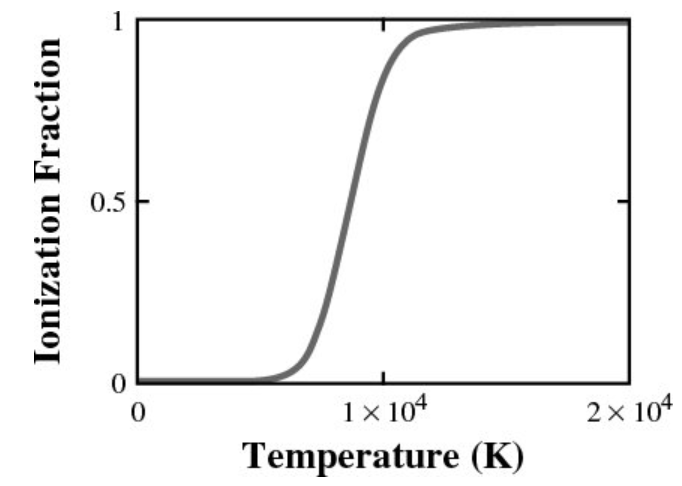
In this figure, the ratio ne/n0 as a function of temperature, for a value of n_e reasonable for stars like the Sun.