Tight Junctions
See also: Leaky Gut ; Zonulin
Videos


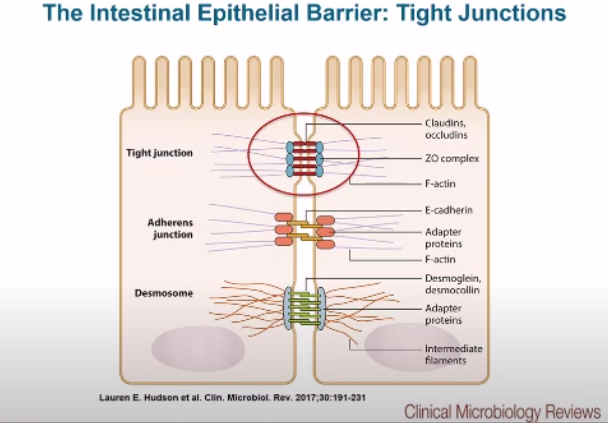
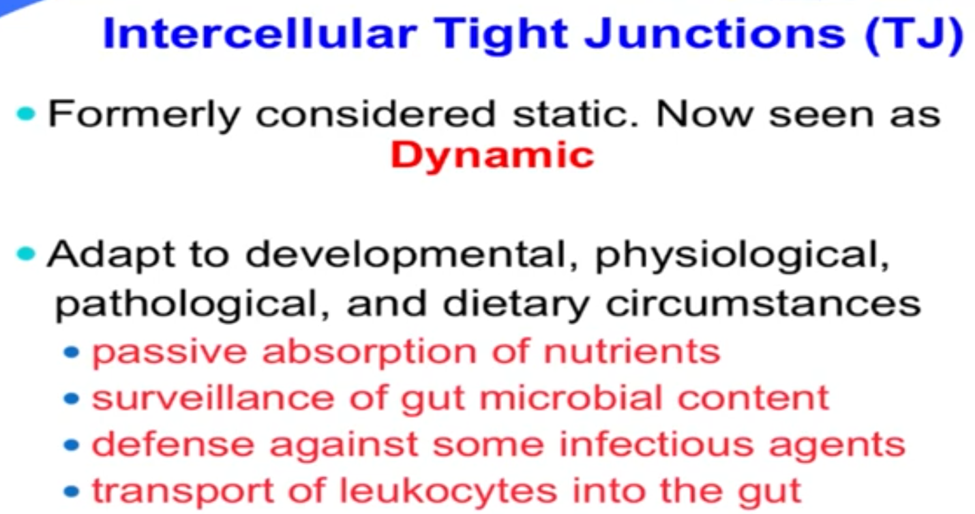
Paracellular pathway (in gut) – Until the 1980s the concept that intestinal epithelial cells were cemented together with a kind of “grout” was dogma. Then a Japanese group in the late 1980s found that the space between cells is not sealed, there is no cement, there is no wall. Instead, there are doors which, most of the time, are closed. Technically called “tight junctions”. Sometimes the doors can be opened to create a short cut for stuff to enter from the lumen and come into our body.
Until this Japanese research, the big question was how do proteins get into the blood. Proteins don't go through cells. Proteins love water, they're hydrophilic but the cell wall is very hydrophobic. Plus, proteins are huge. The discovery of "doors", tight junctions, was a paradigm shift, they may open to let the "enemies" in.
The question was, if those are doors, what is the key? Who decides if and when they are open? For two decades that remained unanswered, until the discovery of zonulin.
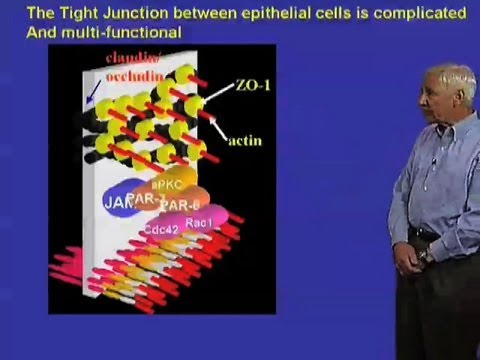
The tight junction is complicated and is involved in a number of cell functions including:
- Barrier
- Polarity
- Cell morphology
- Cell movement
- Cell division
- Cell differentiation
Some junctions bar materials from movement from the lumen into the cell. Others are involved in gluing things together with adhesion structures to prevent anything from passing from one cell to another. Some are involved in talking, from one cell to another.
Cells in the epithelium of the stomach are bound by tight junctions that repel harsh fluids that may injure the stomach lining. Recent exploration of TJ proteins has also revealed the expression of TJ proteins in esophageal mucosal layers.
Altered tight junction (TJ) proteins are correlated with carcinogenesis and tumor development.
While zonulin plays a significant role in regulating tight junction permeability, it's not the only player on the field. There are other agents and mechanisms that can influence the opening and closing of these crucial barriers in the gut lining.
Zonulin and its function:
- Zonulin is a protein that specifically targets and disrupts the intercellular adhesion molecules (JAMs) responsible for holding tight junctions together. This increases paracellular permeability, allowing the passage of larger molecules.
- While research suggests its involvement in various physiological processes, its exact role in healthy individuals still requires further exploration.
Other agents influencing tight junctions:
- Cytokines and inflammatory mediators: Pro-inflammatory cytokines, like TNF-α and IL-1β, can increase tight junction permeability, while others, like IL-10, have tightening effects.
- Bacterial toxins and metabolites: Certain bacterial toxins, like cholera toxin, directly target and disrupt tight junctions, while various bacterial metabolites can modulate their function.
- Short-chain fatty acids (SCFAs): These gut-derived metabolites produced by beneficial bacteria generally promote tighter junctions, contributing to a healthy gut barrier.
- Dietary components: Specific dietary components, like prebiotics and certain omega-3 fatty acids, may influence tight junction function, but more research is needed.
- Physical and psychological stress: Chronic stress can contribute to increased gut permeability, potentially mediated by various pathways impacting tight junctions.
- Medications and drugs: Certain medications, like laxatives and some antibiotics, can have temporary effects on tight junction permeability.
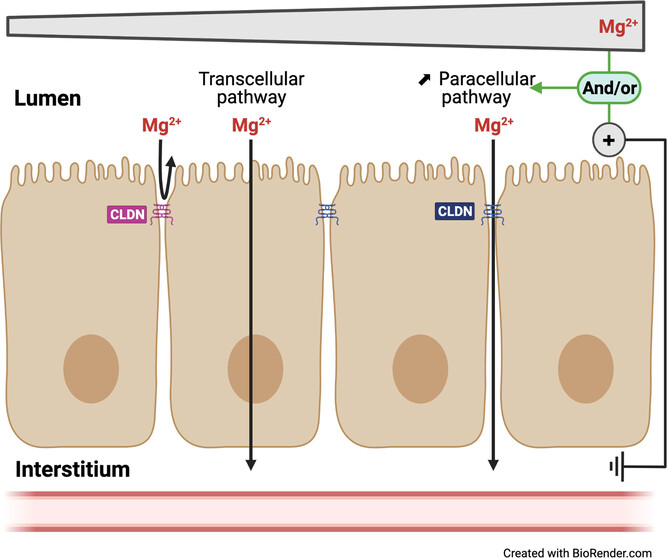
The tight junction limits solute flux along the paracellular pathway, which is typically more permeable than the transcellular pathway. The tight junction is, therefore, the rate-limiting step in transepithelial transport and the principal determinant of mucosal permeability. Thus, it is important to understand the specific barrier properties of the tight junction, which can be defined in terms of size selectivity and charge selectivity.
At least two routes allow transport across the tight junction, and emerging data suggest that the relative contributions of these types of paracellular transport may be regulated independently . one route, the leak pathway, allows paracellular transport of large solutes, including limited flux of proteins and bacterial lipopolysaccharides . Although the size at which particles are excluded from the leak pathway has not been precisely defined, it is clear that materials as large as whole bacteria cannot pass. As might be expected for a route that allows large solutes to cross, the leak pathway does not show charge selectivity. Flux across the leak pathway may be increased by cytokines, including interferon-γ (IFnγ) in vitro and tumor necrosis factor (TnF) in vitro and in vivo.
A second pathway is characterized by small pores that are thought to be defined by tight junction-associated claudin proteins, which are also primary determinants of charge selectivity. These pores have a radius that
excludes molecules larger than 4 Å. Expression of specific claudins varies between organs and even within different regions of a single organ and can be modified by external stimuli, such as cytokines. Thus, tight junctions show both size selectivity and charge selectivity, and these properties may be regulated individually or jointly by physiological or pathophysiological stimuli.
HLA Alleles & Biotoxins
- Here is the process by which the body begins to unravel in the presence of a biotoxin. A biotoxin enters, in the 20% of the population with HLA alleles, we begin to see expression of cytokines in the central nervous system and this establishes the secondary and tertiary consequences. We begin to see alterations in the hypothalamus, in the posterior hypothalamus, destruction of leptin receptors (this why appetite becomes dysregulated and patients start gaining lots of weight. There's a central leptin resistance. There are abnormalities in production of neuropeptides including VIP, MSH - melanocyte stimulating hormone and vasopressin. MSH is a master control hormone that regulates sleep and melatonin, supports endorphin production which is why these patients have chronic pain, it also controls tight junctions in the digestive tract so that's why these patients often have leaky gut that doesn't resolve when you try to seal up the gut lining. If you don't fix the brain, you can't fix the gut.
Lead’s effect on tight junctions
Lead can affect the tight junctions in various ways, potentially leading to increased gut permeability and contributing to negative health consequences.
Mechanisms of lead's impact on tight junctions:
- Direct disruption: Lead can directly interact with and disrupt the proteins that make up tight junctions, weakening their structure and increasing permeability.
- Oxidative stress: Lead exposure can induce oxidative stress, leading to the production of free radicals that damage cell membranes and tight junctions.
- Inflammation: Lead can trigger inflammatory responses in the body, promoting the release of inflammatory mediators that contribute to tight junction breakdown.
- Microbiota changes: Lead exposure can alter the composition and function of gut microbiota, potentially leading to an overgrowth of harmful bacteria that further damage tight junctions.
Evidence supporting the effects of lead on tight junctions:
- In vitro studies: Research on isolated cells and intestinal tissues shows that lead exposure can increase intestinal permeability and disrupt tight junction integrity.
- Animal studies: Studies in rodents exposed to lead demonstrate increased gut permeability and changes in tight junction proteins.
- Human studies: Some epidemiological studies have shown associations between lead exposure and increased intestinal permeability in humans.
Potential health consequences of lead-induced tight junction disruption:
- Increased absorption of toxins and allergens: Impaired tight junctions can allow the passage of harmful substances into the bloodstream, potentially contributing to various health problems.
- Chronic inflammation: Increased gut permeability can trigger chronic low-grade inflammation, potentially linked to various chronic diseases.
- Nutrient malabsorption: Disrupted tight junctions might hinder the proper absorption of nutrients, impacting overall health.
Important considerations:
- The exact mechanisms and long-term consequences of lead's impact on tight junctions are still under investigation.
- Individual susceptibility and the extent of exposure play a role in the severity of effects.
Foods & Herbs
Apigenin has been reported to protect intestinal barrier integrity by reducing inflammation and enhancing tight junction proteins like ZO-1 and occludin _5 _7.
How do signaling molecules modulate tight junction permeability?
Signaling molecules modulate tight junction permeability through several mechanisms:
- Cytokine signaling:
- TNF-α increases gut permeability by promoting caveolin-1-mediated internalization of occludin.
- TNF-α activates the NFκB pathway, which regulates tight junction proteins.
- IFN-γ alters acto-myosin cytoskeletal interactions with tight junction proteins.
- IFN-γ reduces ZO-1 and occludin expression through an AMPK-dependent pathway.
- Kinase signaling:
- Protein kinase C (PKC) localizes at tight junctions and regulates their integrity.
- Casein kinase 2 (CK2) phosphorylation of occludin promotes formation of stable claudin-1/claudin-2/ZO-1 complexes, preventing claudin-2 pore formation.
- Small GTPase signaling:
- Small GTP-binding proteins localized at tight junctions regulate their function.
- Growth factor and hormone signaling:
- Various growth factors and hormones modulate tight junction permeability via intracellular signaling pathways.
- Ion channel and transporter cross-talk:
- Activation of SGLT1 leads to MLCK activation and contraction of the apical actin cytoskeleton, increasing paracellular flux.
- The Na+/K+ ATPase regulates tight junction permeability by inhibiting protein phosphatase 2A activity to induce occludin phosphorylation.
- Cytoskeletal regulation:
- Myosin light chain kinase (MLCK) activation promotes occludin endocytosis and increases tight junction permeability.
These signaling pathways allow for dynamic regulation of tight junction permeability in response to various physiological and pathological stimuli, modulating both the pore pathway for small ions and the leak pathway for larger molecules.