Effects on Immunity
See also: Activate Immunity, Restrain Infection ; Immune Response
Gideon Mailer - Nutrition, Immunity, and the Warning from Early America

Dr. Thomas Cowan, MD at Healthy Immunity

Lifestyle and our mental and emotional states have a profound effect on the immune system. Stress hormones weaken the immune system. When we feel relaxed and happy our bodies produce hormones with a strengthening effect on the immune system. If we consistently ignore good nutrition, sleep, healthy lifestyle...the result is feeling sick and tired.
Physical exercise is necessary for a healthy immune system.
Deep Breathing supports the immune system
Agents used to modify the immune system are also called Immunopharmaceuticals
The effects on the mechanisms of immunopharmaceuticals interact with each other, directly or/and indirectly. The seven principal effects shown below in different colors. (1) Effects on T cells; (2) Effects on cytokine production and other immune effector cells; (3) Effects on antibody production; (4) Herbs used in autoimmune disease; (5) Effects on programmed cell death (apoptosis); (6) Anti-microbe and anti-cancer effects; (7) Anti-oxidative effects. The arrow head symbol means the way of effects, either positive or negative.
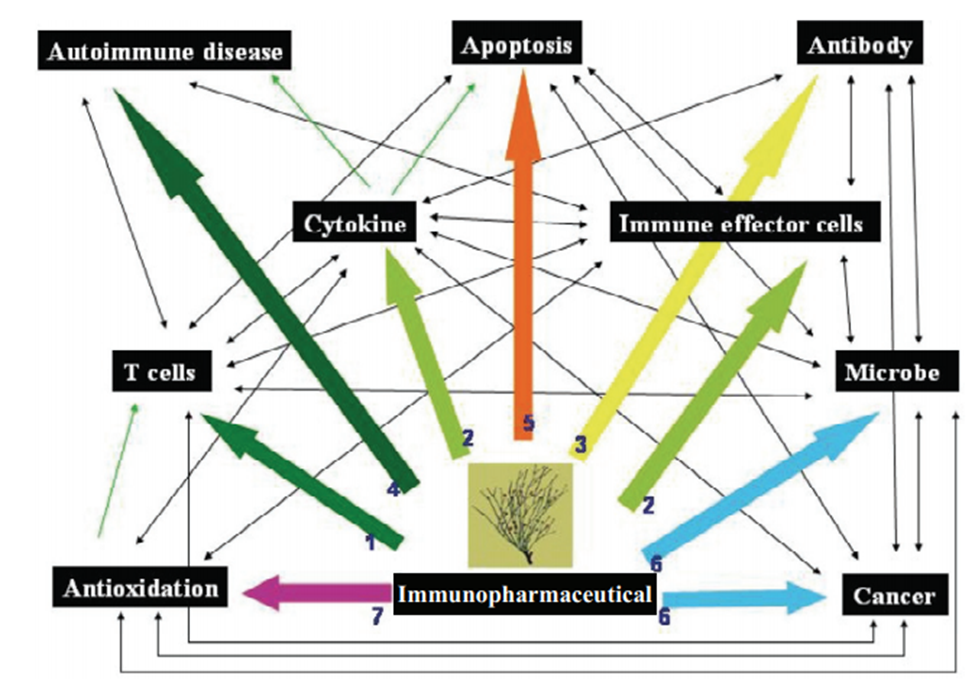
Certain plants possess immunomodulatory properties exerting effects on various parts of the immune system on both cellular and molecular levels: T cells and other immune effector cells, cytokine, and antibody production .
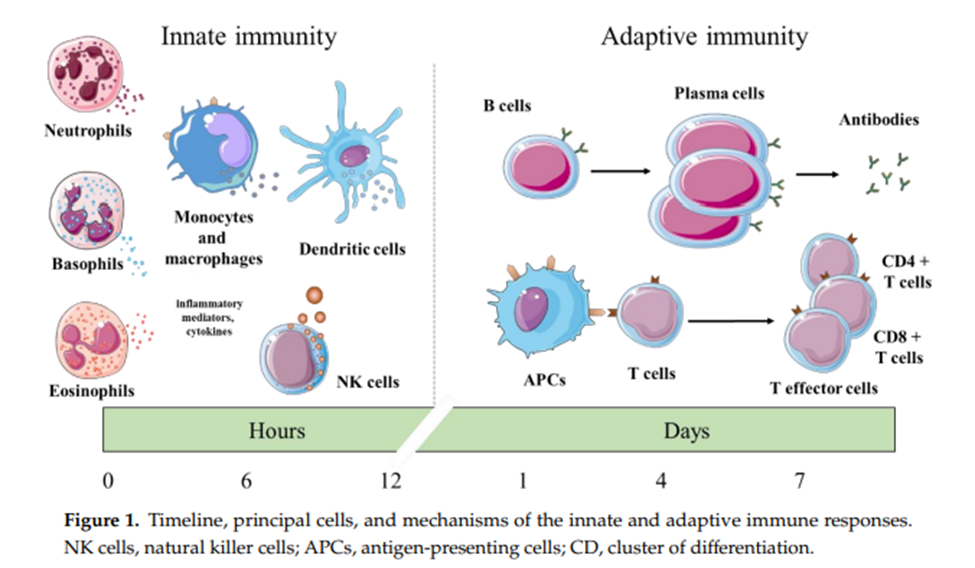
Immune responses can be classified into two categories: The innate (natural) and the adaptive (acquired) immune response.
The innate immune response involves neutrophil, eosinophil and basophil granulocytes, mast cells, dendritic cells, monocytes and macrophages, and natural killer (NK) cells. Their functions include phagocytosis, release of inflammatory mediators, cytokine production, and antigen presentation.
The adaptive response involves the immunoglobulin (Ig)/antibody-producing and secreting B cells as plasma cells, and T cells including CD4+ T helper cells and CD8+ cytotoxic T cells.
Innate immunity provides the first reaction of the immune response, while adaptive immune responses require more time for the activation of various lymphocyte subpopulations. Cytokines are a diverse group of low-molecular-weight soluble proteins regulating cellular proliferation, differentiation, and activity. CD8+ cytotoxic T cells and NK cells destroy infected and malignant cells by inducing their apoptosis. One pathway is by secreting the pore-forming perforin, granzyme proteases, and granulysin from cytolytic granules toward the target cells.
Stimulation of the immune system relates to the non-specific activation of the innate and/or adaptive immune responses leading to enhancement of certain immune functions, which are protecting against various pathogens and malignantly transformed cells.
Below is a diagram showing the timeline for when various parts of the immune system become active (open the panel all the way for a better view)
Categories for Activity on the Immune System
Classification of immunomodulators
Clinically, immunomodulators can be classified into the following three categories:
Immunoadjuvants are used to enhance the efficacy of vaccines and therefore could be considered specific immune stimulants. Immunoadjuvants hold the promise of being the true modulators of the immune response. It has been proposed that they be exploited as selectors between cellular and humoral helper T1 (Th1) and helper T2 cells (Th2), immunoprotective, immunodestructive, and reagenic [immunoglobulin E (IgE)] versus IgG type immune responses posing a real challenge to vaccine designers.
Immunostimulants are inherently non-specific as they are envisaged as enhancements to a body’s resistance to infection. They can act through innate as well as adaptive immune responses. In healthy individuals, the immunostimulants are expected to serve as prophylactic and promoter agents, i.e., as immunopotentiators, by enhancing the basic level of immune response. In the individual with impairment of immune response, they are expected to act as immunotherapeutic agents.
Immunosuppressants are a structurally and functionally heterogeneous group of drugs, which are often concomitantly administered in combination regimens to treat various types of organ transplant rejection and autoimmune diseases.
Immunomodulating (Immunomodulators)
Relaxation is a primary contributing factor to immune health. The immune system, respiratory system and nervous system are very closely connected.
Articles/Studies
The Immunopharmaceutical Effects and Mechanisms of Herb Medicine
Photoimmunology: how ultraviolet radiation affects the immune system.
Western diet and the immune system: An inflammatory connection.
Vitamin-mediated regulation of intestinal immunity.