Sarsaparilla
See "Jamaican Sarsaparilla" (the preferred medicinal species)
Not to be confused with: adulterations and mistaken identity often occurs among Smilax species.
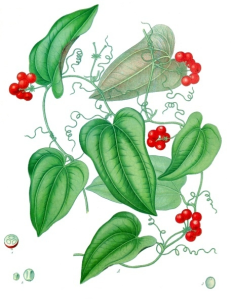
Medicinal Parts: the dried root, the entire undergound part, and the tuberous swellings produced by the runners of Smilax species such as Smilax officinalis, Smilax aristolochiaefolii, Smilax regelii and Smilax febrifuga. Its collected in the wild from January to May. Roots are cut up and air-dried.
Qualities Warming, moistening
Properties Alterative, diuretic
Constituents
- Steroidal Saponins from the Genus Smilax and Their Biological Activities
- Three new steroidal saponins from Smilax officinalis
The root has been used as an ingredient in root beer and other beverages, where it is valued for its foaming properties, not for its flavoring properties.
Medicinal
Cook, 1869: the Physiomedical Dispensatory.
A mild bittersweet herb used for strengthening the liver, purifying the blood, and balancing the glands. It helps relieve arthritic pains and clear skin conditions. It has a hormonal balancing action, possibly due to its action on gut bacteria.
Sarsaparilla root has long been used as a traditional medicine in Central and South America, where it is employed in the treatment of sexual impotence; rheumatism and joint pain; headaches; the common cold; skin ailments, including leprosy; and as a general tonic in cases of physical weakness.
The plant has become popular as a herbal remedy in many parts of the world and considerable research has been carried out into the medically active compounds in the root.
The most important active compounds in the root are a range of plant steroids and saponins; other compounds present include flavonoids.
The saponins have been shown to facilitate the body's absorption of other drugs and phytochemicals, which accounts for its history of use in herbal formulas as an agent for bioavailability and to enhancement the power and effect of other herbs.
Clinical research has validated the traditional use of sarsaparilla for skin conditions such as psoriasis, eczema, acne, and leprosy. In one clinical study with 92 patients it was reported that use of the root improved psoriasis lesions in 62% of cases and completely cleared lesions in 18% of cases. The root's blood cleansing properties are believed to be largely responsible for this, and in particular the steroid sarsaponin, which has been shown to remove endotoxins from the blood.
Sarsaparilla's effective use in the treatment of leprosy has been documented in a 1959 human trial.
The effectiveness of sarsaparilla in the treatment of adolescent acne caused by excessive androgens has received some experimental support as well.
Flavonoids in sarsaparilla have been documented to have immune modulation and liver protective activities. Sarsaparilla is beneficial for the treatment arthritis due to its ability to inhibit TNF-α induced NF-kβ activation
Clinical observations in China demonstrated that sarsaparilla was effective (according to blood tests) in about 90% of acute and 50% of chronic cases of syphilis.
Other studies have show the antibiotic, antifungal and antimycobacterial properties of the root.
Its anti-inflammatory activity has been demonstrated in several in vitro and in vivo studies.
The root has been reported to have stimulatory activity on the kidneys in humans and, in chronic nephritis, it was shown to increase the urinary excretion of uric acid.
Brain Protection
In animal and cell-based studies, both sarsaparilla and its active components reduced the damage caused to brain cells by:
- Alzheimer’s disease [R, R, R]
- Parkinson’s disease [R]
- Stroke [R]
- Overactivation of their glutamate receptors [R]
These benefits were only observed in animals and cells. Further studies in humans are needed.
Physio-Medical Therapeutics, Materia Medica and Pharmacy BY T. J. LYLE, A.M.M. 1897
The Physiomedical Dispensatory by William Cook, M.D., 1869
A Tribe of climbing and shrubby plants, with oval leaves conspicuously veined. The plant now under consideration is a native of Central America, especially of Honduras, Guatemala, Mexico, and New Grenada. Several varieties of the root come upon the market, of which the present species seems most valuable. According to Humboldt and Bonpland, this plant has an angular, twining, and somewhat prickly stem, the young shoots being smooth. Leaves ovate-oblong, acute, smooth, tough, five to seven-nerved, a foot long, on short petioles, with stipules in the form of tendrils. The roots are slender, very long, several from the same collum, reddish-brown, and tough. They come to market folded in lengths of two and a half feet, in small bundles. Some specimens are a dirty ash-gray, and others rather reddish. The average size is that of a large goose-quill. It has but little odor, but emits a decided and pleasant smell on being boiled; and its taste is at first mucilaginous and slightly bitter, but afterwards moderately yet persistently biting and warming to the fauces.
Several species of smilax are common in woods in all sections of the United States, some of which are called by the popular name of greenbrier, and one (S. herbacea) furnishes a flower with the wretched smell of carrion. The roots of some of the greenbriers appear to be fairly medicinal, though they have not been used sufficiently to venture an opinion upon their usefulness. The menispermum palmatum is called sarsaparilla, though not allied to the order Smilacaceae; and so is aralia nudicaulis.
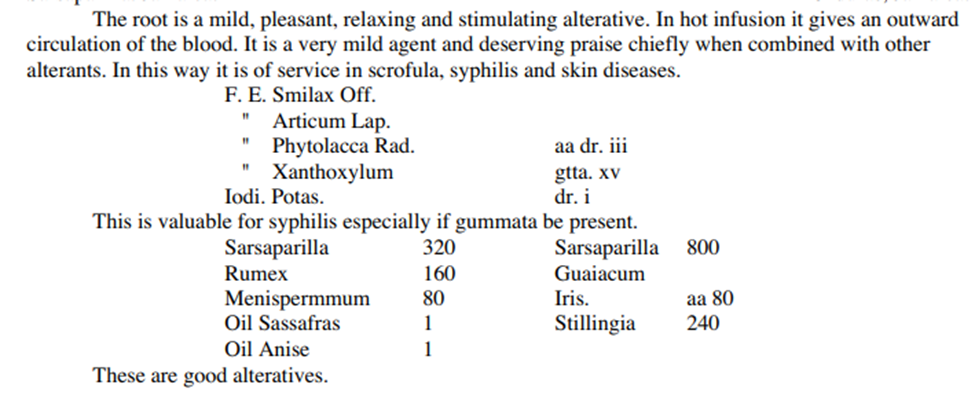
Properties and Uses: The root of the sarsaparilla is placed among the most efficient alteratives, of the relaxant and moderately tonic grade. Its powers have been much overrated; and though good, it is more valuable for its pleasantness and mildness than for its potency. The method of its action is less as a secernent than a sustainer of capillary circulation; and its ultimate benefits are seen only after long use. Secondary syphilis and mercurial cachexy are the cases to which it is mostly applied; though it is also commended in rheumatism and chronic cutaneous affections. Used alone, its benefits are moderate; but if combined with such articles as guaiacum, stillingia, and iris, good results will be obtained. A long continuance of heat decidedly injures it; and some old bundles are nearly inert. The great price of the article is scarcely remunerated by the virtue obtained from it. Decoction, sirup, or extract, is the proper method of administration.
Pharmaceutical Preparations:
I. Decoction. Five ounces of sliced sarsaparilla are boiled in two quarts of water to one quart, and strained. But the evidence is abundant that such an amount of boiling renders the product nearly inert; and indeed boiling at all is quite injurious to the article. A better method is to digest the sliced root for an hour in a quart of water not above
150 degrees F., in a close vessel. Dose, two to four fluid ounces three times a day.
II. Extract. An extract of this root prepared by water, is of small consequence. That prepared by exhausting the
root with seventy-five percent alcohol, and evaporating to solidity on a water bath, is a fair representative of the root, and an ounce of it commonly contains the strength of half a pound of the drug. Dose, ten to twenty grains, dissolved in water, three times a day.
III. Fluid Extract.
This is usually prepared, according to the Pharmacopoeias, by either boiling the root or digesting it with hot water. A much better way is to macerate a pound of the root in a covered vessel for two days with diluted alcohol; treating by percolation till eight fluid ounces have passed; reserving this, and exhausting with tepid water; evaporating the latter on a water bath to eight fluid ounces, and mixing the two products. Dose, a fluid drachm four times a day. An officinal sirup is prepared by boiling, and is almost worthless. An officinal compound sirup is made of two pounds sarsaparilla; three ounces guaiacum; two ounces, each, rose leaves, senna, and licorice; five drops, each, oils of sassafras and anise; and three drops oil of wintergreen, using diluted alcohol as a menstruum, procuring a gallon of the tincture, and adding eight pounds of sugar. It is a very pleasant but mild preparation.