The Core Assets
The Core Assets
The African City Properties Trust Ltd formed the core of the Glazer brothers’ Johannesburg real estate portfolio. It was incorporated in England on 31 October 1894 and officially it owned a portfolio of land and buildings, mostly in the Johannesburg CBD.
ACP Investments Ltd was incorporated by Bernard Glazer and his brother Sam in South Africa in 1948 – the year that the National Party came to power in South Africa and that the state of Israel was formed. ACP Investments was created specifically to acquire the shares of The ACP Trust Ltd from its British shareholders. This was effected, it appears, through a hostile management buyout led by Sam and Bernard Glazer and underwritten by Volkskas. Once complete, the entire business of ACP Trust was transferred to a South African-incorporated company called The African City Properties Trust (1952) Ltd.
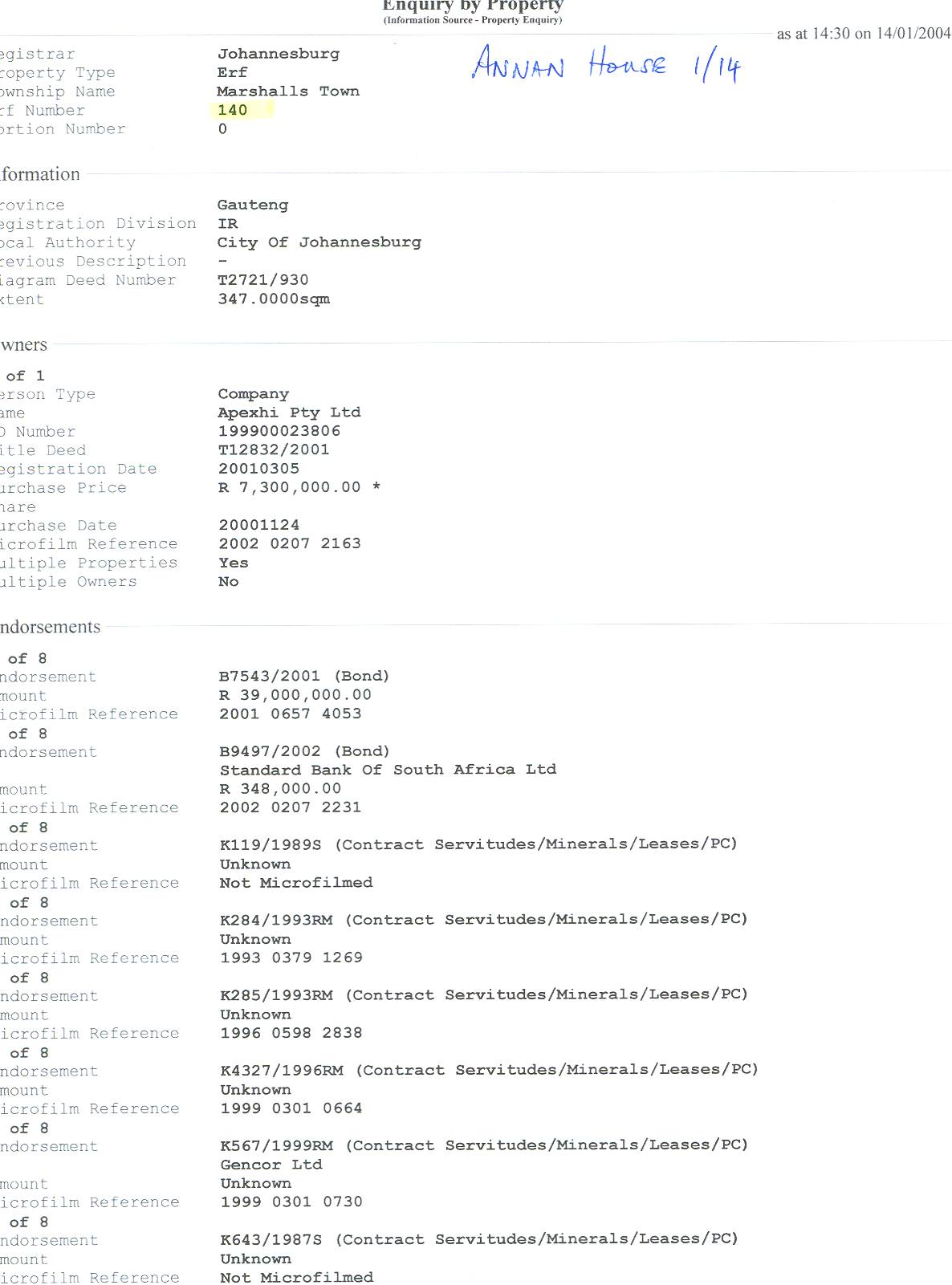
This company, with its entire asset portfolio, was sold in 1965 to Urban Investment Properties (Pty) Ltd, the sole shareholder of which was the Joint Municipal Pension Fund (Transvaal), situated in Benoni. The entire parcel was later acquired by Retco Ltd some time in the seventies; Retco’s major shareholder appears to have been Federated Employers Insurance Ltd, which later became Fedsure, before it was taken over by Investec in 1987. However, the parcel of land didn’t move all the way with the Federated bundle. It was hived off in 1981 – after having been held through Retco by South African Breweries for a while – to the CBD Property Fund, which was controlled by Sage Holdings Ltd through Sage-Ned-Equity Properties (Pty) Ltd (see Appendix A, B, C, D & E). An inspection of the title deeds for many of these properties show that a number of them share exactly the same four rights to minerals (RM) endorsements. This is unusual, as mineral rights endorsements are usually unique to the property in question. One of these is held by Gencor, the rest are unknown. Requests made to see these endorsements have so far been ignored by the Deeds Office in Johannesburg. However, efforts are being made to get copies.
The fact that the plan to take over The African City Properties Trust Ltd of the UK was put into action in 1948, the very year the Nats came into power, is one clue to the notion that this was not just a handful of buildings and empty stands. The fact that The ACP Trust’s English chairman prior to the takeover, William G Fossick, was also a director of the mining company Tati Ltd in 1956 [CONFIRM YEARS] is a further clue to the link between The ACP Trust and mining. Another lies in the fact that its Johannesburg office was in a building which it owned, called Annan House. Englishman Robert Annan became chairman of Consolidated Gold Fields in 1944, by which time he’d been a member of the South African Institue of Mining and Metallurgy for almost a decade. Born in 1885, he was listed in the 1960 Who ’s Who as a ‘director of mining companies’. The secretary of the ACP Trust was Charles Forbes, whose son Sir Archibald Forbes became chairman of Central Mining and Investment Corporation and a director of Rand Mines, in 1959. The fact that the company created to be the South African holding entity, ACP Investments Ltd, had Broederbond member and banker Jan Hurter on its board is one more clue to its importance.
The original UK version of The ACP Trust had its own political heavyweights on its board: The chairman in 1934 – when the first records are available – was Major Sir George Manners, DL, JP, grandson of the 5th Duke of Rutland, who held the seat at Haddon Hall, which had been the seat of the family for more than five centuries and had been linked to mining in England for much of that time. Another director was Sir Arthur Fell, Knight-Bachelor, a conservative MP who was born in Nelson, New Zealand in 1850 and who died in Wimbledon in December 1934. Other directors in 1934 included Alan J Davidson; Ernest Sydenham-Clarke; and Charles A Chidell. [ANY MINING OR POLITICAL LINKS?]
The company’s head office was in London and a local committee ran the South African office, which in 1937 moved into one of the company’s newly rebuilt properties: Annan House in Commissioner St, Johannesburg. Annan House consisted of seven shops and 173 offices and cost ₤70 220 to build. The total asset portfolio of the company – at cost – in 1934 was some ₤900 000, although the financial statements stated that the market value was much higher. The authorised and issued share capital had a nominal value of ₤375 000. The ‘European’ (meaning white) population of Johannesburg was estimated at 225 000 in that year and rateable value of land and buildings exceeded ₤74 million. This rose to ₤112 million in 1938, in which year the value of plans passed was ₤11 million.
Demolishing and rebuilding was de rigeur in the thirties as Johannesburg expanded and property values increased: New technology and a growing population meant that two- and three-storey buildings on high-value sites in the Johannesburg CBD were regularly razed and replaced by new buildings of 10 to 15 floors. The turnover of The ACP Trust from rents, dividends, interest and commission in 1938 was ₤149 305. However, as mentioned, the real business was mineral rights, but that all happened off-ledger.
The action surrounding The ACP Trust began in 1948. The National Party came to power in that year and an interesting character joined the board of ACP: Lt-Col Richard Lowther Broad, MC, about whom a book has been written called A Talent To Survive: The Wartime Exploits of Lt-Col Richard Lowther Broad by Rex Woods. Sadly the book is now out of print, but a copy could probably provide an interesting insight into wartime activities to which Bernard Glazer or his brother Sam were linked and which enabled them to emerge from the war with the millions that they splashed all over town. The suspicion regarding Lt-Col Broad arises because he only remained on the board until March 1950, and by the time he resigned a new local committee had been appointed in Johannesburg, one that included Bernard and Sam Glazer as well as JJ Bosman and W Buhrmann, the latter both managers at Volkskas Ltd in Pretoria. All four would become directors within a year, along with the aforementioned Jan Hurter.
The transition saw enough jostling to fuel the mind of even the most reluctant conspiracy theorist; there’s even an untimely death along the way. Each year the directors’ report expressed appreciation for the work of the local committee. The directors’ report for the financial year ended 31 December 1949 stated, ‘Your Directors record their appreciation of the services during this difficult year of the Manager and Staff in South Africa…’ One feels that each one was biting his tongue when he signed the report. The same report mentions an offer by ‘Messrs. Glazer Brothers and Volkskas Limited’, through ACP Investments Ltd, ‘to purchase the Preference and Ordinary shares’ of the company, conditional on a 90% acceptance of the offer. The chairman’s report for the same year ‘strongly [advised] shareholders to accept this offer … without loss of time; being fully convinced that, in the events which have happened, to adopt any other course would be very unwise’. Clearly those were not good days at the office.
However, the directors did not go quietly. Their parting shot was a special resolution passed on 5 July 1949 that gave the board the power to grant ‘pensions or other allowances’ to any person who had worked at the company or to that person’s widow or dependants if he was already dead. On the face of it, this was a legitimate attempt to secure the pensions of the staff and would have been passed by the shareholders as such. However, a sentence at the end of the resolution offers a clue to other payments that might have been going on, perhaps off-ledger mineral rights payments into the pockets of the directors: It mentions the term ‘Salaried Director’ and defines this as a director receiving salary or remuneration in addition to his fees as a director ‘whether under a Service Agreement or otherwise’. A further special resolution passed on 13 April 1950 deleted paragraphs in the Articles of Association relating to bearer shares, although bearer shares were authorised by the Articles of Association of ACP Investments Ltd, the South African company that would become the new holding company.
On 27 July 1951, Sam and Bernard Glazer were appointed to the board of directors, along with Bosman, Buhrmann and Hurter. Sam’s address was given as 113 Manners Mansions, Jeppe Street in Johannesburg; Bernard’s, as 2 Lauriston Court. Both were buildings owned by the company they had just bought.
The acquisition was effected through the issue of debenture stock in ACP Investments Ltd, the new, South African-based holding company (Flowchart A, p8). Debenture stock is a form of capital whereby the stockholder gets repaid within a fixed period at a fixed rate of interest (as against a normal shareholder to whom the company to owes the nominal value of the shares indefinitely). The original UK shareholders received.