The Cast and the Accounting Pattern
The Cast and the Accounting Pattern
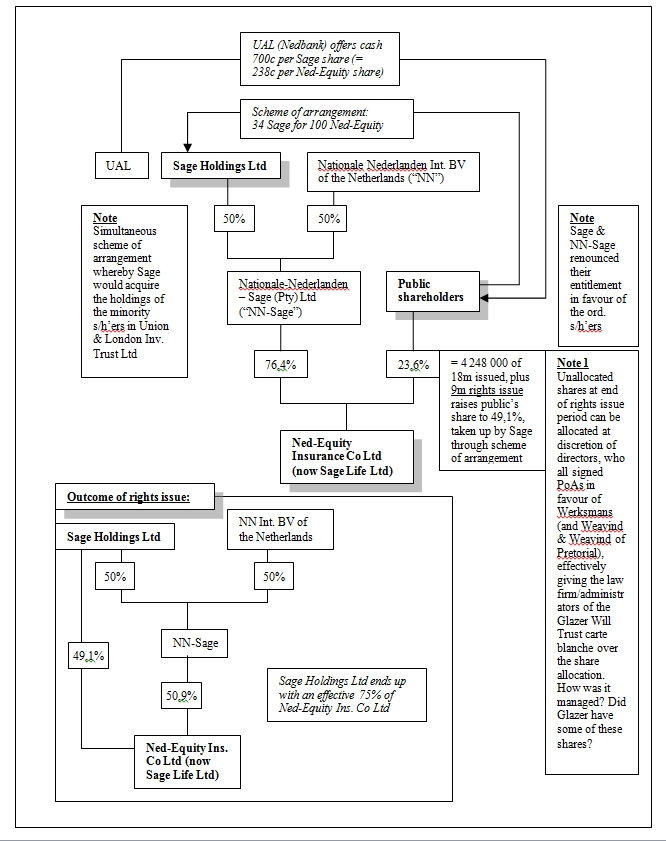
Bernard Glazer died on 17 July 1984. A renounceable rights issue of nine million shares in Ned-Equity Insurance Company Ltd (a subsidiary of Sage, now called Sage Life) was announced in a circular to shareholders on 9 November 1984 (see Flowchart G, p18). Sage and NN-Sage renounced their entitlement to the new shares in favour of the ordinary shareholders, which meant that the public shareholders could take up all nine million. After this had taken place, Sage would then take up those shares in exchange for shares in Sage. The outcome would be that Sage would hold 75% of Ned-Equity Insurance Company Ltd (up from an effective 38,2%); the public would hold shares in Sage instead of Ned-Equity. In terms of the circular, any unallocated shares could be allocated at the discretion of the directors. But on 17 October 1984, each director had signed a Power of Attorney in favour of Werksmans (and Weavind & Weavind Inc of Pretoria) to ‘sign the circular and letter of allocation and any alteration thereto’ with
- * *
Flowchart F
Renounceable rights issue in Ned-Equity Insurance Co Ltd (later Sage Life Ltd), October 1984 by which public shareholdings were transferred to Sage
- * *
regard to the rights issue. Cyril Jaffe, a partner at Werksmans, was by this stage the executor of Glazer’s estate. It would be fascinating to see how Werksmans handled this share transaction. One may well ask why one has any reason to be suspicious of a great, old, established – and giant – law firm whose great, old, established – and giant correspondent firm in the US is Sherman & Sterling.
Check this: Former judge Mervyn King was one of the trustees of Natal textile magnate Phillip Frame’s estate. Frame expressly required that his legacy be managed for the sake of his workers’ job security; this was to be achieved by conservative expansion through profit retention. Unfortunately the estate was stripped down and shipped off to his daughters in London, who clearly didn’t want to deal with all those grubby workers; 24 000 jobs were lost (noseweek 45, April 2003). There were four trustees of Philip Frame’s estate, including King; one of the others was Werksmans partner and Sage board member Carl Stein.
Now consider this: Around the time that Sage was launching its American arm, the Health & Racquet Club owners Leisurenet went to the wall, ostensibly driven by the onerous burden of its too-hasty international expansion drive. However there is much to suggest it was part of a well-orchestrated plan to justify the movement of funds overseas and then to simply shut up shop. The empowerment group Sekunjalo Investments is currently suing the Leisurenet auditors Deloitte & Touche for what they allege is the accounting firm’s involvement in the scam. Deloitte & Touche, in turn, have served notice on a number of the former directors of Leisurenet. Among them is Archie Aaron, a partner at Werksmans.
In December 2002 Sage chairman Louis Shill told Moneyweb that he was ‘planning to retire in the financial year after he turned 74. That would have put his retirement date around June 2004.’ (Moneyweb Digest , 11 April 2003) This is an odd age for a man to set for his retirement; people usually set these targets in multiples of five, so why did he not choose an age like 70, or 75? The fact that the Glazer estate is due to close in July 2004 may or may not have had something to do with his reasoning. In the end, Shill retired during 2003 following ‘disastrous’ financial results for the company as a result of their foray into America. However, one has to ask whether the poor results in the USA were really as devastating for Sage as it appears, or whether it was just part of the same capital flight plan. The pattern is compelling.
The auditors of Sage are Grant Thornton South Africa, formerly Kessel Feinstein. The old doyen of the firm, Julius Feinstein, was with Benny Glazer throughout. His name appears on all the Tati and Bechuanaland Exploration Company accounts and he became an administrator of Glazer’s estate – and a director of all of his companies – after Benny died. Grant Thornton has its origins in the city of Chicago in 1934 [CONFIRM]. Paul Marcinkus, head of the Vatican Bank when it was being managed by acknowledge Mafia banker Michele Sindona was from Chicago, as was David Kennedy, head of Continental Illinois of Chicago, the bank that was involved with the Crown Agents when Franklin National and six other banks around the world collapsed in 1974. Glazer’s links with the Crown Agents are revealed in the banking chapter. Grant Thornton were the auditors of Italian giant Parmalat, which collapsed in December 2003 with hundreds of companies declaring false assets while the real money was apparently siphoned off.
The head of Werksmans’s recently formed specialist tax division is Mazansky. When Werksmans acquired the services of Mazansky, it was touted by the Sunday Times (26 May 2002) as ‘one of the most audacious corporate poaches in SA business history’. It wasn’t really; he was just playing musical chairs: Mazansky came from Grant Thornton (then Grant Thornton Kessel Feinstein). The spin was clearly intended to try to create a perception of distance between the two firms, and the editor never picked it up. That editor would have cringed had he read this before seeing the Financial Mail supplement of 14 November 2003: When it finally dropped the ‘Kessel Feinstein’ and became simply ‘Grant Thornton’, the auditing firm promoted the fact through this 20-page leaflet, and Mazansky was one of the people quoted as part of the fluff; he said, ‘It (Grant Thornton) was my cradle, nursery school and high school.’ Other people quoted in the same supplement included Mervyn King and Garth Griffin, chief executive of Sage and former CE of Old Mutual, which has also moved its listing to London, where it bills itself as an global player, even though ‘still makes most of its money in South Africa’ (The Guardian , 23 Dec 2003).
Sage took out a full page advert to support the supplement, as did Netpartner Investments Ltd, which controls the private hospital group Netcare and features former Werksmans partner HR Levin on its board (clearly someone had to take care of the families’ health while the dads stripped the government of its ability to do so). There’s also a full page ad for Ellerine Holdings, and a quote by Eric Ellerine, who used that vehicle to list himself on the Stock Exchange. Ellerine is also chairman of Redefine Income Fund Ltd, and on the board of Investec and Corpcapital [CONFIRM ALL THESE], which owns Coronation Fund Managers, which also took out a full-page ad. (From there the group spreads to Bidvest, which is the industrial arm.) A few others within this group filled half and quarter-page advertising berths, while Werksmans managed to squeeze itself into a tiny quarter page. Perhaps they were still bitter about the Mazansky affair, because the law firm had by then shown itself to be quite capable of taking out regular full page ads in the main issue of Financial Mail , among others. It has also ensconced itself in one of the prime sites in the Sandton CBD, which is the first stop on the capital flight road out of Johannesburg. Werksmans recently tucked itself in between a couple of six-star hotels there, where it renovated a whole building in between the main hotels. Investec is just up the drag and Sun International is has erected its new head office directly over the road.
Louis Shill has remained on the board of Sage as a non-executive director, and still holds 11% of the company (Moneyweb Digest , 23 May 2003). Shill, the accredited founder of Sage, was a chartered accountant who served his articles at Kessel Feinstein and the nephew [CHECK] of Seftel Shill, managing director of the Premier Trading Company (not related to Premier Milling) in Benoni [A GLAZER CO?]; the older Shill was born in Lithuania in 1914, a year after Bernard Glazer, who emigrated from Lithuania in 1930. As the story on the acquisition of Ashbourne Investments Ltd in the UK shows, Glazer was not averse to using front men. In that instance he used Lionel Casper, related [HOW?] to the chief rabbi of Johannesburg, Bernard Moses Casper.
Today, Sage holds about 5% of the shares of the banking giant Absa through Sage Life (formerly Ned-Equity Insurance Company Ltd, who made the rights issue in 1984 after Glazer died); Absa in turn holds more than 20% of the shares of Sage. The person who took over from Shill was Dr Danie Cronje, who is also chairman of Absa. Cronje was on the board of Volkskas International when Glazer resigned after a fierce conflict had emerged between the two in late 1982; this was just some 18 months before Glazer died. The actions of Dr Cronje with regards to this institution can be found in the banking chapter.
The board of Sage has been populated by a band of heavyweights with a similar look and feel to the crew that surrounded Glazer: a mixture of Jews and Afrikaners, the latter having strong banking and Broederbond/National Party ties: Apart from Dr Cronje, Garth Griffin (former Old Mutual managing director) and Werksmans partner Carl Stein, the following names have featured: Dave Winckler, former executive partner of KPMG SA (formerly Peat, Marwick, Mitchell & Co, the auditors of The African City Properties Trust (1952) Ltd); John Postmus, former GM of the SA Reserve Bank; Dr Dirk Mostert, chairman of the Mines Pension Funds; Theo van Wyk of the Rembrandt Group and Denis Falck of the related Remgro Ltd; as well as none other than Barend du Plessis, who was Minister of Finance under the National Party.
On 29 December 2003, when the whole world was on holiday and nobody would see or care, a cautionary notice was issued by Imara Corporate Finance South Africa (Pty) Ltd via the JSE Securities Exchange News Service (Sens) regarding a transaction between Alpina Investments Ltd (formerly Gold Edge Holdings Ltd) and Fairvest Property Holdings Ltd. It was to do with the purchase of the shares and loan accounts in a company called Daisy Street Investments No 127 (Pty) Ltd for a consideration of R251 million. Apparently there had been a change of plan: Alpina was going to delay the acquisition of certain properties and acquire other ones instead. The interesting thing is that Imara is the company chaired by Adam Fleming (he of Harmony Gold and James Bond-reflected fame), while the accountants for Fairvest were Grant Thornton, who were also preparing ‘independent professional opinions on the fair (sic) and reasonableness of the … transactions’. It would be interesting to know what properties Daisy Investments suddenly decided not to sell.
(Show Retco today?)