Flowchart B
Flowchart B
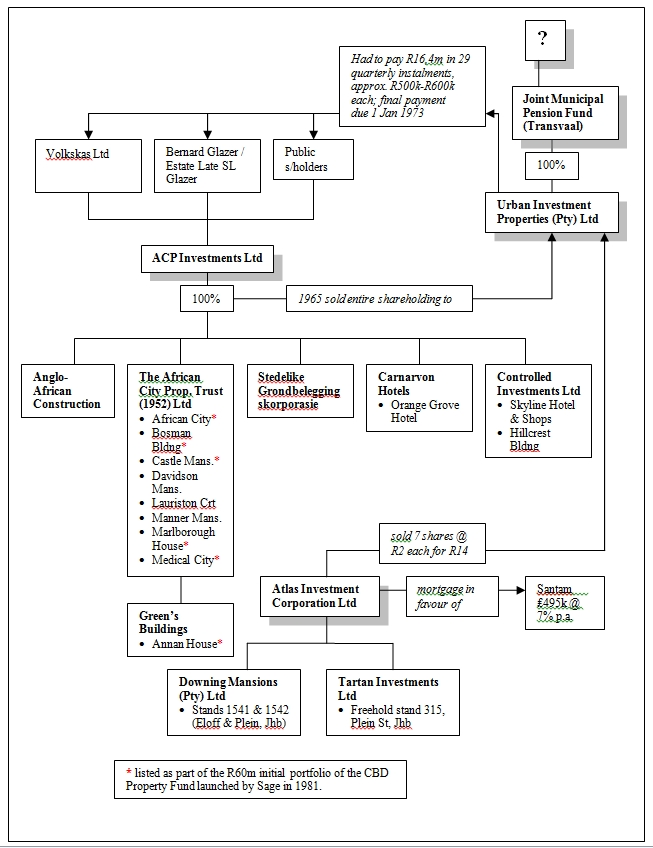
The sale in 1965 of the assets of ACP Investments Ltd to Urban Investment Properties (Pty) Ltd debentures to the tune of ₤1,3 million; Volkskas, to the tune of ₤0,6 million. The last payment in terms of these debentures was due in December 1970. In addition to the debentures, a further ₤1,1 million of ordinary shares were issued. Glazer Bros and Volkskas took up the majority of these shares (it’s not known in what ratio); some 200 members of the public held the rest. Some of the money raised through this issue went to the original UK shareholders; the rest, towards acquiring other subsidiaries for ACP Investments Ltd. These new subsidiaries were companies that they already owned, so effectively they bought from themselves; it was a consolidation exercise. One of the companies transferred into the ACP Investments stable was Stedelike Grondbeleggingskorporasie, which owned a building called the Bank Building, situated at 1 De Villiers St, Johannesburg, an address which will become relevant later on.
The debentures were secured against the shares and ultimately against the properties themselves and the new company was not allowed to raise mortgages against the buildings it had acquired. However, it was boom time in Johannesburg and some of the buildings occupied valuable CBD properties and, just like Annan House earlier, they needed to be rebuilt. In order to gain the right to raise the mortgages to accomplish this, the South Africans offered a higher rate of interest on the debentures, by one half of a percent, and pledged to pay them off earlier – by 1962. Such was their level of confidence in the asset they’d acquired.
The African City Properties Trust (1952) Ltd was registered in South Africa as a subsidiary of ACP Investments and the business of the original UK version of the company were transferred to it; the UK company was then liquidated. Two important names arise at this stage: The secretary of the new company was Pieter van Wyk de Vries, who would later, three days after Bernard Glazer’s death in 1984, act on a Power of Attorney granted to him by Glazer. The other noteworthy name was that of Nathan Werksman, whose law firm would become the giant Werksmans and whose senior partner Cyril Jaffe would become an administrator of Glazer’s estate – and fail, throughout the first eighteen years of the estate’s duration, to mention the presence of mineral rights to Glazer’s daughter Michele. Werksman’s list of directorships at this time already ran to more than five pages.
The significance of the ACP transaction is not only that the Glazer Bros were able to raise – or put up themselves – a good portion of the ₤1,1 million cash , but that they had the contacts, on both the English as well as the Afrikaans sides, to facilitate the deal. In order to get onto the company’s local committee, to get the sanction they needed to take over the company, they must have had access to a higher system. On the other side of the coin, they were giving the Afrikaners a foot in the door of the the mining world – a world until then controlled almost exclusively by the Jews of London. A few years later, in 1955, the Glazer brothers would emerge as the majority shareholders in Bechuanaland Exploration Company Ltd and Tati Company Ltd, both founded by Cecil John Rhodes and subsidiaries of the British South Africa Company, the company through which England had owned and managed the southern African colonies all the way from South Africa to Northern Rhodesia (now Zambia). They would also acquire Read’s Drift, which produced 60% of the world’s lime, during that same period.
Another important fact about The African City Properties Trust Ltd was that it was the chief local agent for the Union Assurance Society Ltd. The life insurance link to the Glazer estate will be investigated in a separate chapter, although it naturally overlaps with the property portfolio.
In 1954 the issued share capital of The African City Properties Trust (1952) Ltd was increased by ₤500 000 by means of an issue of 6% non-redeemable cumulative preference shares. In that year the South African auditors Kane, Fine, Berman & Co resigned as joint auditors and left Peat, Marwick, Mitchell & Co as sole auditors. In 1982, when the ball passed to Sage under the umbrella of the CBD Property Fund, the same firm would become joint auditors once again, this time with Kessel Feinstein; they would replace Coopers & Lybrand, who served a term as bean counters while it was at the feet of South African Breweries.(The South African Breweries years were 1973 to 1981, which bumps into the period of the Carling Black Label royalties scheme. It would appear that through owning a foreign royalty, SA Breweries had found another way to get their cash out and no longer needed the mining parcel. [CHECK DATES])
But we’re running ahead of ourselves.