The Arcadia Alignment
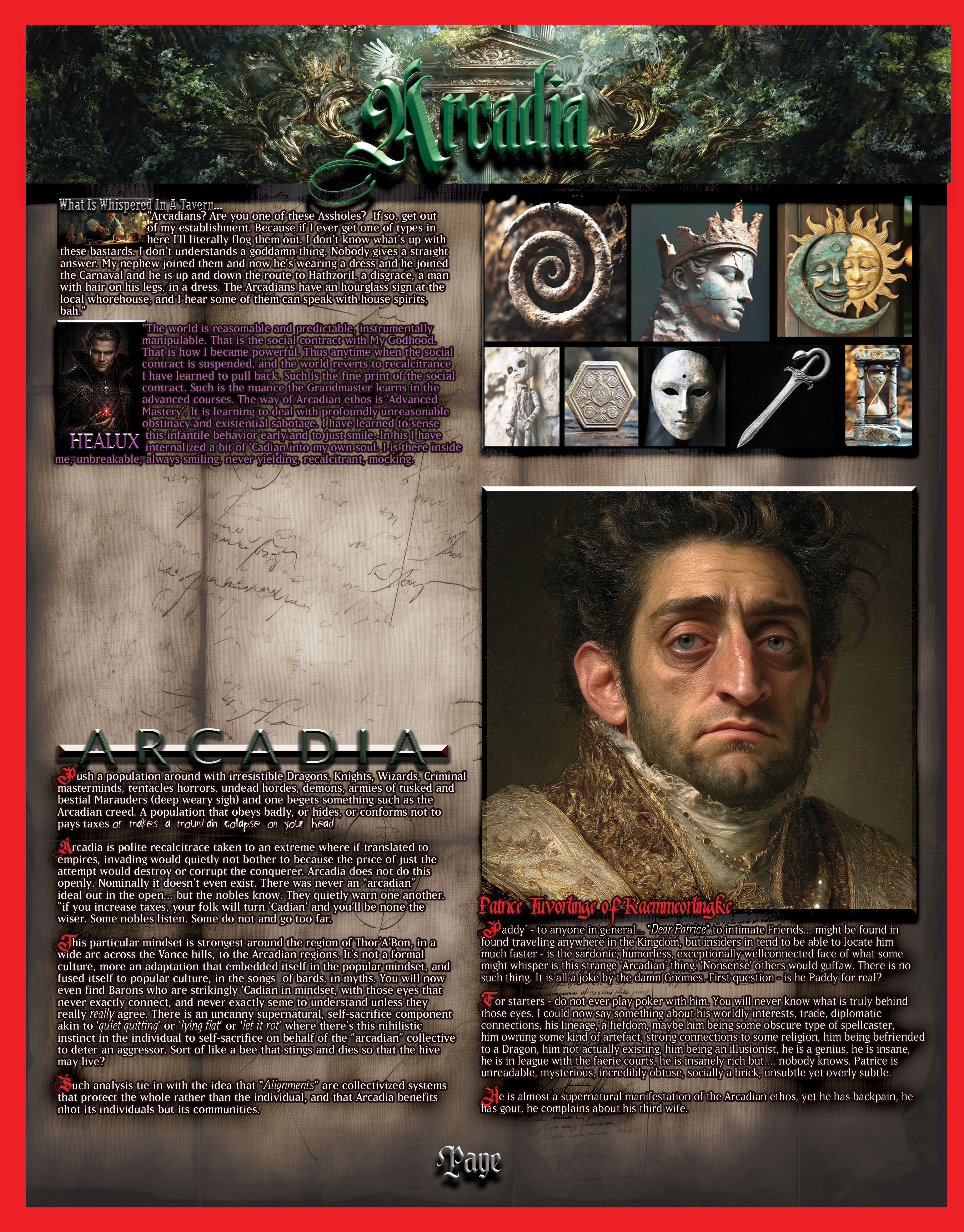
There are those in the Kingdom who will tell you, with a knowing look and lowered voice, that Arcadia is not an alignment at all, but a rumor that has grown legs. They will insist that no banner flies above it, no citadel houses it, no charter binds its members, and no proclamation ever announced its founding. They are correct in all of these particulars. Yet the rumor persists, and more curiously, it produces results. Matters settle. Tempers cool. Certain crises dissolve without spectacle. Certain individuals, who might have become dangerous in other climates, instead become merely influential. If Arcadia does not exist, it performs an admirable imitation.
One does not join Arcadia in the manner one joins a guild or swears fealty to a lord. There is no oath, no token, no signet ring pressed into the palm. Rather, one begins to notice a pattern in one’s own conduct. A preference for indirect solutions. A suspicion of grand gestures. An instinct to step sideways when others step forward. Arcadians are not pacifists in the doctrinal sense, nor are they crusaders for restraint. They simply find that the world is more navigable when force is the last instrument drawn and the least admired when it must be used. They value durability over drama.
It is often said that Arcadians are difficult to read. This is not entirely fair. They are readable, but only by those who have ceased expecting clarity to arrive in the form of declarations. An Arcadian speaks plainly enough, but leaves room around their words. They answer questions without exhausting them. They comply without surrendering initiative. Those accustomed to confrontation may mistake this for evasiveness, and those hungry for allegiance may mistake it for disloyalty. In truth, it is a habit of preserving space in which better outcomes may grow.
Arcadia does not advertise because it does not recruit. Those who are inclined toward its methods tend to find one another through shared irritations. A distaste for spectacle. A reluctance to reduce complex matters to slogans. An unwillingness to be hurried into moral theater. In courts and councils, Arcadians are rarely the loudest voices, yet they are often the last consulted before a decision hardens into law. They are the ones who ask whether a victory must also be humiliating, whether an enemy must also be annihilated, whether a reform must also be irreversible. These questions are not sentimental; they are practical.
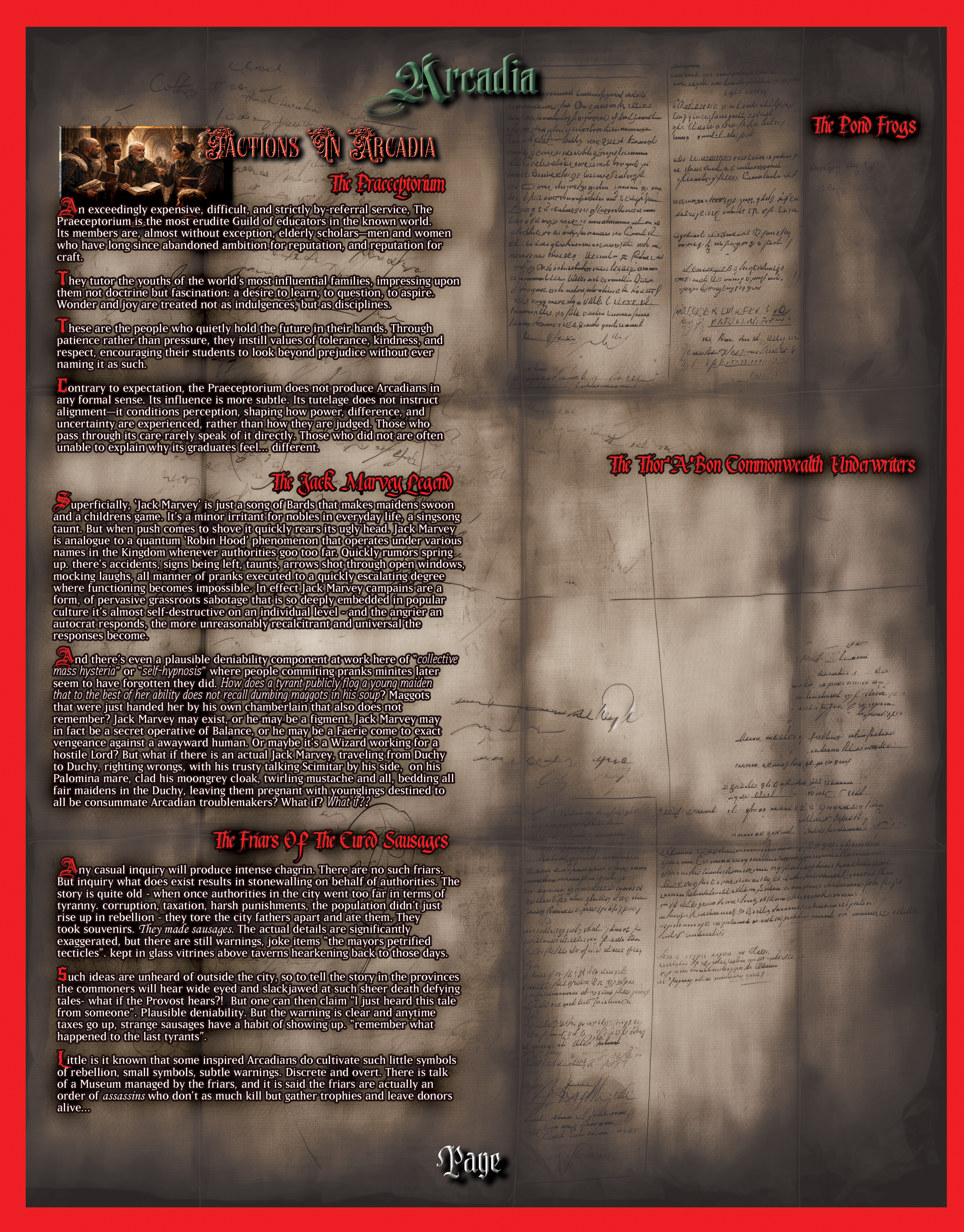
In matters of education, Arcadian influence is particularly visible, though seldom acknowledged. The Praeceptorium, whose name carries weight in certain circles, does not claim allegiance to any alignment, yet its methods are frequently described as Arcadian in spirit. It teaches not obedience, but attentiveness. Not conformity, but curiosity disciplined by patience. Students shaped in such an environment do not emerge as disciples of Arcadia. They emerge as individuals less susceptible to panic, less eager to simplify, and less inclined to confuse noise with strength. Whether this outcome was intended is a matter for speculation.
Arcadians are sometimes accused of snobbery. The charge is not entirely unfounded. They tend to cultivate taste, precision, and a certain fastidiousness of manner. They prefer well-made things to loud ones, thoughtful company to crowded rooms, and conversations that circle a subject before settling upon it. Yet this refinement is less about exclusion than about filtration. Arcadians believe that environments shape conduct, and that coarseness, once normalized, multiplies. They are therefore attentive to tone, timing, and proportion. If this appears effete to the impatient, so be it.
Their relationship to power is complex. Arcadians neither worship authority nor reflexively oppose it. They understand that institutions, like individuals, are prone to excess when unobserved. Rather than storming the gates, they cultivate vantage points. Rather than issuing manifestos, they adjust incentives. An Arcadian may serve a ruler faithfully while quietly ensuring that no single decree becomes absolute. They may stand beside a reformer while ensuring that the reform leaves room for amendment. This habit of modulation has earned them both gratitude and suspicion.
It is a mistake to assume that Arcadia is harmless. Though it disdains violence as a first resort, it is not incapable of decisive action. When pressed beyond endurance, Arcadians can be remarkably aligned with disciplines that prize misdirection and precision. A jest that disarms, a feigned incompetence that lulls, a delay that exposes weakness—these are tools as surely as any blade. Yet even in such moments, the objective is rarely conquest. It is restoration of balance, or at least the prevention of irreversible folly.
Perhaps the most telling feature of Arcadia is what it refuses to claim. When conflicts de-escalate without public credit, when rivals reach compromise without humiliation, when policies are revised quietly rather than overturned theatrically, Arcadians do not step forward to announce their success. They are content to let others believe that events resolved themselves. In this sense, Arcadia thrives in anonymity. Recognition, while pleasant, is not required for efficacy.
Those who pass through Arcadian circles often remark upon a curious sensation. They feel neither converted nor coerced, yet their approach to difficulty shifts. They become slower to anger, more resistant to flattery, less impressed by volume. They learn to distinguish between urgency and importance. They discover that not every provocation demands response, and that some battles are best won by declining to fight them at all. Whether this is wisdom or merely temperament depends upon one’s view of the world.
Arcadia will never be the alignment of heroes in ballads. It produces no martyrs eager for pyres, no conquerors hungry for maps. Its triumphs are measured in crises averted and catastrophes softened. It is, in the final measure, an alignment for those who believe that the world is best preserved not by grand corrections, but by countless small refusals to make it worse. If that sounds unremarkable, consider how rare such refusals can be.
And so Arcadia continues, unannounced and unadorned. Those who need it will find it, or find themselves already practicing its habits without knowing the name. Those who seek banners and clarion calls will look elsewhere. In the quiet between declarations, in the pause before escalation, in the careful choice not to humiliate when one could—there Arcadia is most clearly seen, though seldom acknowledged.