Brown, John 2
John Brown (May 9, 1800 – December 2, 1859) was an American abolitionist leader. First reaching national prominence for his radical abolitionism and fighting in Bleeding Kansas, he was eventually captured and executed for a failed incitement of a slave rebellion at Harpers Ferry preceding the American Civil War.
An evangelical Christian of strong religious convictions, Brown was profoundly influenced by the Puritan faith of his upbringing.[1][2][3] He believed that he was "an instrument of God",[4]: 248 raised up to strike the "death blow" to American slavery, a "sacred obligation".[3][4]: 189 [5][6] Brown was the leading exponent of violence in the American abolitionist movement,[7]: 426 believing it was necessary to end American slavery after decades of peaceful efforts had failed.[4][5][8] Brown said repeatedly that in working to free the enslaved, he was following Christian ethics, including the Golden Rule,[9][10] as well as the U.S. Declaration of Independence, which states that "all men are created equal".[11][12][13][14]: 721 [15] He stated repeatedly that in his view, these two principles "meant the same thing".[16][17][18]
the American Civil War| hide Economic <ul style="list-style: none; margin: 0px; padding: 0px; line-height: inherit;"><li style="margin-bottom: 0px;"><a href="https://en.wikipedia.org/wiki/Atlantic_slave_trade#End_of_the_Atlantic_slave_trade" title="Atlantic slave trade" style="text-decoration: none; color: rgb(51, 102, 204); background: none; overflow-wrap: break-word; white-space: nowrap;">End of Atlantic slave trade</a></li><li style="margin-bottom: 0px;"><a href="https://en.wikipedia.org/wiki/Panic_of_1857" title="Panic of 1857" style="text-decoration: none; color: rgb(51, 102, 204); background: none; overflow-wrap: break-word; white-space: nowrap;">Panic of 1857</a></li></ul> |
hide Political <ul style="list-style: none; margin: 0px; padding: 0px; line-height: inherit;"><li style="margin-bottom: 0px;"><a href="https://en.wikipedia.org/wiki/Northwest_Ordinance" title="Northwest Ordinance" style="text-decoration: none; color: rgb(51, 102, 204); background: none; overflow-wrap: break-word; white-space: nowrap;">Northwest Ordinance</a></li><li style="margin-bottom: 0px;"><a href="https://en.wikipedia.org/wiki/Kentucky_and_Virginia_Resolutions" title="Kentucky and Virginia Resolutions" style="text-decoration: none; color: rgb(51, 102, 204); background: none; overflow-wrap: break-word; white-space: nowrap;">Kentucky and Virginia Resolutions</a></li><li style="margin-bottom: 0px;"><a href="https://en.wikipedia.org/wiki/Missouri_Compromise" title="Missouri Compromise" style="text-decoration: none; color: rgb(51, 102, 204); background: none; overflow-wrap: break-word; white-space: nowrap;">Missouri Compromise</a></li><li style="margin-bottom: 0px;"><a href="https://en.wikipedia.org/wiki/Nullification_crisis" title="Nullification crisis" style="text-decoration: none; color: rgb(51, 102, 204); background: none; overflow-wrap: break-word; white-space: nowrap;">Nullification crisis</a></li><li style="margin-bottom: 0px;"><a href="https://en.wikipedia.org/wiki/Gag_rule_(United_States)" title="Gag rule (United States)" style="text-decoration: none; color: rgb(51, 102, 204); background: none; overflow-wrap: break-word; white-space: nowrap;">Gag rule</a></li><li style="margin-bottom: 0px;"><a href="https://en.wikipedia.org/wiki/Tariff_of_Abominations" title="Tariff of Abominations" style="text-decoration: none; color: rgb(51, 102, 204); background: none; overflow-wrap: break-word; white-space: nowrap;">Tariff of 1828</a></li><li style="margin-bottom: 0px;"><a href="https://en.wikipedia.org/wiki/Slavery_Abolition_Act_1833" title="Slavery Abolition Act 1833" style="text-decoration: none; color: rgb(51, 102, 204); background: none; overflow-wrap: break-word; white-space: nowrap;">End of slavery in British colonies</a></li><li style="margin-bottom: 0px;"><a href="https://en.wikipedia.org/wiki/Texas_Revolution" title="Texas Revolution" style="text-decoration: none; color: rgb(51, 102, 204); background: none; overflow-wrap: break-word; white-space: nowrap;">Texas Revolution</a></li><li style="margin-bottom: 0px;"><a href="https://en.wikipedia.org/wiki/Texas_annexation" title="Texas annexation" style="text-decoration: none; color: rgb(51, 102, 204); background: none; overflow-wrap: break-word; white-space: nowrap;">Texas annexation</a></li><li style="margin-bottom: 0px;"><a href="https://en.wikipedia.org/wiki/Mexican%E2%80%93American_War" title="Mexican–American War" style="text-decoration: none; color: rgb(51, 102, 204); background: none; overflow-wrap: break-word; white-space: nowrap;">Mexican–American War</a></li><li style="margin-bottom: 0px;"><a href="https://en.wikipedia.org/wiki/Wilmot_Proviso" title="Wilmot Proviso" style="text-decoration: none; color: rgb(51, 102, 204); background: none; overflow-wrap: break-word; white-space: nowrap;">Wilmot Proviso</a></li><li style="margin-bottom: 0px;"><a href="https://en.wikipedia.org/wiki/Nashville_Convention" title="Nashville Convention" style="text-decoration: none; color: rgb(51, 102, 204); background: none; overflow-wrap: break-word; white-space: nowrap;">Nashville Convention</a></li><li style="margin-bottom: 0px;"><a href="https://en.wikipedia.org/wiki/Compromise_of_1850" title="Compromise of 1850" style="text-decoration: none; color: rgb(51, 102, 204); background: none; overflow-wrap: break-word; white-space: nowrap;">Compromise of 1850</a></li><li style="margin-bottom: 0px;"><a href="https://en.wikipedia.org/wiki/Fugitive_Slave_Act_of_1850" title="Fugitive Slave Act of 1850" style="text-decoration: none; color: rgb(51, 102, 204); background: none; overflow-wrap: break-word; white-space: nowrap;">Fugitive Slave Act of 1850</a></li><li style="margin-bottom: 0px;"><a href="https://en.wikipedia.org/wiki/Kansas%E2%80%93Nebraska_Act" title="Kansas–Nebraska Act" style="text-decoration: none; color: rgb(51, 102, 204); background: none; overflow-wrap: break-word; white-space: nowrap;">Kansas–Nebraska Act</a></li><li style="margin-bottom: 0px;"><a href="https://en.wikipedia.org/wiki/Ostend_Manifesto" title="Ostend Manifesto" style="text-decoration: none; color: rgb(51, 102, 204); background: none; overflow-wrap: break-word; white-space: nowrap;">Ostend Manifesto</a></li><li style="margin-bottom: 0px;"><a href="https://en.wikipedia.org/wiki/Caning_of_Charles_Sumner" title="Caning of Charles Sumner" style="text-decoration: none; color: rgb(51, 102, 204); background: none; overflow-wrap: break-word; white-space: nowrap;">Caning of Charles Sumner</a></li><li style="margin-bottom: 0px;"><a href="https://en.wikipedia.org/wiki/Lincoln%E2%80%93Douglas_debates" title="Lincoln–Douglas debates" style="text-decoration: none; color: rgb(51, 102, 204); background: none; overflow-wrap: break-word; white-space: nowrap;">Lincoln–Douglas debates</a></li><li style="margin-bottom: 0px;"><a href="https://en.wikipedia.org/wiki/1860_United_States_presidential_election" title="1860 United States presidential election" style="text-decoration: none; color: rgb(51, 102, 204); background: none; overflow-wrap: break-word; white-space: nowrap;">1860 presidential election</a></li><li style="margin-bottom: 0px;"><a href="https://en.wikipedia.org/wiki/Crittenden_Compromise" title="Crittenden Compromise" style="text-decoration: none; color: rgb(51, 102, 204); background: none; overflow-wrap: break-word; white-space: nowrap;">Crittenden Compromise</a></li><li style="margin-bottom: 0px;"><a href="https://en.wikipedia.org/wiki/Confederate_States_of_America#Secession" title="Confederate States of America" style="text-decoration: none; color: rgb(51, 102, 204); background: none; overflow-wrap: break-word; white-space: nowrap;">Secession of Southern states</a></li><li style="margin-bottom: 0px;"><a href="https://en.wikipedia.org/wiki/Peace_Conference_of_1861" title="Peace Conference of 1861" style="text-decoration: none; color: rgb(51, 102, 204); background: none; overflow-wrap: break-word; white-space: nowrap;">Peace Conference of 1861</a></li><li style="margin-bottom: 0px;"><a href="https://en.wikipedia.org/wiki/Corwin_Amendment" title="Corwin Amendment" style="text-decoration: none; color: rgb(51, 102, 204); background: none; overflow-wrap: break-word; white-space: nowrap;">Corwin Amendment</a></li></ul> |
|---|
hide Social <ul style="list-style: none; margin: 0px; padding: 0px; line-height: inherit;"><li style="margin-bottom: 0px;"><a href="https://en.wikipedia.org/wiki/Nat_Turner%27s_slave_rebellion" title="Nat Turner's slave rebellion" style="text-decoration: none; color: rgb(51, 102, 204); background: none; overflow-wrap: break-word; white-space: nowrap;">Nat Turner's slave rebellion</a></li><li style="margin-bottom: 0px;"><a href="https://en.wikipedia.org/wiki/Elijah_Parish_Lovejoy" title="Elijah Parish Lovejoy" style="text-decoration: none; color: rgb(51, 102, 204); background: none; overflow-wrap: break-word; white-space: nowrap;">Martyrdom of Elijah Lovejoy</a></li><li style="margin-bottom: 0px;"><a href="https://en.wikipedia.org/wiki/Pennsylvania_Hall_(Philadelphia)" title="Pennsylvania Hall (Philadelphia)" style="text-decoration: none; color: rgb(51, 102, 204); background: none; overflow-wrap: break-word; white-space: nowrap;">Burning of Pennsylvania Hall</a></li><li style="margin-bottom: 0px;"><i><a href="https://en.wikipedia.org/wiki/American_Slavery_As_It_Is" title="American Slavery As It Is" style="text-decoration: none; color: rgb(51, 102, 204); background: none; overflow-wrap: break-word; white-space: nowrap;">American Slavery As It Is</a></i></li><li style="margin-bottom: 0px;"><i><a href="https://en.wikipedia.org/wiki/Uncle_Tom%27s_Cabin" title="Uncle Tom's Cabin" style="text-decoration: none; color: rgb(51, 102, 204); background: none; overflow-wrap: break-word; white-space: nowrap;">Uncle Tom's Cabin</a></i></li><li style="margin-bottom: 0px;"><a href="https://en.wikipedia.org/wiki/Bleeding_Kansas" title="Bleeding Kansas" style="text-decoration: none; color: rgb(51, 102, 204); background: none; overflow-wrap: break-word; white-space: nowrap;">Bleeding Kansas</a></li><li style="margin-bottom: 0px;"><i><a href="https://en.wikipedia.org/wiki/The_Impending_Crisis_of_the_South" title="The Impending Crisis of the South" style="text-decoration: none; color: rgb(51, 102, 204); background: none; overflow-wrap: break-word; white-space: nowrap;">The Impending Crisis of the South</a></i></li><li style="margin-bottom: 0px;"><a href="https://en.wikipedia.org/wiki/Oberlin%E2%80%93Wellington_Rescue" title="Oberlin–Wellington Rescue" style="text-decoration: none; color: rgb(51, 102, 204); background: none; overflow-wrap: break-word; white-space: nowrap;">Oberlin–Wellington Rescue</a></li><li style="margin-bottom: 0px;"><a href="https://en.wikipedia.org/wiki/John_Brown%27s_raid_on_Harpers_Ferry" title="John Brown's raid on Harpers Ferry" style="text-decoration: none; color: rgb(51, 102, 204); background: none; overflow-wrap: break-word; white-space: nowrap;">John Brown's raid on Harpers Ferry</a></li></ul> |
hide Judicial |
hide Military <ul style="list-style: none; margin: 0px; padding: 0px; line-height: inherit;"><li style="margin-bottom: 0px;"><i><a href="https://en.wikipedia.org/wiki/Star_of_the_West" title="Star of the West" style="text-decoration: none; color: rgb(51, 102, 204); background: none; overflow-wrap: break-word; white-space: nowrap;">Star of the West</a></i></li><li style="margin-bottom: 0px;"><a href="https://en.wikipedia.org/wiki/Battle_of_Fort_Sumter" title="Battle of Fort Sumter" style="text-decoration: none; color: rgb(51, 102, 204); background: none; overflow-wrap: break-word; white-space: nowrap;">Battle of Fort Sumter</a></li><li style="margin-bottom: 0px;"><a href="https://en.wikipedia.org/wiki/President_Lincoln%27s_75,000_volunteers" title="President Lincoln's 75,000 volunteers" style="text-decoration: none; color: rgb(51, 102, 204); background: none; overflow-wrap: break-word; white-space: nowrap;">President Lincoln's 75,000 volunteers</a></li></ul> |
Brown first gained national attention when he led anti-slavery volunteers and his own sons during the Bleeding Kansas crisis of the late 1850s, a state-level civil war over whether Kansas would enter the Union as a slave state or a free state. He was dissatisfied with abolitionist pacifism, saying of pacifists, "These men are all talk. What we need is action – action!". In May 1856, Brown and his sons killed five supporters of slavery in the Pottawatomie massacre, a response to the sacking of Lawrence by pro-slavery forces. Brown then commanded anti-slavery forces at the Battle of Black Jack and the Battle of Osawatomie.
In October 1859, Brown led a raid on the federal armory at Harpers Ferry, Virginia (today West Virginia), intending to start a slave liberation movement that would spread south; he had prepared a Provisional Constitution for the revised, slavery-free United States that he hoped to bring about. He seized the armory, but seven people were killed and ten or more were injured. Brown intended to arm slaves with weapons from the armory, but only a few slaves joined his revolt. Those of Brown's men who had not fled were killed or captured by local militia and U.S. Marines, the latter led by Robert E. Lee. Brown was tried for treason against the Commonwealth of Virginia, the murder of five men, and inciting a slave insurrection. He was found guilty of all charges and was hanged on December 2, 1859, the first person executed for treason in the history of the United States.[19][20]: 179
The Harpers Ferry raid and Brown's trial, both covered extensively in national newspapers, escalated tensions that led, a year later, to the South's long-threatened secession and the American Civil War. Southerners feared that others would soon follow in Brown's footsteps, encouraging and arming slave rebellions. He was a hero and icon in the North. Union soldiers marched to the new song "John Brown's Body", that portrayed him as a heroic martyr. Brown has been variously described as a heroic martyr and visionary, and as a madman and terrorist.[21][13][22]
- Early life and family
- Actions in Kansas
- Raid at Harpers Ferry
- The trial
- Death and aftermath
- Viewpoints
- Influences
- Legacy
- Archival material
- Bibliography
- See also
*
Early life and family
Family and childhood

House in which Brown was born, Torrington, Connecticut, photographed in 1896, destroyed by fire in 1918.[23][24][25]
John Brown was born May 9, 1800, in Torrington, Connecticut.[26] The fourth of the eight children of Owen Brown (1771–1856) and Ruth Mills (1772–1808), he described his parents as "poor but respectable".[27]: 7 Owen Brown's father was Capt. John Brown (1728–1776), who died in the Revolutionary War in New York on September 3, 1776;[28] John Brown moved his grandfather's tombstone to his farm in North Elba, New York.[29] In 1857, Brown stated that he descended from Peter Browne, one of the Pilgrim Fathers, who landed from the Mayflower at Plymouth, Massachusetts, in 1620. There are some historians that believe that his ancestor was Peter Brown, who arrived in Connecticut in 1650.[30]
His mother, of Dutch and Welsh descent,[27]: 5 was the daughter of Gideon Mills, also an officer in the Revolutionary Army.[28] His older sister Anna Ruth was born in 1798, and his younger brothers Salmon and Oliver Owen were born in 1802 and 1804, respectively.[31][32] Oliver Owen was also an abolitionist.[33] Brown also had a brother named Frederick, who visited him when he was in jail, awaiting execution.[34]
While Brown was very young, his father moved the family briefly to his hometown, West Simsbury, Connecticut.[28] In 1805, the family moved, again, to Hudson, Ohio, in the Western Reserve, which at the time was mostly wilderness;[27]: 5, 7 it became the most anti-slavery region of the country.[35] The founder of Hudson, David Hudson, with whom John's father had frequent contact, was an abolitionist and an advocate of "forcible resistance by the slaves".[27]: 17
Owen Brown became a leading and wealthy citizen of Hudson.[28][36] He operated a tannery and employed Jesse Grant, father of President Ulysses S. Grant. Jesse lived with the Brown family for some years.[36] Owen hated slavery[37] and participated in Hudson's anti-slavery activity and debate, offering a safe house to Underground Railroad fugitives.[38] With no school beyond the elementary level in Hudson at that time, John studied at the school of the abolitionist Elizur Wright, father of the famous Elizur Wright, in nearby Tallmadge.[39]: 17 John's mother Ruth died in 1808. In his memoir, he wrote that he mourned her for years. While he respected his father's new wife, he never felt an emotional bond with her.[27]: 8 [7]: 427
In a story he told to his family, when he was 12 years old and away from home moving cattle, he worked for a man with a colored boy, who was beaten before him with an iron shovel. Brown asked him why he was treated thus, the answer was that he was a slave. According to Brown's son-in-law Henry Thompson, it was that moment when John Brown decided to dedicate his life to improving African Americans' condition.[40][41]
Young adulthood
At 16, Brown left his family for New England to acquire a liberal education and become a Gospel minister.[42] He consulted and conferred with the Rev. Jeremiah Hallock, then clergyman at Canton, Connecticut, whose wife was a relative of Brown's, and as advised proceeded to Plainfield, Massachusetts, where, under the instruction of the late Rev. Moses Hallock, he prepared for college. He would have continued at Amherst College,[14]: 13 [39]: 17 but he suffered from inflammation of the eyes which ultimately became chronic, and precluded him from the possibility of the further pursuit of his studies, and he returned to Hudson.[28]....
Time in Springfield, Massachusetts
[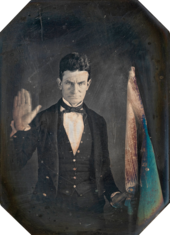 ](https://en.wikipedia.org/wiki/File:John_Brown_by_Augustus_Washington,_1846-7.png)
A daguerreotype of Brown taken by African-American photographer Augustus Washington in Springfield, Massachusetts, c. 1846–1847. Brown is holding the hand-colored flag of Subterranean Pass Way, his militant counterpart to the Underground Railroad.[68]
In 1846, Brown moved to Springfield, Massachusetts, as an agent for Ohio wool growers in their relations with New England manufacturers of woolen goods, but "also as a means of developing his scheme of emancipation".[69] The white leadership there, including "the publisher of The Republican, one of the nation's most influential newspapers, were deeply involved and emotionally invested in the anti-slavery movement".[70]
Two years before Brown's arrival in Springfield, in 1844, the city's African-American abolitionists had founded the Sanford Street Free Church, now known as St. John's Congregational Church, which became one of the most prominent abolitionist platforms in the United States. From 1846 until he left Springfield in 1850, Brown was a member of the Free Church, where he witnessed abolitionist lectures by the likes of Frederick Douglass and Sojourner Truth.[71]
In 1847, after speaking at the Free Church, Douglass spent a night speaking with Brown, after which Douglass wrote, "From this night spent with John Brown in Springfield, Mass. [in] 1847, while I continued to write and speak against slavery, I became all the same less hopeful for its peaceful abolition. My utterances became more and more tinged by the color of this man's strong impressions."[70] During Brown's time in Springfield, he became deeply involved in transforming the city into a major center of abolitionism, and one of the safest and most significant stops on the Underground Railroad.[72] Brown contributed to the 1848 republication, by his friend Henry Highland Garnet, of David Walker's Appeal to the Coloured Citizens of the World (1829).[73]
Before Brown left Springfield in 1850, the United States passed the Fugitive Slave Act, a law mandating that authorities in free states aid in the return of escaped slaves and imposing penalties on those who aid in their escape. In response Brown founded a militant group to prevent the recapture of fugitives, the League of Gileadites.[74] In the Bible, Mount Gilead was the place where only the bravest of Israelites gathered to face an invading enemy.
Brown founded the League with the words, "Nothing so charms the American people as personal bravery. [Blacks] would have ten times the number [of white friends than] they now have were they but half as much in earnest to secure their dearest rights as they are to ape the follies and extravagances of their white neighbors, and to indulge in idle show, in ease, and in luxury."[75] Upon leaving Springfield in 1850, he instructed the League to act "quickly, quietly, and efficiently" to protect slaves that escaped to Springfield – words that would foreshadow Brown's later actions preceding Harpers Ferry.[75] From Brown's founding of the League of Gileadites onward, not one person was ever taken back into slavery from Springfield. Brown gave his rocking chair to the mother of his beloved black porter, Thomas Thomas, as a gesture of affection.[70]
Brown made connections in Springfield that later yielded financial support he received from New England's great merchants, allowed him to hear and meet nationally famous abolitionists like Douglass and Sojourner Truth, and included the foundation of the League of Gileadites.[70][69] During this time, Brown also helped publicize David Walker's speech Appeal.[76] Brown's personal attitudes evolved in Springfield, as he observed the success of the city's Underground Railroad and made his first venture into militant, anti-slavery community organizing. In speeches, he pointed to the martyrs Elijah Lovejoy and Charles Turner Torrey as whites "ready to help blacks challenge slave-catchers."[77] In Springfield, Brown found a city that shared his own anti-slavery passions, and each seemed to educate the other. Certainly, with both successes and failures, Brown's Springfield years were a transformative period of his life that catalyzed many of his later actions.[70]
His daughter Amelia died in 1846, followed by Emma in 1849.[66]...
Actions in Kansas
Kansas Territory was in the midst of a state-level civil war from 1854 to 1860, referred to as the Bleeding Kansas period, between pro- and anti-slavery forces. The issue was to be decided by the voters of Kansas, but who these voters were was not clear; there was widespread voting fraud in favor of the pro-slavery forces, as a Congressional investigation confirmed.[82]
Move to Kansas
Five of Brown's sons — John Jr., Jason, Owen, Frederick, and Salmon — moved to Kansas Territory in the spring of 1855. Brown, his son Oliver, and his son-in-law Henry Thompson followed later that year.[83] His wagon was loaded with weapons and ammunition.[84] Brown stayed with Florella (Brown) Adair and the Reverend Samuel Adair, his half-sister and her husband, who lived near Osawatomie. During that time, he rallied support to fight proslavery forces,[83] and became the leader of the antislavery forces.[84]
His wife Mary refused to relocate to Kansas.[85]: 1188
Pottawatomie
Main articles: Pottawatomie massacre and Bleeding Kansas
Brown in 1856
Brown and the free-state settlers were optimistic that they could bring Kansas into the union as a slavery-free state.[86] After the winter snows thawed in 1856, the pro-slavery activists began a campaign to seize Kansas on their own terms. Brown was particularly affected by the sacking of Lawrence, the center of anti-slavery activity in Kansas, on May 21, 1856. A sheriff-led posse from Lecompton, the center of pro-slavery activity in Kansas, destroyed two abolitionist newspapers and the Free State Hotel. Only one man, a border ruffian, was killed.
Preston Brooks's May 22 caning of anti-slavery Senator Charles Sumner in the United States Senate, news of which arrived by newswire (telegraph), also fueled Brown's anger. A pro-slavery writer, Benjamin Franklin Stringfellow, of the Squatter Sovereign, wrote that "[pro-slavery forces] are determined to repel this Northern invasion, and make Kansas a slave state; though our rivers should be covered with the blood of their victims, and the carcasses of the abolitionists should be so numerous in the territory as to breed disease and sickness, we will not be deterred from our purpose".[87] Brown was outraged by both the violence of the pro-slavery forces and what he saw as a weak and cowardly response by the antislavery partisans and the Free State settlers, whom he described as "cowards, or worse".[88]
The Pottawatomie massacre occurred during the night of May 24 and the morning of May 25, 1856. Under Brown's supervision, his sons and other abolitionist settlers took from their residences and killed five "professional slave hunters and militant pro-slavery"[89] settlers north of Pottawatomie Creek, in Franklin County, Kansas.
In the two years prior to the Pottawatomie Creek massacre, there had been eight killings in Kansas Territory attributable to slavery politics, but none in the vicinity of the massacre. There had been no prior organized action by abolitionists against pro-slavery forces. The massacre was the match in the powderkeg that precipitated the bloodiest period in "Bleeding Kansas" history, a three-month period of retaliatory raids and battles in which 29 people died.[90]
Palmyra and Osawatomie
In 1856, a force of Missourians, led by Captain Henry Clay Pate, captured John Jr. and Jason, destroyed the Brown family homestead, and later participated in the Sack of Lawrence. On June 2, in the Battle of Black Jack, John Brown, nine of his followers, and 20 local men successfully defended a Free State settlement at Palmyra, Kansas, against an attack by Pate. Pate and 22 of his men were taken prisoner.[91]
...
Raid at Harpers Ferry
[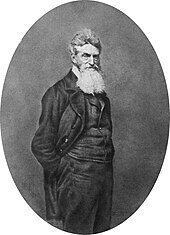
Brown in May, 1859
Main article: John Brown's raid on Harpers Ferry
See also: List of sources for John Brown's raid on Harpers Ferry
Brown's plans
Brown's plans for a major attack on American slavery began long before the raid. According to his wife Mary, interviewed while her husband was awaiting his execution in Charles Town, "He had been waiting twenty years for some opportunity to free the slaves; we has all been waiting with him the proper time that he should put his resolve into action."[96] He spent the years between 1842 and 1849 winding up his business affairs, settling his family in the Negro community at Timbuctoo, New York, and organizing in his own mind an anti-slavery raid that would strike a significant blow against the entire slave system, running slaves off Southern plantations.[97]
As put by Frederick Douglass, "His own statement, that he had been contemplating a bold strike for the freedom of the slaves for ten years, proves that he had resolved upon his present course long before he, or his sons, ever set foot in Kansas."[98] According to his first biographer James Redpath, "for thirty years, he secretly cherished the idea of being the leader of a servile insurrection: the American Moses, predestined by Omnipotence to lead the servile nations in our Southern States to freedom."[99] An acquaintance said: "As Moses was raised up and chosen of God to deliver the Children of Israel out of Egyptian bondage, ...he was...fully convinced in his own mind that he was to be the instrument in the hands of God to effect the emancipation of the slaves."[100]
Brown was careful about whom he talked to. "Captain Brown was careful to keep his plans from his men", according to Jeremiah Anderson, one of the participants in the raid.[101]: 358 According to his son Owen, the only one who survived of Brown's three participating sons, interviewed in 1873, "John Brown's entire plan has never, I think, been published."[102]
He did discuss his plans at length, for over a day, with Frederick Douglass, trying unsuccessfully to persuade Douglass, a Black leader, to accompany him to Harpers Ferry (which Douglass thought a suicidal mission that could not succeed).[101]: 350–351 [101]: 355–356
Brown thought that "A few men in the right, and knowing that they are right, can overturn a mighty king. Fifty men, twenty men, in the Alleghenies would break slavery to pieces in two years".[14]: 426 As he put it later, after the failure of his raid, "I had, as I now think, vainly flattered myself that without very much bloodshed [through the revolt supposed to start with Harpers Ferry] it [ending slavery] might be done."[14]: 398
Preparations
[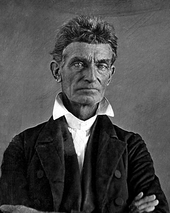
Brown c. 1856 (daguerreotype)
Brown returned to the East by November 1856, and spent the next two years in New England raising funds. Initially he returned to Springfield, where he received contributions, and also a letter of recommendation from a prominent and wealthy merchant, George Walker. Walker was the brother-in-law of Franklin Benjamin Sanborn, the secretary for the Massachusetts State Kansas Committee, who introduced Brown to several influential abolitionists in the Boston area in January 1857.[69][27]
Amos Adams Lawrence, a prominent Boston merchant, secretly gave Brown a large amount of cash. William Lloyd Garrison, Thomas Wentworth Higginson, Theodore Parker and George Luther Stearns, and Samuel Gridley Howe also supported Brown. A group of six abolitionists – Sanborn, Higginson, Parker, Stearns, Howe, and Gerrit Smith – , two of them wealthy, agreed to offer Brown financial support for his antislavery activities; they eventually provided most of the financial backing for the raid on Harpers Ferry, and came to be known as the Secret Six[103] or the Committee of Six.
Recent research has also highlighted the substantial contribution of Mary Ellen Pleasant, an African American entrepreneur and abolitionist, who donated $30,000 toward the cause.[104] Brown, however, often requested help from these donors with "no questions asked", and it remains unclear how much of Brown's scheme was related to his financial backers.[citation needed]
In December 1857, an anti-slavery Mock Legislature, organized by Brown, met in Springdale, Iowa.[5] On several of Brown's trips across Iowa he preached at Hitchcock House, an Underground Railroad stop in Lewis, Iowa.[105]
On January 7, 1858, the Massachusetts Committee pledged to provide 200 Sharps Rifles and ammunition, which were being stored at Tabor, Iowa. In March, Brown contracted with Charles Blair, through an intermediary friend, Horatio N. Rust of Collinsville, Connecticut (1828–1906),[106] for 1,000 pikes.[107]
In the following months, Brown continued to raise funds, visiting Worcester, Springfield, New Haven, Syracuse, and Boston. In Boston, he met Henry David Thoreau and Ralph Waldo Emerson. He received many pledges but little cash. In March, while in New York City, he was introduced to Hugh Forbes, an English mercenary, who had experience as a military tactician fighting with Giuseppe Garibaldi in Italy in 1848. Brown hired him as his men's drillmaster and to write their tactical handbook. They agreed to meet in Tabor that summer.
Using the alias Nelson Hawkins, Brown traveled through the Northeast and then visited his family in Hudson, Ohio. On August 7, he arrived in Tabor. Forbes arrived two days later. Over several weeks, the two men put together a "Well-Matured Plan" for fighting slavery in the South. The men quarreled over many of the details. In November, their troops left for Kansas. Forbes had not received his salary and was still feuding with Brown, so he returned to the East instead of venturing into Kansas. He soon threatened to expose the plot to the government.[citation needed] This was when Brown started to wear a beard, "to change his usual appearance".[108]

William Maxon's house, near Springdale, Iowa, where John Brown's associates lived and trained, 1857–1859. Brown lived at the home of John Hunt Painter, less than a mile away.
With a free-state victory in the October elections, Kansas was quiet. Brown made his men return to Iowa, where he told them tidbits of his Virginia scheme.[109] In January 1858, Brown left his men in Springdale, Iowa, and set off to visit Frederick Douglass in Rochester, New York. There he discussed his plans with Douglass, and reconsidered Forbes' criticisms.[110]
Brown wrote a Provisional Constitution that would create a government for a new state in the region of his invasion. He then traveled to Peterboro, New York, and Boston to discuss matters with the Secret Six. In letters to them, he indicated that, along with recruits, he would go into the South equipped with weapons to do "Kansas work".[111]: 519 While in Boston making secret preparations for his operation on Harper's Ferry, he was raising money for weapons that were manufactured in Connecticut. Abolitionist Chaplain Photius Fisk gave him a sizable donation and obtained his autograph which he later gave to the Kansas Historical Society.[112]
Brown and 12 of his followers, including his son Owen, traveled to Chatham, Ontario, where he convened on May 10 a Constitutional Convention.[113] The convention, with several dozen delegates including his friend James Madison Bell, was put together with the help of Dr. Martin Delany.[114] One-third of Chatham's 6,000 residents were fugitive slaves, and it was here that Brown was introduced to Harriet Tubman, who helped him recruit.[115] The convention's 34 blacks and 12 whites adopted Brown's Provisional Constitution.
Brown had long used the terminology of the Subterranean Pass Way from the late 1840s, so it is possible that Delany conflated Brown's statements over the years. Regardless, Brown was elected commander-in-chief and named John Henrie Kagi his "Secretary of War". Richard Realf was named "Secretary of State". Elder Monroe, a black minister, was to act as president until another was chosen. A. M. Chapman was the acting vice president; Delany, the corresponding secretary. In 1859, "A Declaration of Liberty by the Representatives of the Slave Population of the United States of America" was written.[116][117]
Although nearly all of the delegates signed the constitution, few volunteered to join Brown's forces, although it will never be clear how many Canadian expatriates actually intended to join Brown because of a subsequent "security leak" that threw off plans for the raid, creating a hiatus in which Brown lost contact with many of the Canadian leaders. This crisis occurred when Hugh Forbes, Brown's mercenary, tried to expose the plans to Massachusetts Senator Henry Wilson and others.
The Secret Six feared their names would be made public. Howe and Higginson wanted no delays in Brown's progress, while Parker, Stearns, Smith and Sanborn insisted on postponement. Stearns and Smith were the major sources of funds, and their words carried more weight. To throw Forbes off the trail and invalidate his assertions, Brown returned to Kansas in June, and remained in that vicinity for six months. There he joined forces with James Montgomery, who was leading raids into Missouri.
[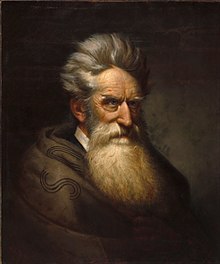
Portrait of Brown by Ole Peter Hansen Balling, 1872
On December 20, Brown led his own raid, in which he liberated 11 slaves, took captive two white men, and looted horses and wagons. The Governor of Missouri announced a reward of $3,000 (equivalent to $90,478 in 2021) for his capture. On January 20, 1859, he embarked on a lengthy journey to take the liberated slaves to Detroit and then on a ferry to Canada.
While passing through Chicago, Brown met with abolitionists Allan Pinkerton, John Jones, and Henry O. Wagoner who arranged and raised the fare for the passage to Detroit[118] and purchased supplies for Brown. Jones's wife and fellow abolitionist, Mary Jane Richardson Jones, provided new clothes for Brown and his men, including the garb Brown was hanged in six months later.[119][120]
On March 12, 1859, Brown met with Frederick Douglass and Detroit abolitionists George DeBaptiste, William Lambert, and others at William Webb's house in Detroit to discuss emancipation.[121] DeBaptiste proposed that conspirators blow up some of the South's largest churches. The suggestion was opposed by Brown, who felt humanity precluded such unnecessary bloodshed.[122]
Over the course of the next few months, he traveled again through Ohio, New York, Connecticut, and Massachusetts to drum up more support for the cause. On May 9, he delivered a lecture in Concord, Massachusetts, that Amos Bronson Alcott, Emerson, and Thoreau attended. Brown reconnoitered with the Secret Six.
In June he paid his last visit to his family in North Elba before departing for Harpers Ferry. He stayed one night en route in Hagerstown, Maryland, at the Washington House, on West Washington Street. On June 30, 1859, the hotel had at least 25 guests, including I. Smith and Sons, Oliver Smith and Owen Smith, and Jeremiah Anderson, all from New York. From papers found in the Kennedy Farmhouse after the raid, it is known that Brown wrote to Kagi that he would sign into a hotel as I. Smith and Sons.[123]

Leslie's illustration of U.S. Marines attacking John Brown's "Fort"
As he began recruiting supporters for an attack on slaveholders, Brown was joined by Harriet Tubman, "General Tubman", as he called her.[124] Her knowledge of support networks and resources in the border states of Pennsylvania, Maryland, and Delaware was invaluable to Brown and his planners. Some abolitionists, including Frederick Douglass and William Lloyd Garrison, opposed his tactics, but Brown dreamed of fighting to create a new state for freed slaves and made preparations for military action. After he began the first battle, he believed, slaves would rise up and carry out a rebellion across the South.[125]
Brown asked Tubman to gather former slaves then living in present-day southern Ontario who might be willing to join his fighting force, which she did.[126] He arrived in Harpers Ferry on July 3, 1859. A few days later, under the name Isaac Smith, he rented a farmhouse in nearby Maryland. He awaited the arrival of his recruits. They never materialized in the numbers he expected. In late August he met with Douglass in Chambersburg, Pennsylvania, where he revealed the Harpers Ferry plan. Douglass expressed severe reservations, rebuffing Brown's pleas to join the mission. Douglass had known of Brown's plans since early 1859 and had made a number of efforts to discourage blacks from enlisting.
In late September, the 950 pikes arrived from Charles Blair. Kagi's draft plan called for a brigade of 4,500 men, but Brown had only 21 men (16 white and 5 black: three free blacks, one freed slave, and a fugitive slave). They ranged in age from 21 to 49. Twelve had been with Brown in Kansas raids. On October 16, 1859, Brown (leaving three men behind as a rear guard) led 18 men in an attack on the Harpers Ferry Armory.
He had received 200 Beecher's Bibles – breechloading .52 (13.2 mm) caliber Sharps rifles – and pikes from northern abolitionist societies in preparation for the raid. The armory was a large complex of buildings that contained 100,000 muskets and rifles, which Brown planned to seize and use to arm local slaves. They would then head south, drawing off more and more slaves from plantations, and fighting only in self-defense. As Douglass and Brown's family testified, his strategy was essentially to deplete Virginia of its slaves, causing the institution to collapse in one county after another, until the movement spread into the South, wreaking havoc on the economic viability of the pro-slavery states.[citation needed]
The raid
Initially, the raid went well, and they met no resistance entering the town. John Brown's raiders cut the telegraph wires and easily captured the armory, which was being defended by a single watchman. They next rounded up hostages from nearby farms, including Colonel Lewis Washington, great-grandnephew of George Washington. They also spread the news to the local slaves that their liberation was at hand. Two of the hostages' slaves also died in the raid.[127]
Things started to go wrong when an eastbound Baltimore & Ohio train approached the town. After holding the train, Brown inexplicably allowed it to continue on its way. At the next station where the telegraph still worked, the conductor sent a telegram to B&O headquarters in Baltimore. The railroad sent telegrams to President Buchanan and Virginia Governor Henry A. Wise.[128]...
Name: John Brown
Achievements: Anti-slavery leader of Harper’s Ferry attack
Born: May 9, 1800; Torrington, Connecticut
Died: December 2, 1859; Charlestown, Virginia (Aged 59)
Field & Discipline: Politics; Abolitionist
Language: English
Father: Owen Mills
Mother, Ruth
Siblings: Two
Spouse: 1) Dianthe Lusk; 2) Mary Ann Day
Children: by Lusk: four sons and one daughter: John; Jason; Owen; Frederick; Ruth. by Day: three sons and three daughters: Watson; Salmon; Oliver; Anne; Sarah; Ellen.
Education: Frontier school, Hudson
Life & Times:
John Brown played a leading role in the anti- slavery movement. In 1837, at a meeting, he raised his right hand and said, "Here, before God, in the presence of these witnesses, I consecrate my life to the destruction of slavery". By this time the economic climate had changed, land values had fallen and farmer Brown was declared bankrupt. However, from his nineteen remaining sheep Brown built up a flock, then a successful wool business in partnership with Simon Perkins.
On his travels for the wool business, he went to East to Springfield, Massachusetts. While there, he arranged to meet Frederick Douglass, a slave who had bought his freedom and was now one of the most inspiring abolitionist speakers. Brown wanted Douglass' advice on how to help slaves free themselves. His plan was to have a small force in the Appalachian Mountains which could would form armed groups, of as few as five men, to which any fleeing slaves could attach themselves.
In this way, groups of escaping slaves could be given an armed guard and supplied with food and guides. In preparation for this, in 1849 Brown moved his family to the Adirondacks at North Elba, NY, to a black community set up by the philanthropist, Gerrit Smith, with whom he became friends.
In 1850 a law was passed making it mandatory for all citizens to help the Federal army to catch fugitive slaves. Two years later, Brown returned to live in Ohio, and for the next two years was busy with litigation relating to his failed wool business.
In 1854, five of his sons moved to Kansas Territory, where an Act had been passed allowing settlers in the territory to decide whether or not to legalize slavery. Most chose not to do so.
Brown’s son John wrote asking for weapons to fight a group of Southerners known as the Border Ruffians, who were roaming the state attempting to legalize slavery. In 1855 Brown travelled to Osawatomie in Kansas, taking with him a wagon, guns and ammunition. His sons had settled in a small place which they named Brownsville, in an area where the pro-slavery element was in power, thanks to rigged elections. Laws had been passed forbidding freedom of speech or the press on the subject of anti-slavery and anybody who helped a fugitive slave, or had books in their possession that dealt with slave rebellion, faced the death penalty.
The anti-slavery group among the settlers set up their own government, with their own constitution, in the town of Lawrence, but on May 22 1856, news came to Brownsville that, Border Ruffians were assembling to attack Lawrence. John Brown Junior was the captain of a militia company called the Liberty Guards, so he rounded up his men and his father accompanied them as they set out for Lawrence.
Brown led a raid on the pro-slavery settlement of Shermanville, at Pottawatomie Creek, where they killed five men, claiming this action was needed to inspire "a restraining fear" in the pro-slavers. He was now an outlaw leader of a band of guerrillas, including his two sons, his son-in-law, and a few other settlers. Two of his sons, John Junior and Jason, freed two slaves at gunpoint from a slaveholder, but were caught and imprisoned, narrowly escaping the death penalty.
Brown returned to East in 1856 after his sons were freed and the Border
Ruffians expelled from Kansas territory, convinced that peace in Kansas was only temporary. He began to store guns and supplies.
In 1857, Brown went to Boston and met Franklin Sanbourn, a graduate of Harvard and the secretary of the Massachusetts State Kansas Committee. He introduced Brown to influential Bostonians and offered to help him raise and arm a company of men for Kansas. A group of men, later called the "Secret Six" (among them Gerrit Smith) raised funds for Brown. While in Boston he also met the writers [met] Thoreau* and [met] Emerson* as well as Bronson Alcott, the educationalist and father of [met father of] Alcott*.
In October 1857 the free-state candidates won a majority in the Kansas elections. Brown now felt he was free to invade the South and began to assemble a fighting force in Kansas, while he worked on a new constitution for the United States, drawn up in the name of "the oppressed citizens of the country".
In 1858, after lobbying the country’s black leaders, Brown called a meeting in Chatham, Ontario to explain his plan to establish a mountain sanctuary for escaped slaves. He was elected Commander-in-Chief of the new order. By 1859, Brown had decided to attack the Federal armoury at Harper's Ferry as an announcement, to the blacks in the South, of his plans to free them. Harper's Ferry was to be a rallying call to the movement.
In June he said goodbye to his family, rented a farmhouse in Maryland across the Potomac from Harper’s Ferry, brought in arms, and collected volunteers. Disguised as a fisherman, he had a final meeting with Frederick Douglass and on October 16th 1859 took the armoury and about sixty hostages. During the attacks, to which only a handful of blacks arrived in support, two of Brown’s sons were killed and he surrendered to the US Marines, commanded by Colonel (later General) [captured by] Lee*.
On October 30th, at Concord, Thoreau gave a lecture called, "A Plea for Captain John Brown" describing him as a man of ideas and principles who dared to sacrifice his life for the liberation of the slaves. He delivered the same message at Worcester and Boston and used the trial to promote "the eternal justice and glory" of Brown's cause.
However, Brown was tried, convicted of murder, slave insurrection, and treason and, on 2nd December 1859, was hanged. His death inspired [inspired] Julia Ward Howe* to write [inspired] ‘Battle Hymn of the Republic*’
In consequence of the Harper Ferry attack, more than two hundred and fifty troops were sent to garrison the armory, among whom was [work related to] John Wilkes Booth* (who later assassinated Abraham Lincoln).
Extra Connections: President [work related to] Buchanan* thought his acts would encourage secession.
He received support from [supported by] Greeley*
Assessment: John Brown's action at Harper's Ferry precipitated the South's withdrawal from the Union and the subsequent Civil War.
Oneliner: John Brown, radical anti-slavery leader
Bibliography:
- Oates, Stephen B, To Purge This Land With Blood, A Biography of John Brown, University of Massachusetts Press, Amherst, 1970.
- Scott, John Anthony and Scott, Robert Alan, John Brown of Harper's Ferry, Facts on File, New York, 1988.