Alcott LM
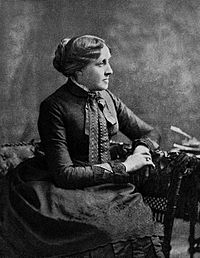
Achievements: Wrote “Little Women.”
Born: November 29, 1832; Germantown, Pennsylvania
Died: March, 6, 1888; Boston, Massachusetts (Aged 55)
Field & Discipline: Literature; Writer
Language: English
Father: Amos Bronson Alcott;
Abigail Elizabeth May
Siblings: 3 sisters: Anna; May; Elizabeth
Spouse: None
Children: None
Education: At home
Major Work: "Little Women"
Life & Times:
In 1840 Louisa and the family moved to Concord, Mass., so her father could be near [influenced by] Emerson*, the leader of the Transcendentalists in New England. Emerson [influenced by] Thoreau*, another transcendentalist and a writer-poet-philosopher, became great influences on the young Louisa. Thoreau helped educate her and let her accompany him on long walks. He and his brother ran the Concord Academy and Louisa received education there.
At 14, she developed a crush on Emerson, who was 43 (she had just read [influenced by] Bettina von Arnim*'s book "Goethe's Correspondence with a Child", a fictional account of letters between Johann Wolfgang von Goethe and a passionate 15-year-old). When the family returned to Boston in 1848, moving away from Emerson and Thoreau, Alcott was miserable.
She was determined to be an actress or a writer, and started a family newspaper, "The Olive Leaf". In 1851, one of her poems, "Sunlight", under the pseudonym Flora Fairfield, was published in Peterson's Magazine. Alcott's writings were receiving almost no attention, and a school she and her elder sister, Anna, started ran out of money, despite an ""Alcott Fund" set up by Emerson, and contributed to by, among others, [helped by] Longfellow*.
The family moved to a cottage in Walpole, New Hampshire.
In 1857 the family moved back to Concord and the town became Louisa's base for the rest of her life. In 1858, she accepted a position as governess. That year, her youngest sister, Elizabeth, died after a long debilitating illness. In 1859 Louisa heard [influenced by] John Brown* speak at Concord Town Hall. He was a friend of Franklin B. Sanbourn, one of her father's colleagues. Emerson and Thoreau were also in the audience. Brown told the gathering of the desperate conditions in Kansas and the violent deaths of several pro-slavery activists.
Brown's fervor roused Alcott, and the arrival of regiments near Concord excited her: After Brown's raid on Harper’s Ferry, she wrote she was "glad I have lived to see the anti-slavery movement and this heroic act." Brown was tried and hanged. Alcott's father and Emerson read at a memorial service. Thoreau helped one of the raiders, Francis Jackson Merriam, escape to Canada. Louisa joined a vigilance committee to protect Sanbourn.
By 1860, Alcott's writing was beginning to be recognized. The Atlantic Monthly, the best literary magazine in New England, published some poems and stories. Two years later, the death of Thoreau from tuberculosis threw Alcott into a deep depression.
In 1863, her: "Pauline's Passion and Punishment", was published, earning her $100. For five years she published the same kind of fiction, but always under the pseudonym, A.M. Barnard. Revenge was a constant theme. Her women were unethical and reckless and did not come close to the Victorian idea of femininity. Under the pseudonym Nurse Periwinkle, her "Hospital Sketches" were published, also in 1863, and were a great success.
Alcott's novel: "Moods," sold out in a week. It dealt with a young girl dominated by males, disappointed with herself, and living in a house full of family troubles, stemming from the conflict between mother and father. The young [criticized by] Henry James*, in a condescending review, ironically advised her to write about what she knew. "The Marble Woman," about an orphan girl retrieving her father's love, was less well received.
Discouraged, Alcott continued to write but accepted an offer from Mr. William Weld to accompany his invalid daughter, Anna, and Anna's brother George, to Europe. They sailed on the "China," Cunard’s first iron-screw steamer. During the tour of Europe, in London she met Italian author [met] Mazzini*, and [met] Dickens*.
In 1867, she became editor of a children's magazine, "Merry's Museum," and in the next year, at 36, wrote the first volume of "Little Women," having been asked for a story by the publisher. Four months later, the work was published with the subtitle "Meg, Jo, Beth and Amy. The Story of Their Lives - a Girls' Book." It was a runaway success. At the same time, Alcott wrote an advice column encouraging women to seek careers, to lead lives of self-denial, noting that: "liberty is a better husband than love to many of us."
The popularity of "Little Women" (even her father was pleased) meant Alcott could now provide well for the family, but it also meant she was confined to writing in the same vein. She resigned herself to producing what was wanted. In 1869 "Good Wives" was published.
While travelling in Europe between 1870 and 1871, accompanying her sister May, and May's friend, May Alice Bartlett, Alcott got news that her sister Anna's husband had died, and she rushed home. Shortly after, Alcott published "Little Men", written in the same style as "Little Women". By 1886, Alcott had fallen into ill health. She entered a convalescent home in 1887. In March, 1888, her father died. Louisa said: "shall I ever find time to die?" Two days later, she was dead.
Assessment: Alcott influenced the future of children's stories by the popularity of "Little Women," now regarded as a classic.
Oneliner: Louisa May Alcott, author of “Little Women”
Bibliography:
- Saxton, Martha;Louisa May, a Modern Biography of Louisa May Alcott; Andre Deutsch Ltd., London, 1978.