Cantor, Eddie
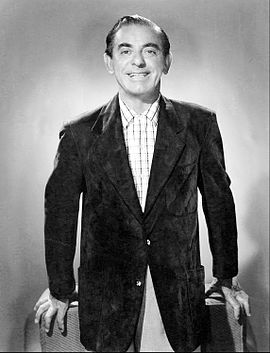
Eddie Cantor (January 31, 1892[1] – October 10, 1964), born Edward Israel Iskowitz,[2][3] was an American "illustrated song" performer, comedian, dancer, singer, actor, and songwriter.[4] Familiar to Broadway, radio, movie, and early television audiences, this "Apostle of Pep" was regarded almost as a family member by millions because his top-rated radio shows revealed intimate stories and amusing anecdotes about his wife Ida and five daughters.
Some of his hits include "Makin' Whoopee", "Ida", "Yes! We Have No Bananas", "If You Knew Susie", "Ma! He's Makin' Eyes at Me", "Baby", "Margie", and "How Ya Gonna Keep 'em Down on the Farm (After They've Seen Paree)?" He also wrote a few songs, including "Merrily We Roll Along", the Merrie Melodies Warner Bros. cartoon theme.
His eye-rolling song-and-dance routines eventually led to his nickname, "Banjo Eyes". In 1933, artist Frederick J. Garner caricatured Cantor with large round eyes resembling the drum-like pot of a banjo. Cantor's eyes became his trademark, often exaggerated in illustrations, and leading to his appearance on Broadway in the musical Banjo Eyes (1941).
His charity and humanitarian work was extensive, and he is credited with coining the phrase, and helping to develop the March of Dimes. He was awarded an honorary Academy Award in 1956 for distinguished service to the film industry.
Contents
- 1Biography
- 2Stage
- 3Radio and recordings
- 4Film and television
- 5Filmography
- 6Books and merchandising
- 7Tributes
- 8Further information
- 9See also
- 10References
- 11External links
Biography
Cantor was born in New York City, the son of Russian-Jewish immigrants, Meta and Mechel Itzkowitz. The precise date of his birth is unknown.[5] His mother died in childbirth one year after his birth, and his father died of pneumonia when Eddie was two, leaving him to be raised by his grandmother, Esther Kantrowitz.[6] As a child, he attended Surprise Lake Camp.[7] A misunderstanding when his grandmother signed him into school gave him her last name of Kantrowitz (shortened by the clerk to "Kanter"). Esther died on January 29, 1917, two days before Cantor signed a long-term contract with Florenz Ziegfeld, Jr., to appear in his Follies.

The Cantors in 1952
Cantor had adopted the first name "Eddie" when he met his future wife Ida Tobias in 1913, because she felt that "Izzy" was not the right name for an actor. Cantor and Ida were married in 1914. They had five daughters, Marjorie, Natalie, Edna, Marilyn, and Janet, who provided comic fodder for Cantor's longtime running gag, especially on radio, about his five unmarriageable daughters. Several radio historians, including Gerald Nachman (Raised on Radio), have said that this gag did not always sit well with the girls. Natalie's second husband was the actor Robert Clary and Janet married the actor Roberto Gari.[8]
Cantor was the second president of the Screen Actors Guild, serving from 1933 to 1935. He invented the title "The March of Dimes" for the donation campaigns of the National Foundation for Infantile Paralysis, which was organized to combat polio. It was a play on the The March of Time newsreels popular at the time. He began the first campaign on his radio show in January 1938, asking listeners to mail a dime to President Franklin D. Roosevelt. At that time, Roosevelt was the most notable American victim of polio. Other entertainers joined in the appeal via their own shows, and the White House mail room was deluged with 2,680,000 dimes—a large sum at the time.
Following the death of their daughter Marjorie at the age of 44, both Eddie and Ida's health declined rapidly. Ida died in August 1962 of "cardiac insufficiency",[6][9] and Eddie died on October 10, 1964, in Beverly Hills, California, after suffering his second heart attack at age 72.[6] He is interred in Hillside Memorial Park Cemetery in Culver City, California.
...