Jackson CT
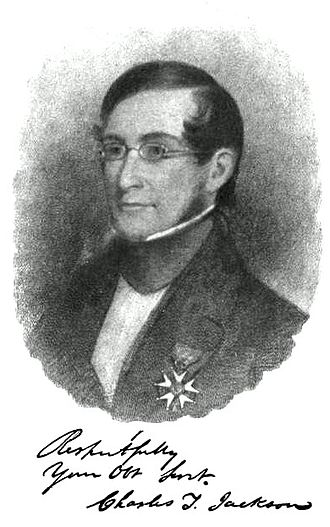
NAME: Jackson, Charles Thomas.
ACHIEVEMENTS: American geology pioneer
NICKNAME/ALIAS: None.
DATE/PLACE OF BIRTH: 21st June 1805, Plymouth, MA
DATE/PLACE OF DEATH/AGE AT DEATH: 28th August 1880, Somerville, MA. Aged 75.
DISCIPLINE: Anaesthesia/Geology
FIELD: Medicine/Geology
LANGUAGE: English.
PARENTS:
SIBLINGS:
SPOUSE:
CHILDREN:
EDUCATION: Harvard Medical School; Sorbonne, Paris, France.
MAJOR WORK: None.
LIFE AND TIMES: Jackson studied medicine at Harvard, but found other interests when, as a student, he visited Nova Scotia where he discovered glacial drifts and chiastolitic crystals in schist. After Harvard he went to Paris, France, where he studied at the Sorbonne and attended lectures not only in medicine, but geology and mineralogy.
While there he became friendly with the French geologist, Elie de Beaumont. Jackson then attended autopsies on cholera victims in Vienna, before returning to America. He sailed from Europe in 1832, on the same ship (the Sully) as the portrait painter, <crossed Atlantic with> Samuel Morse*. During the voyage the two discussed ideas for sending messages by electrical impulses.
Back in America, Jackson published a report on the Vienna autopsies, and set up his own medical practice in Boston, but due to his arrogant nature few patients stayed long on his books.
In 1834 he read about experiments by an army doctor, William Beaumont, on a patient whose stomach was left exposed after a gunshot wound. This was the first time that a sample of pure gastric juice had been obtained, and Jackson begged Beaumont to give him a sample, so as to conduct his own experiments.
He also wrote to Congress requesting the right to use the patient, describing himself as "an eminent chemist", and giving little credit to Beaumont. Congress refused. In 1836, Jackson abandoned his medical practice and opened an analytical laboratory in Boston, where he pioneered practical training in chemistry. He also undertook mineral assays for the US government. He also conducted the first American experiments in agricultural chemistry.
In 1837, Morse wrote to Jackson saying that he had perfected his idea for the electric telegraph and was trying to sell it. Jackson wrote back referring to the invention of "our" telegraph and expressing surprise that his own name was not included in the publicity.
He then embarked on a seven-year long campaign to claim credit for Morse's invention. He unsuccessfully petitioned Congress, the Patent office and the French Academy, claiming that he had told Morse of electromagnetism.
By this time Jackson was nationally famous for his laboratory. He was also unpopular with his staff and students who alleged that he claimed their work as his own. He was appointed state geologist of New Hampshire in 1839, and became a member of many international societies including the Boston Society of Natural History, the Geological Society of France, the Imperial Mineralogical Society of St Petersburg, the American Association of Geologists and Naturalists, and the American Academy of Arts and Sciences.
In March 1844, he agreed to take on a dentist, <taught> WTG Morton*, as a pupil in his laboratory, in preparation for the Harvard Medical school examination in chemistry. At some point he told Morton that he had used drops of sulphuric ether to treat toothache and suggested that Morton should try it on the tissue surrounding a tooth he was working on. Morton discovered that the ether numbed adjacent parts of the face and came up with the idea of administering ether during prolonged or difficult dental surgery.
In January 1845, another dentist, Horace Wells, inhaled nitrous oxide and anesthetized himself while a tooth was removed. He and Morton asked Jackson for a certificate of approval for this procedure, but were turned down.
Morton continued the experiments and finally succeeded in anesthetizing dental patients in 1846, but when he asked Jackson for a recommendation, he was again refused. In October 1846, Morton successfully anaesthetised a patient before the Boston medical fraternity. Jackson immediately demanded money and a share of the patent.
Jackson began another long campaign to be recognised as the discoverer of ether, forcing an enquiry at the Massachusetts hospital about who should receive the credit. Jackson wrote to Elie de Beaumont, and the Prussian geologist <corresponded with> Alexander von Humboldt*. asking them to present his case in Europe.
In 1846, Jackson became an official United States geologist, working on mineral deposits in the Michigan area. He was working on a survey around Lake Superior in 1848, when he heard the news that the hospital inquiry had decided in favour of Morton. He began to exhibit signs of delusion, claiming credit for some of William Harvey's 17th century work on the circulation of the blood. Jackson was fired from his post in 1849.
In 1850, the French Academy's Ether Commission decided that Jackson and Morton should share the Montyon Prize, but Jackson still continued to fight for greater recognition. In 1854, he visited <supported claim by> Long,* who had used ether as an anesthetic as early as 1842. In order to belittle Morton, Jackson backed Long's claim to be the discoverer of the process.
In 1861, he published "Manual of Etherisation", in which he again claimed to be the inventor of anaesthesia. In the manual, he also claimed to have invented gun cotton (invented by Christian Schonbein).
By this time Jackson had became an alcoholic and he was finally taken into custody after visiting Morton's grave in 1873. The inscription on the tombstone referred to Morton as the "Revealer of Anaesthetic Inhalation". At the sight, Jackson began to scream and writhe on the ground. He was taken to an asylum where he remained for the next seven years until he died in August 1880, at the age of seventy-five.
ASSESSMENT: A pioneer of American geology.
EXTRA CONNECTIONS: His geology work related to that of <work related to> Maclure*
<was assisted by> Silliman Jnr assisted him.
Jackson is particularly remembered for his involvement in a series of often bitter priority conflicts that left their marks on the scientific and social scenes of his day. They followed a standard pattern: a discovery would be announced by someone, Jackson would then claim prior discovery, and a controversy would ensue. Among them were conflicts over the discovery of guncotton (Christian Friedrich Schönbein), the telegraph (Samuel F. B. Morse), the digestive action of the stomach (William Beaumont), and the anesthetic effects of ether (William T. G. Morton).
It is widely believed and reported that in 1873, Jackson was afflicted with mental illness, either through a seizure,[2] or having a manic episode upon seeing Morton's tombstone,[3] and spent the remainder of his life in the McLean Asylum, Somerville, Massachusetts, where he died on August 28, 1880. In fact, Jackson suffered a left brain stroke that affected his language area, and while he never regained his speech, he was cooperative and did not exhibit "inappropriate behavior of insanity".[4] By unanimous vote of the McLean Asylum Trustees, Jackson was hosted as a guest at the Asylum at no charge for the entire duration of his stay in part because of his earlier helpful work in collaboration with McLean Superintendent Dr. Luther Bell showing beneficial effects of ether in McLean Asylum patients (Wolfe & Patterson, 2007, pages 18–19), as described in Jackson's Manual of Etherization (1861). He is buried at Mount Auburn Cemetery in Cambridge, Massachusetts, as is one of his rivals, Dr. William T. G. Morton.
ONELINER: CT Jackson, geologist and anesthetist
BIBLIOGRAPHY:
Macquitty, Betty, The Battle for Oblivion, George G Harrap & Co. Ltd., London, 1969.
Woodward, Grace Steel, The Man Who Conquered Pain, A biography of William Thomas Green Morton, Beacon Press, Boston, 1962.
Charles Thomas Jackson - Wikipedia