Schonbein, CF
Schonbein, Christian Friedrich.
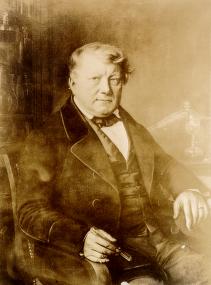
ACHIEVEMENT(S): German chemist who discovered and named the gas ozone and was the first to describe guncotton (nitrocellulose).
DATE/PLACE OF BIRTH: 18th October 1799, in Metzingen, Swabia, now Germany.
DATE/PLACE/AGE AT DEATH: 29th August 1868, in Sauersberg, near Baden-Baden, Germany. Aged 68.
DISCIPLINE: Chemist.
FIELD: Chemistry.
LANGUAGE: German.
EDUCATION: Elementary only.
MAJOR WORK: 'Beitrage zur Physikalischen Chemie', 1844.
LIFE AND TIMES:
Coming from a poor family, Schonbein was forced to leave school in 1814 and became an apprentice in a chemical and pharmaceutical factory in Boblingen. Over the next six years, he threw himself into his work and picked up a great deal of knowledge of both theoretical and applied chemistry. Having only had an elementary education, Schonbein privately studied Latin, French, English, philosophy and mathematics.
In April 1820, he left Boblingen to work at the J G Dingler chemical factory in Augsburg, where he helped Dingler by translating French publications for the new 'Dingler Polytechnisches Journal'. The job was short lived and Schonbein moved on to the chemical factory of J N Adam in Hemhofen, near Erlangen.
Over the next three years, he paid regular visits to the University of Erlangen, where he met the nature-philosopher Schelling*. He became a life-long friend of Schelling and formed a close relationship with the naturalist and nature-philosopherOken*.
In 1823, although unqualified, Schonbein was given a job teaching chemistry, physics and mineralogy in the FWA Froebel* Institute in Keilhau, a small town near Rudolfstadt in Thuringia. Three years later, he moved to England, where he taught for a year at a boy's school in Epsom, Surrey.
He moved on to Paris in 1827 and attended the lectures of Gay-Lussac*, JJ Ampere* and Thenard*. The following year, he joined the University of Basel, where he lectured on physics and chemistry and was given an honorary Ph.D. by the faculty of philosophy, before being promoted to Professor of Physics and Chemistry in 1835.
While conducting experiments at Basel on the decomposition of water, he detected, in the autumn of 1839, that the oxygen obtained in the process had a peculiar odor. Schonbein thought that it was like the smell produced when a large electrical machine was operating, a similarity that had been noticed by the Dutch chemist van Marum in 1785.
Schonbein established that the odour was of a gas produced at the anode. Over the next few years, he studied the properties of this gas, which he called ozone and believed to be a compound.
In 1844, he found that ozone was produced when phosphorous glowed in air, that it bleached litmus, freed iodine from potassium iodide, and changed potassium ferrocyanide into ferricyanide.
The electrical, chemical and physiological reactions of ozone closely resembled those of chlorine and bromine, and Schonbein concluded that it also formed a salt and its chemical affinity should place it directly after chlorine.
The following year, Marignac and Auguste Arthur de la Rive independently proved that an electric spark within pure, dry oxygen created ozone, and they concluded that it was oxygen in a particular state of chemical affinity.
Schonbein was persistent in his belief that ozone, as well as chlorine, was a compound, until 1851, when he declared, correctly, that, in all probability, ozone was an allotropic form of oxygen.
During the early 1840s, Schonbein was experimenting with nitric and sulphuric acids as well and, in 1845, he found an improved method of making explosives. In 1838, the chemist T.-J. Pelouze, assisted from 1840 by Sobrero* (who discovered nitroglycerine in 1847), had found that cotton could be made highly explosive by dipping it in concentrated nitric acid.
Schonbein’s method involved dipping cotton-wool in a mixture of fuming nitric and sulphuric acids, then washing and drying the product to remove the excess acid. He called the result ‘gun cotton’ (now known as nitrocellulose) and announced its discovery at a scientific meeting at Basel in March 1846.
To begin with, the nitrocellulose was unpredictable and dangerous, but, by the 1860’s, it had been refined enough to be used as an explosive. During his investigations, Schonbein also came across collodion, a solution of guncotton and ether, which found early application in medicine and photography and is now used in lacquers and celluloid plastics, first discovered by the American inventor Hyatt* in 1870.
Schonbein also completed research on the passivity of iron, catalysis and the properties of hydrogen peroxide and produced more 360 scientific papers in his lifetime.
ASSESSMENT: An extremely talented and almost entirely self-educated chemist.
EXTRA CONNECTIONS: His work related to that of the explosives maker, John Hall*.
His ozone work related to Fabry* in 1896.
His work was used by Nobel*
ONELINER: Christian Schonbein, discoverer of ozone
BIBLIOGRAPHY:
Encyclopaedia Britannica
DSB.
PARENTS: Unknown.
SIBLINGS: Unknown.
SPOUSE: Unknown.
CHILDREN: Unknown.