Courbet
Jean Désiré Gustave Courbet (French: [ɡystav kuʁbɛ]; 10 June 1819 – 31 December 1877) was a French painter who led the Realist movement in 19th-century French painting. Committed to painting only what he could see, he rejected academic convention and the Romanticism of the previous generation of visual artists. His independence set an example that was important to later artists, such as the Impressionists and the Cubists. Courbet occupies an important place in 19th-century French painting as an innovator and as an artist willing to make bold social statements through his work.
Courbet's paintings of the late 1840s and early 1850s brought him his first recognition. They challenged convention by depicting unidealized peasants and workers, often on a grand scale traditionally reserved for paintings of religious or historical subjects. Courbet's subsequent paintings were mostly of a less overtly political character: landscapes, seascapes, hunting scenes, nudes and still lifes. He was imprisoned for six months in 1871 for his involvement with the Paris Commune, and lived in exile in Switzerland from 1873 until his death.
I am fifty years old and I have always lived in freedom; let me end my life free; when I am dead let this be said of me: 'He belonged to no school, to no church, to no institution, to no academy, least of all to any régime except the régime of liberty.' [1]
Contents
- 3 Notoriety
- 4 Courbet and the Paris Commune
- 5 Exile and death
- 6 Legacy
- 7 Courbet and Cubism
- 8 Gallery
- 9 See also
- 10 Notes and references
- 11 Further reading
- 12 External links
Biography
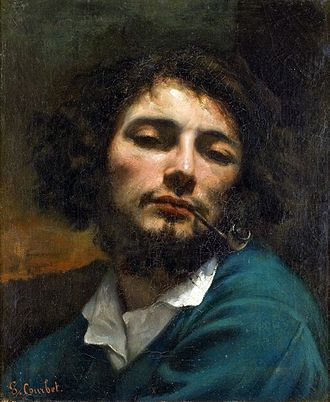
L'homme à la pipe (Self-portrait, Man with a pipe), 1848–49, Musée Fabre, Montpellier
Courbet was born in 1819 to Régis and Sylvie Oudot Courbet in Ornans (department of Doubs). Being a prosperous farming family, anti-monarchical feelings prevailed in the household. (His maternal grandfather fought in the French Revolution.) Courbet's sisters, Zoé, Zélie and Juliette, were his first models for drawing and painting. After moving to Paris he often returned home to Ornans to hunt, fish and find inspiration.[3]
He went to Paris in 1839 and worked at the studio of Steuben and Hesse. An independent spirit, he soon left, preferring to develop his own style by studying the paintings of Spanish, Flemish and French masters in the Louvre, and painting copies of their work.
His first works were an Odalisque inspired by the writing of Victor Hugo and a Lélia illustrating George Sand, but he soon abandoned literary influences, choosing instead to base his paintings on observed reality. Among his paintings of the early 1840s are several self-portraits, Romantic in conception, in which the artist portrayed himself in various roles. These include Self-Portrait with Black Dog (c. 1842–44, accepted for exhibition at the 1844 Paris Salon), the theatrical Self-Portrait which is also known as Desperate Man (c. 1843–45), Lovers in the Countryside (1844, Musée des Beaux-Arts, Lyon), The Sculptor (1845), The Wounded Man (1844–54, Musée d'Orsay, Paris), The Cellist, Self-Portrait (1847, Nationalmuseum, Stockholm, shown at the 1848 Salon), and Man with a Pipe (1848–49, Musée Fabre, Montpellier).[4]
Trips to the Netherlands and Belgium in 1846–47 strengthened Courbet's belief that painters should portray the life around them, as Rembrandt, Hals and other Dutch masters had. By 1848, he had gained supporters among the younger critics, the Neo-romantics and Realists, notably Champfleury.[5]
Courbet achieved his first Salon success in 1849 with his painting After Dinner at Ornans. The work, reminiscent of Chardin and Le Nain, earned Courbet a gold medal and was purchased by the state.[6] The gold medal meant that his works would no longer require jury approval for exhibition at the Salon[7]—an exemption Courbet enjoyed until 1857 (when the rule changed).[8]
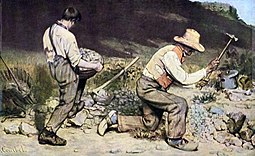
In 1849-50, Courbet painted Stone-Breakers (destroyed in the Allied Bombing of Dresden in 1945), which Proudhon admired as an icon of peasant life; it has been called "the first of his great works".[9] The painting was inspired by a scene Courbet witnessed on the roadside. He later explained to Champfleury and the writer Francis Wey: "It is not often that one encounters so complete an expression of poverty and so, right then and there I got the idea for a painting. I told them to come to my studio the next morning."[9]...
Courbet and the Paris Commune

A satirical sketch of Gustave Courbet taking down a "Rambuteau column" (a urinal), caricature published by a popular Commune newspaper, the Père Duchêne illustré

Commune officials pose with the wreckage of the Vendôme column, pulled down based on a suggestion of Courbet. After the fall of the Commune, he was ordered to pay the cost of putting the column back up.
On 4 September 1870, during the Franco-Prussian War, Courbet made a proposal that later came back to haunt him. He wrote a letter to the Government of National Defense, proposing that the column in the Place Vendôme, erected by Napoleon I to honour the victories of the French Army, be taken down. He wrote:
In as much as the Vendôme Column is a monument devoid of all artistic value, tending to perpetuate by its expression the ideas of war and conquest of the past imperial dynasty, which are reproved by a republican nation's sentiment, citizen Courbet expresses the wish that the National Defense government will authorize him to disassemble this column."[34]
Courbet proposed that the Column be moved to a more appropriate place, such as the Hotel des Invalides, a military hospital. He also wrote an open letter addressed to the German Army and to German artists, proposing that German and French cannons should be melted down and crowned with a liberty cap, and made into a new monument on Place Vendôme, dedicated to the federation of the German and French people. The Government of National Defense did nothing about his suggestion to tear down the column, but it was not forgotten.[35]
On 18 March, in the aftermath of the French defeat in the Franco-Prussian War, a revolutionary government called the Paris Commune briefly took power in the city. Courbet played an active part and organized a Federation of Artists, which held its first meeting on 5 April in the Grand Amphitheater of the School of Medicine. Some three hundred to four hundred painters, sculptors, architects, and decorators attended. There were some famous names on the list of members, including André Gill, Honoré Daumier, Jean-Baptiste-Camille Corot, Eugène Pottier, Jules Dalou, and Édouard Manet. Manet was not in Paris during the Commune and did not attend, and Corot, who was seventy-five years old, stayed in a country house and his studio during the Commune, not taking part in the political events.
Courbet chaired the meeting and proposed that the Louvre and the Museum of the Luxembourg Palace, the two major art museums of Paris, closed during the uprising, be reopened as soon as possible and that the traditional annual exhibit called the Salon be held as in years past, but with radical differences. He proposed that the Salon should be free of any government interference or rewards to preferred artists; no medals or government commissions would be given. Furthermore, he called for the abolition of the most famous state institutions of French art; the École des Beaux-Arts, the School of Rome, the School of Athens, and the Fine Arts section of the Institute of France.[36]
...
After the final suppression of the Commune by the French army on 28 May, Courbet went into hiding in the apartments of different friends. He was arrested on 7 June. At his trial before a military tribunal on 14 August, Courbet argued that he had only joined the Commune to pacify it and that he had wanted to move the Vendôme Column, not destroy it. He said he had only belonged to the Commune for a short period, and rarely attended its meetings. He was convicted, but given a lighter sentence than other Commune leaders; six months in prison and a fine of five hundred Francs. Serving part of his sentence in the prison of Saint-Pelagie in Paris, he was allowed an easel and paints, but he could not have models pose for him. He did a famous series of still-life paintings of flowers and fruit.[43]
Exile and death
Courbet completed his prison sentence on 2 March 1872, but his problems caused by the destruction of the Vendôme Column were still not over. In 1873, the newly elected president of the Republic, Patrice Mac-Mahon, announced plans to rebuild the column, with the cost to be paid by Courbet. Unable to pay, Courbet went into a self-imposed exile in Switzerland to avoid bankruptcy. In the following years, he participated in Swiss regional and national exhibitions. Surveilled by the Swiss intelligence service, he enjoyed in the small Swiss art world the reputation as head of the "realist school" and inspired younger artists such as Auguste Baud-Bovy and Ferdinand Hodler.[44]
Important works from this period include several paintings of trout, "hooked and bleeding from the gills",[45] that have been interpreted as allegorical self-portraits of the exiled artist.[45] In his final years, Courbet painted landscapes, including several scenes of water mysteriously emerging from the depths of the earth in the Jura Mountains of the France–Switzerland border.[46] Courbet also worked on sculpture during his exile. Previously, in the early 1860s, he had produced a few sculptures, one of which – the Fisherman of Chavots (1862) – he donated to Ornans for a public fountain, but it was removed after Courbet's arrest.[47]
In May 1877, the state set the final cost of reconstructing the Vendôme Column at 323,000 francs for Courbet to repay in annual installments of 10,000 francs for the next 33 years.[48] On 31 December 1877, a day before the first installment was due,[49] Courbet died, aged 58, in La Tour-de-Peilz, Switzerland, of a liver disease aggravated by heavy drinking....
Legacy

Claude Monet, Le Déjeuner sur l'herbe (right section), with Gustave Courbet, 1865–66, Musée d'Orsay, Paris
Courbet was admired by many younger artists. Claude Monet included a portrait of Courbet in his own version of *Le Déjeuner sur l'herbe* from 1865–1866 (Musée d'Orsay, Paris). Courbet's particular kind of realism influenced many artists to follow, notably among them the German painters of the Leibl circle,[50] James McNeill Whistler, and Paul Cézanne. Courbet's influence can also be seen in the work of Edward Hopper, whose Bridge in Paris (1906) and Approaching a City (1946) have been described as Freudian echoes of Courbet's The Source of the Loue and The Origin of the World.[51] His pupils included Henri Fantin-Latour, Hector Hanoteau and Olaf Isaachsen.
Courbet once wrote this in a letter:
I have always lived in freedom; let me end my life free; when I am dead let this be said of me: 'He belonged to no school, to no church, to no institution, to no academy, least of all to any régime except the régime of liberty.'[52]
Courbet and Cubism

Young Ladies Beside the Seine (Summer), 1856, Petit Palais, Paris: one of Courbet's best-known paintings, exemplifying his "uncompromising emphasis on density and weight"[53]
Two 19th-century artists prepared the way for the emergence of Cubism in the 20th century: Courbet and Cézanne.[54] Cézanne's contributions are well-known.[55] Courbet's importance was announced by Guillaume Apollinaire, poet-spokesperson for the Cubists. Writing in Les Peintres Cubistes, Méditations Esthétiques (1913) he declared, "Courbet is the father of the new painters."[56] Jean Metzinger and Albert Gleizes often portrayed Courbet as the father of all modern art.[56]
...
Nazi-looted art
During the Third Reich (1933-1945) Jewish art collectors throughout Europe had their property seized as part of the Holocaust. Many artworks created by Courbet were looted by Nazis and their agents during this period and have only recently been reclaimed by the families of the previous owners.
Courbet's La Falaise d'Etretat was owned by the Jewish collector Marc Wolfson and his wife Erna, who both were murdered in Auschwitz. After disappearing during the Nazi Occupation of France, it reappeared years later at the musée d'Orsay[62]...The French Database of Art Objects at the Jeu de Paume (Cultural Plunder by the Einsatzstab Reichsleiter Rosenberg) has 41 entries for Courbet.