Maclure, William
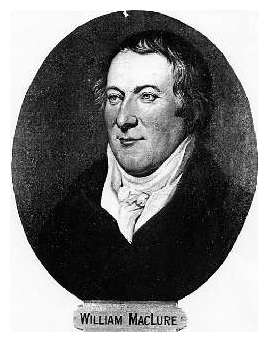
Achivements: First studies of U.S. geology
Born: October 27, 1763; Ayr, Scotland
Died: March 23, 1840; San Angel, Mexico
Field & Discipline: Science; Geology
Language: English
Father: David Maclure
Mother: Ann
Siblings: Unknown
Spouse: Unknown
Children: Unknown
Education: Private tutors
Major Work:
Observations on the Geology of the United States (1817)
Life & Times:
In 1782 at the age of 19 Maclure took his first trip to the USA where he concluded 'mercantile agreements," returning to London as a partner in the American firm of Miller Hart and Co.
For the next fifteen years he traveled widely in America and Europe conducting affairs for the firm (which traded in hardware, utensils and perhaps textiles) and making his fortune. On visits to Scandinavia and Russia he became interested and took lessons in geology.
So impressed by the American Revolution (and horrified at the French one) that in 1796 he returned to USA to establish residence in Philadelphia and then became a US citizen. In 1797, having made his fortune, he wound up his business interests and retired to Philadelphia.
He was a [a pal of] Jefferson*, who had known him as a merchant in Richmond in earlier days became a firm friend and helper.
In 1799 Maclure left for Europe on a nine year tour to study geology and natural history. Two years later his friend Jefferson was elected president and asked him to take the job of US representative in Paris (1803-4) for the settlement of the claims of US citizens in respect of damages incurred at sea in the earlier, undeclared sea war between the US and France.
In 1805 he set off on a tour through central France and Switzerland looking at volcanic rocks and their nature, trying to form his own ideas about the rock-origin theories of [was a follower of] Werner*
While collecting rock specimens in Switzerland, in October 1805 at Yverdon Maclure met the Swiss educational reformer [a fan of] Pestalozzi* and was so impressed by his work he offered one of his teachers, [gave financial support to] Joseph Neef*, the money to open a Pestaozzian school in USA (which Neef did, in 1809). At some point in this European trip Maclure also met Volney, the French geologist and author of an 1803 French text on the geology of the USA.
In 1808 he bought a Paris house to use as his operational base in Europe. After a brief visit to Spain he returned to USA and began geological trips (Maine, New Hampshire, Vermont, Massachussetts, Rhode Island, Connecticut, New York, New Jersey, Pennsylvania, Delaware, Maryland and Georgia; he crossed the Alleghenies no fewer than fifty times!) to collect material for a book on US geology. In 1809 he left again for a trip through Russia, Switzerland and Poland, during which he also met the famous Swedish chemist [met] Berzelius*.
From then on he was commuting regularly across the Atlantic, gathering more information and widening his circle of naturalist/geologist acquaintances such as Charles Leseuer and [a pal of] Benjamin Silliman*. In 1815, after meeting Lesueur in France, he persuaded him to return to USA and they spent the winter of 1815 on an expedition examining the geology and natural history of the Caribbean as well as making more traverses of the Alleghenies.
From December 1817 to April 1818 Maclure was on an expedition with Lesueur and others to Georgia and Spanish Florida.
May 1817 he published an expanded and revised edition of his earlier notes, titled: Observations on the Geology of the United States. In the text and map Maclure divided the country into areas of ‘primitive’ rocks (the area from New England southwest to Alabama), ‘transitional’ rocks (in the folds of the Appalachians), ‘floess and secondary’ rocks and ‘alluvial’ rocks (in the Missippi valley and coastal plain from Cape Cod south to the mouth of the Mississippi. Each type of rock was color-coded on the map.
In 1819, Maclure left to live for four years in Spain, near Alicante, where he hoped to establish an agricultural school for the common people, combining labor and instruction, a little on Pestalozzian lines. But in 1824 the Spanish government was overthrown by a revolution, Maclure’s land was confiscated, and he returned to the U.S.
In 1825 he met British philanthropist [collaborated with and financially supported) Robert Owen* (and his son [knew] David Dale Owen*) in Philadelphia and invested $82,000 in Owen’s project to set up an utopian community at New Harmony, Indiana. In January, 1826, the keelboat Philanthropist (afterwards known as "The Boatload of Knowledge") took the New Harmony founding members down the Ohio River to Mount Vernon, Indiana. From there the travelers made their way overland to New Harmony.
During the next year Maclure became involved in an experiment to test Pestalozzian education on the New Harmony community, and to this end persuaded Neef to join him. He also gave New Harmony a library, as well as instruments and collections, so as to make it a center of learning in the West. However, after only little more than a year Maclure had left the commune thanks to differences between him and Owen over money, and the general rancorous atmosphere of the place.
By 1827 he was in Mexico, once again on geological expeditions. He then moved there permanently, tried and failed to set up an education project with the aim of teaching native Indians, and remained in the country until his death.
Extra Connections: He discovered the mid-West deposits which would one day provide the germanium for the [work related to] Shockley* transistor.
His work related to that of [work related to that of] CT Jackson*
Assessment:
Oneliner: William Maclure, educationalist and philanthropist and first US geologist.
Bibliography:
- Dictionary of American Biography.
- Dictionary of Scientific Biography.
- Encyclopedia Britannica.
- Merrill, G.P., The first hundred years of American geology. 1924.
- S G Morton, S.G., A memoir of William Maclure. 1844.
- J S Doskey, J. S. (ed), 1988 The European Journals of William Maclure. 1988.
- Maclure, W., Observations on the Geology of the United States. American Philosophical Soc Transactions vol. 6 pp. 411-428 1809.
- Armytage,W.H.G., "William Maclure, 1763-1840: A British Interpretation," (Indiana Magazine of History 47 (1951) 1-20).
- Real Utopia
Wikipedia (with timeline)