Watt, James
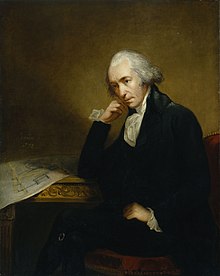
Achievements: Steam engine
Born: January 19, 1736; Greenock, Strathclyde, Scotland
Died: August 25, 1819; Heathfield House, near Birmingham (Aged 83)
Field & Discipline: Engineering; Instrument Maker
Education: Greenock Grammar School
Major Work:
Invention of the improved steam engine and copier
Life & Times:
In 1754, Watt went to Glasgow where a member of his mother’s family helped him find temporary work as an optician’s assistant, but he soon found that no training was available in Glasgow and left for London. There, John Morgan, who traded in brasswork, took him on as a fee paying, unpaid trainee and he stayed for a year, learning the trade, before going back home, ill and exhausted.
Back in Glasgow, a collection of astronomical instruments arrived from Jamaica in 1756 and Watt was asked to carefully clean off the salt that had contaminated them while at sea. Many Glasgow scientists came to examine the instruments while the work was being done and were impressed with the standard of Watt’s work. Two people he met and befriended in this way were the Professor of Chemistry at Glasgow University, [befriended by] Black* and his student, John Robison.
In 1757, [helped by] Adam Smith arranged for Watt to be allowed to set up an instrument making shop within the University precincts. He was given the title ‘Mathematical Instrument Maker to the University.’ While he was making instruments for Professor Black, he learned about Black’s his discovery of latent heat. Watt’s most famous invention happened during the time he was working at the university. In 1763, Professor John Anderson asked him to repair a model of the [repaired pump by] Newcomen* pump and, while he was working on it, he found that the pump performed erratically and had heavy fuel consumption.
Because of this, Watt started to examine the properties of steam, boilers and pistons. Thanks to what he had learned from Black about latent heat, he was able to design a system to keep the pump cylinder hot, while sending the spent steam to evaporate in a separate condenser kept under chilled water. In this way the main cylinder was kept hot enough not to cause premature condensation on each cycle, when new steam entered. With help from [financial help from] Roebuck*, a friend of Joseph Black, Watt spent a great deal of time experimenting with the objective of building a full size engine. Finally, in 1767, the work was sufficiently advanced and Watt went south to England to apply for a patent. On the way back, he stopped off in Birmingham and met [partner of] Boulton*, an industrialist friend of Roebuck. He also met [met] Erasmus Darwin* and told him, in confidence, about his invention.
According to Watt’s 1769 patent, the manufacture of the new pump was to be in partnership between Roebuck, but, because he couldn’t see himself making much money with the pump straight away, Watt went back to the business of civil engineering and canal surveying. Between 1767 and 1774, he carried out surveys for the Caledonian Canal that runs from Inverness to Fort William.
Roebuck’s business collapsed in 1774, so Watt went into partnership with Boulton, with a plan to build a new steam engine at Boulton’s Soho Foundry in Birmingham. By 1776, they had produced a functioning machine, but it took another five years’ development before it was reliable and economical. When the new engine was nearly ready, the company received two orders, one from the ironworks of [client was] John Wilkinson*. His company had become involved in the development of the engine, when other ironworks had been incapable of boring out the engine cylinder with the required precision. Both engines produced for the first two orders were successful and other orders followed. Demand was high, mainly because of the fuel efficiency of Watt’s engine, which used only a quarter of the fuel of the old Newcomen engine on which he had improved.
Watt continued to carry out various upgrades until the 1790’s. One of these was to make the engine double acting, so that it operated on the return of the piston as well as on the forward motion. Watt designed an automatic centrifugal governor, which reduced the supply of steam if the engine was going too fast, and increased it when the engine slowed. Watt also designed an indicator able to measure the steam pressure, or the level of vacuum within the cylinder.
Watt’s employee, [employed] Murdock* developed [patented] ‘sun-and-planet’ gearing* that enabled rotary motion. This development played an important part in triggering the Industrial Revolution. Between 1775 and 1800, out of a total of 325 engines built by the Soho works, around 114 were for textile mills, of which 92 were used in cotton mills.
In the year Watt had patented his improved engine, [engine used by] Arkwright* designed a machine for spinning with rollers. The two inventions brought the development of a whole new industry, and the first steam-powered cotton mill began production in Nottingham in 1785, the same year that another rotative engine was set up at [engine used by] Whitbread’s* brewery in Chiswell Street, London.
Boulton & Watt began to produce steam engines for ships, and between 1794 and 1805, the American engineer [engine used by] Fulton* ordered engines for the steamboats he was constructing.
In addition to the steam engine, Watt invented a process for copying letters, which he used to help with the administration of his business. Later this was further developed by the American Cyrus P. Dalkin, and was in use until the development of the photocopier. One of the first orders for Watt’s copying machines, patented in 1780, came from Adam Smith.
In 1783, Watt determined the use of horsepower as a system of measuring power, to provide a systematic means of pricing machinery. He calculated that 1 horsepower was developed when a 33,000 pound weight was raised by 1 foot, just under a third of a metre, per minute, and this value was accepted until very recently.
Watt began to take a greater interest in chemistry when, through membership of the Lunar Society of Birmingham, he met [met] Priestley*. Other members and acquaintances included Erasmus Darwin, [met] Wedgwood* and the eminent chemists, [met] Lavoisier* and [met] Berthollet*.
In 1783, Watt hit on the idea that water was a compound rather than an element, so he submitted a paper to the Royal Society FRS. This caused a debate to determine who should receive the credit for discovering the composition of water, Watt, [row with] Cavendish* or Lavoisier. The outcome was that Watt was accepted as having first realised that water was a compound, but that Lavoisier had correctly determined its make-up.
During the 1780s, as well as engineering projects, Watt worked on experiments for bleaching textiles using chlorine, as did Berthollet in France.
In 1784 Watt was elected to the Royal Society of Edinburgh and, the next year, became a Fellow of the [fellow of] Royal Society* in London. He spent most of the 1790’s in legal battles over the infringement of his patent on the separate condenser. He spent the last nineteen years of his life living and working in a house he built in Heathfield, near Birmingham, England.
Extra Connections:
His work related to that of [work related to] Trevithick*, [work related to] Smeaton*, [work related to] Savery*, [work related to] Rennie*, [work related to] Jefferson*, [work related to] Smithson* and [work related to] Neilson*.
The [used lamp by] Argand* lamp lit Watt’s factory.
Friend of physician [a pal of] Richard Bright*, geologist [a pal of] Hutton*
The engineer [apprentice was] Clegg* was his apprentice
Involved in the development of [worked on] gaslight*
Met US chemist [met] Silliman Snr*
[biography by] Smiles* wrote his biography
Engineer [employed] George Stephenson* serviced one of his engines.
Made the engines for the [engine-fitted] SS Great Eastern*
A descendant was [descendant was] Watson-Watt*
His engine was used on the first [engine used on] steam locomotive*
Assessment: The improved steam engine of James Watt is the cornerstone on which the modern technological world is built. His name was given to the watt, the unit of electrical power.
Oneliner: James Watt, who perfected the steam engine
10/15 update:
In 1754, Watt went to Glasgow where a member of his mother’s family helped him find temporary work as an optician’s assistant, but he soon found that no training was available in Glasgow and left for London. There, John Morgan, who traded in brasswork, took him on as a fee paying, unpaid trainee and he stayed for a year, learning the trade, before going back home, ill and exhausted.
Back in Glasgow, a collection of astronomical instruments arrived from Jamaica in 1756 and Watt was asked to carefully clean off the salt that had contaminated them while at sea.
Many Glasgow scientists came to examine the instruments while the work was being done and were impressed with the standard of Watt’s work. Two people he met and befriended in this way were the Professor of Chemistry at Glasgow University, Black* and his student, John Robison.
In 1757, Adam Smith* arranged for Watt to be allowed to set up an instrument making shop within the University precincts. He was given the title ‘Mathematical Instrument Maker to the University.’
While he was making instruments for Professor Black, he learned about Black’s his discovery of latent heat. Watt’s most famous invention happened during the time he was working at the university. In 1763, Professor John Anderson asked him to repair a model of the Newcomen* pump and, while he was working on it, he found that the pump performed erratically and had heavy fuel consumption.
Because of this, Watt started to examine the properties of steam, boilers and pistons. Thanks to what he had learned from Black about latent heat, he was able to design a system to keep the pump cylinder hot, while sending the spent steam to evaporate in a separate condenser kept under chilled water. In this way the main cylinder was kept hot enough not to cause premature condensation on each cycle, when new steam entered.
With help from Roebuck*, a friend of Joseph Black, Watt spent a great deal of time experimenting with the objective of building a full size engine. Finally, in 1767, the work was sufficiently advanced and Watt went south to England to apply for a patent.
On the way back, he stopped off in Birmingham and met Boulton*, an industrialist friend of Roebuck. He also met Erasmus Darwin* and told him, in confidence, about his invention.
According to Watt’s 1769 patent, the manufacture of the new pump was to be in partnership between Roebuck, but, because he couldn’t see himself making much money with the pump straight away, Watt went back to the business of civil engineering and canal surveying. Between 1767 and 1774, he carried out surveys for the Caledonian Canal that runs from Inverness to Fort William.
Roebuck’s business collapsed in 1774, so Watt went into partnership with Boulton, with a plan to build a new steam engine at Boulton’s Soho Foundry in Birmingham. By 1776, they had produced a functioning machine, but it took another five years’ development before it was reliable and economical.
When the new engine was nearly ready, the company received two orders, one from the ironworks of John Wilkinson*. His company had become involved in the development of the engine, when other ironworks had been incapable of boring out the engine cylinder with the required precision.
Both engines produced for the first two orders were successful and other orders followed. Demand was high, mainly because of the fuel efficiency of Watt’s engine, which used only a quarter of the fuel of the old Newcomen engine on which he had improved.
Watt continued to carry out various upgrades until the 1790’s. One of these was to make the engine double acting, so that it operated on the return of the piston as well as on the forward motion. Watt designed an automatic centrifugal governor, which reduced the supply of steam if the engine was going too fast, and increased it when the engine slowed. Watt also designed an indicator able to measure the steam pressure, or the level of vacuum within the cylinder.
Watt’s employee, Murdock* developed ‘sun-and-planet’ gearing* that enabled rotary motion. This development played an important part in triggering the industrial revolution. Between 1775 and 1800, out of a total of 325 engines built by the Soho works, around 114 were for textile mills, of which 92 were used in cotton mills.
In the year Watt had patented his improved engine, Arkwright* designed a machine for spinning with rollers. The two inventions brought the development of a whole new industry, and the first steam-powered cotton mill began production in Nottingham in 1785, the same year that another rotative engine was set up at Whitbread’s* brewery in Chiswell Street, London.
Boulton & Watt began to produce steam engines for ships, and between 1794 and 1805, the American engineer Fulton* ordered engines for the steamboats he was constructing.
In addition to the steam engine, Watt invented a process for copying letters, which he used to help with the administration of his business. Later this was further developed by the American Dalkin*, and was in use until the development of the photocopier. One of the first orders for Watt’s copying machines, patented in 1780, came from Adam Smith.
In 1783, Watt determined the use of horsepower as a system of measuring power, to provide a systematic means of pricing machinery. He calculated that 1 horsepower was developed when a 33,000 pound weight was raised by 1 foot, just under a third of a metre, per minute, and this value was accepted until very recently.
Watt began to take a greater interest in chemistry when, through membership of the Lunar Society of Birmingham, he met Priestley*. Other members and acquaintances included Erasmus Darwin, Wedgwood* and the eminent chemists, Lavoisier* and Berthollet*.
In 1783, Watt hit on the idea that water was a compound rather than an element, so he submitted a paper to the Royal Society. This caused a debate to determine who should receive the credit for discovering the composition of water, Watt, Cavendish* or Lavoisier. The outcome was that Watt was accepted as having first realised that water was a compound, but that Lavoisier had correctly determined its make-up.
During the 1780s, as well as engineering projects, Watt worked on experiments for bleaching textiles using chlorine, as did Berthollet in France.
In 1784 Watt was elected to the Royal Society of Edinburgh and, the next year, became a Fellow of the Royal Society* in London. He spent most of the 1790’s in legal battles over the infringement of his patent on the separate condenser. He spent the last nineteen years of his life living and working in a house he built in Heathfield, near Birmingham, England.
ASSESSMENT: The improved steam engine of James Watt is the cornerstone on which the modern technological world is built. His name was given to the watt, the unit of electrical power.
Bibliography:
- Dickinson, H. W., James Watt, Craftsman and Engineer, 1936.
- Hart, Ivor B., James Watt and the History of Steam Power, Henry Schuman, New York, 1949.
Multimedia:
Video: Connections 3 ep 1: "Feedback"
Father: James Watt
Mother: Agnes Muirheid (alternative spelling Muirhead)
Siblings: John
Spouse: 1) Margaret Miller (a cousin, married 1764, d.1773); 2) Ann McGregor (married 1773)
Children: James; Gregory