Edison, Thomas
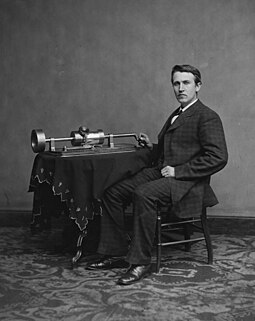
Name: Thomas Alva Edison
Nickname/Alias: “The Wizard of Menlo Park”
Achievements: Light bulb, phonograph, carbon transmitter.
Born: February 11, 1847; Milan, Ohio
Died: October 18, 1931; West Orange, New Jersey (Aged 84)
Field & Discipline: Science; Physics; Invention; Electricity
Language: English
Father: Samuel Edison
Mother: Nancy Eliott
Siblings: Six
Spouse: 1) Mary Stilwell (m. 1871); 2) Mina Miller (m. 1886)
Children: Theodore Miller; Charles; Thomas Alva Jr.; Madeleine; William Leslie; Marion Estelle
Education: State school and home education by his mother, a former school teacher.
Major Work:
Phonograph
Electrical pioneer
Incandescent light
Life & Times:
In 1859, Edison got a job selling newspapers and candies on the local railway at Port Huron, Michigan. During the Civil War he worked as a telegraph operator. Between 1863 and 1868 he travelled though the United States and border areas of Canada, working as a telegrapher.
In 1868, Edison took a job with the Western Union Telegraph Company in Boston and patented the electrographic vote recorder and his stock ticker, which telegraphically broadcast stock exchange prices. Unable to find buyers, he approached Franklin L. Pope, a telegraph engineer with New York’s Gold Indicator Company. The company’s transmitter had stopped working, so Edison repaired the fault and became a full-time employee.
The two men soon pooled their talent and Pope, Edison and Company was established. Edison produced his “gold ticker” and their company profited when the ticker was sold to Western Union. Edison soon found that he was doing all of the hard work, so decided to sell his interest in the firm and work for Western Union.
He produced designs to improve their Unison device, enabling them to link a number of outside offices with a central station transmitter. Western Union bought the improvement rights, so Edison set up his own factory at Newark, employing John Kreuzi, Charles Batchelor and [employed] Acheson* to produce stock tickers and other telegraphic equipment.
By 1874, he had produced a system allowing four messages to be sent along one telegraph wire. He had also invented the stock printer and made improvements to the typewriter.
[rival telephone by] Alexander Graham Bell* invented the telephone in 1876, beating both Edison and [rival telephone by] Elisha Grey* to the post, but the sales volume of the first model was low. Edison produced a new, improved model using the resistance of carbon to produce variations in the current used by a transmitter and generate clearer, louder sound.
With the profits, he bought Menlo Park, New Jersey and set up an establishment purely for research and invention. Equipped with good scientific instruments, steam engines and furnaces, Edison called it his “invention factory,” from which he produced his two-electrode vacuum bulb, or valve, which used the “Edison Effect,” and that later led to the development of radio when it was used by [his Effect used by] De Forest* to develop the [his Effect used in] audion*.
Edison developed a way to store and re transmit Morse code messages by using the incoming dot-dash signals to work a stylus to emboss dots and dashes on a rotating cardboard disk. When turned over, another stylus bumping up and down over the indentations made and broke an electrical contact and retransmitted the message. Edison noticed that at high speed this gave out a rising and falling, almost musical sound.
This led him to discover that if he shouted down a horn at a diaphragm fixed across the other and with a pin mounted on it, the oscillating pin would make indentations on a piece of tinfoil. If the piece of foil was then pulled back under the pin it oscillated, caused the diaphragm to vibrate, and recreated the original sound he had made.
He wound the foil on a cylinder, which moved along as it was rotated by hand, so that the indentations caused by a voice formed a line displaced consecutively along the foil the foil.
In December 1877 he recorded and reproduced the nursery rhyme, “Mary’s Little Lamb.” Edison took his phonograph to the editor of “Scientific American” but it took ten years to develop, by which time [work used by] Berliner* was in the market with his gramophone.
In 1879, Edison perfected the incandescent electric lamp by using carbonized cotton that burned for forty-five hours. He searched with his assistant, [assistant was] Tesla*, for better filaments of cellulose, eventually finding a bamboo fibre which gave 1,000 hours of light. [rival was] Swan* had been doing the same research in England, so they joined forces as the Edison and Swan United Electrical Company and produced the Ediswan light.
His next venture involved improving generator output, resulting in the Edison system of current distribution in parallel circuit. This made light and power more economical so, in 1881, he built the first central electric power station at Pearl Street, New York, and later set up the Edison General Electric Company.
In 1887, he moved to West Orange, NJ, where he developed the high-speed camera, and the kinetoscope, for viewing a picture through a pinhole. His inspiration for these projects came from the photographer, [inspired by] Muybridge* and the physiologist [inspired by] Marey*. By 1891 he commissioned the first motion picture with [collaborated with] Eastman*, and then opened the first Kinetoscope Parlour in 1894.
During the First World War, as president of the Naval Consulting Board, he made great improvements to the submarine, and the detection of torpedoes, working alongside [worked with] De Forest* and other leading scientists. He worked jointly with Henry Ford and Harvey S. Firestone to produce rubber from domestic plants, but this process wasn’t successfully completed until after his death.
In 1892, Edison contracted Bright’s disease and gastric ulcers and died two years later, holding a total of one thousand and sixty nine patents.
Extra Connections: His work related to that of [work related to] Gould*, [work related to] Porter*, [work related to] Lumiere*, [work related to] Berzelius*, [work related to] Fessenden*, [work related to] Welsbach*, and [work related to] Sperry*.
He used [used invention by] Sprengel’s* pump.
He was a friend of [a pal of] CM Schwab*.
[employed] Kennelly* worked for him.
He was interviewed by [interviewed by] Dreiser*.
He used celluloid film invented by [used film invented by] Goodwin*.
Major rival was [rival was] Westinghouse G*.
Assessment: Edison was a transitional figure in the late-nineteenth-century who applied the advances of science to industry in order to develop commercially-successful inventions
Oneliner: Thomas Edison, most famous American inventor
Bibliography:
- Josephson, Matthew, Edison: A Biography, New York: McGraw-Hill, 1959.