Berlin, Irving
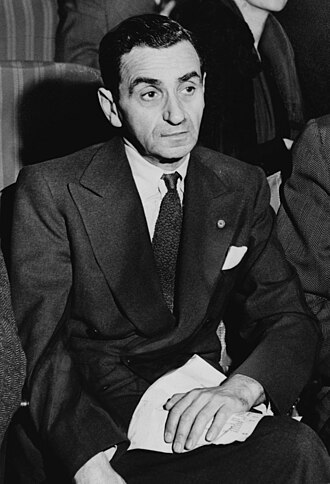
Irving Berlin (born Israel Isidore Baline, May 11, 1888 – September 22, 1989) was a Russian-born Jewish-American composer and lyricist. Widely considered one of the greatest songwriters in American history, his music forms a great part of the Great American Songbook. He published his first song, "Marie from Sunny Italy", in 1907, receiving 37 cents for the publishing rights,[1] and had his first major international hit, "Alexander's Ragtime Band" in 1911. He also was an owner of the Music Box Theatre on Broadway.
"Alexander's Ragtime Band" sparked an international dance craze in places as far away as Berlin's native Russia, which also "flung itself into the ragtime beat with an abandon bordering on mania." Over the years he was known for writing music and lyrics in the American vernacular: uncomplicated, simple and direct, with his stated aim being to "reach the heart of the average American," whom he saw as the "real soul of the country."[2] In doing so, said Walter Cronkite, at Berlin's 100th birthday tribute, he "helped write the story of this country, capturing the best of who we are and the dreams that shape our lives."[3]
He wrote hundreds of songs, many becoming major hits, which made him "a legend" before he turned thirty. During his 60-year career he wrote an estimated 1,500 songs, including the scores for 19 Broadway shows and 18 Hollywood films, with his songs nominated eight times for Academy Awards. Many songs became popular themes and anthems, including "Easter Parade", "White Christmas", "Happy Holiday", "This Is the Army, Mr. Jones", and "There's No Business Like Show Business". His Broadway musical and 1942 film, This is the Army, with Ronald Reagan, had Kate Smith singing Berlin's "God Bless America" which was first performed in 1938. Smith still performed the song on her 1960 CBS television series, The Kate Smith Show. After the September 11 attacks in 2001, Celine Dion recorded it as a tribute, making it no. 1 on the charts.
Berlin's songs have reached the top of the charts 25 times and have been extensively re-recorded by numerous singers including Fred Astaire, Ethel Merman, Frank Sinatra, Dean Martin, Deana Martin, Ethel Waters, Judy Garland, Barbra Streisand, Linda Ronstadt, Rosemary Clooney, Cher, Diana Ross, Bing Crosby, Rita Reys, Frankie Laine, Johnnie Ray, Al Jolson, Billy Eckstine, Sarah Vaughan, Nat King Cole, Billie Holiday, Doris Day, Jerry Garcia, Willie Nelson, Bob Dylan and Ella Fitzgerald. Composer Douglas Moore sets Berlin apart from all other contemporary songwriters, and includes him instead with Stephen Foster, Walt Whitman, and Carl Sandburg, as a "great American minstrel"—someone who has "caught and immortalized in his songs what we say, what we think about, and what we believe."[2] Composer George Gershwincalled him "the greatest songwriter that has ever lived",[4]:117 and composer Jerome Kern concluded that "Irving Berlin has no place in American music—he is American music.".[5]
Contents
- 1 Early life
- 2 Songwriting career
- 3 Movie scores
- 4 Songwriting methods
- 5 Music styles
- 6 Personal life
- 7 Death
- 8 Legacy and influence
- 9 Awards and honors
- 10 Musical scores
- 11 Song lists
- 12 Footnotes
- 13 References
- 14 External links
Russian immigrant
Life in Russia
Berlin was born on May 11, 1888, one of eight children of Moses and Lena Lipkin Beilin. There are several possibilities concerning his birth city. His daughter, Mary Ellin Barrett, states it was in Tyumen, Siberia. Other sources list one of several villages near the city of Mogilyov, Russian Empire (now Belarus). His father, a cantor in a synagogue, uprooted the family to America, as did many other Jewish families in the late 19th century. In 1893 they settled in New York City. As of the 1900 census, the name "Beilin" had changed to "Baline." According to his biographer, Laurence Bergreen, as an adult Berlin admitted to no memories of his first five years in Russia except for one: "he was lying on a blanket by the side of a road, watching his house burn to the ground. By daylight the house was in ashes."[6]:10
Ian Whitcomb described Berlin's life in Russia:
Life might have seemed irksome to Israel Baline: God was watching you everywhere. From the dawn bath to the night straw cot, everything was of religious significance. God was in the food and in the clothing. When Moses caught Israel pulling on his little shoes in a manner proscribed by the Talmud he beat him…
The floor of the Baline hut-home was of hard black dirt. Outside, the squiggly streets of Tyumen were either mud or dust according to the season. Lining the squiggles were horrid wooden huts. Sometimes wild pigs would rage into town and bite children to death…It was not a setting to sing about… Instead, cantor Moses took his children to the synagogue where, in soothing sing-song readings from the Talmud, the cares of the day were eased away. Life in Tyumen sounds pretty awful but, in later years, Irving Berlin said he was unaware of being raised in abject poverty. He knew no other life and there was always hot food on the table, even if it was God-riddled.[7]
Whitcomb also describes further the turning point in Berlin's early life:
But, suddenly one day, the Cossacks rampaged in on a pogrom... they simply burned it to the ground. Israel and his family watched from a distant road. Israel was wrapped in a warm feather quilt. Then they made a hasty exit. Knowing that they were breaking the law by leaving without a passport (Russia at that time was the only country requiring passports), the Balines smuggled themselves creepingly from town to town, from satellite to satellite, from sea to shining sea, until finally they reached their star: the Statue of Liberty.[7]:19
Nicholas II, the new Tsar of Russia, notes Whitcomb, had revived with utmost brutality the anti-Jewish pogroms, which created the spontaneous mass exodus to America. The pogroms were to continue until 1906, and thousands of other families besides the Balines would also escape, including those of George Gershwin and Ira Gershwin, Al Jolson, Sophie Tucker, L. Wolfe Gilbert ("Waiting for the Robert E. Lee"), Jack Yellen("Happy Days Are Here Again"), Louis B. Mayer (MGM) and the Warner brothers.[7]:14
Settling in New York City
They eventually settled on Cherry Street, a "cold-water basement flat with no windows,"[7] in the Yiddish Theater District on the Lower East Side, and had a Yiddish-speaking home.[8][9] His father, unable to find comparable work as a cantor in New York, took a job at a kosher meat market and gave Hebrew lessons on the side, and struggled to support his family. He died a few years later when Irving was thirteen years old. With only a few years of schooling, Irving found it necessary to take to the streets to help support his family.[2] He became a newspaper boy, hawking The Evening Journal. On his first day of the job, according to Berlin’s biographer and friend, Alexander Woollcott, the boy “stopped to look at a ship about to put out for China. So entranced was he that he failed to notice a swinging crane, and he was knocked into the river. When he was fished out, after going down for the third time, he was still holding in his clenched fist the five pennies that constituted his first day's receipts, his contribution to the family budget.”[2][10] His mother took jobs as a midwife, and three of his sisters worked wrapping cigars, common for immigrant girls. His older brother worked in a sweatshop assembling shirts. Each evening, when the family came home from their day's work, Bergreen writes, "they would deposit the coins they had earned that day into Lena's outspread apron."[6] :11
^Movie Scores:
In 1922, Madame Butterfly was his first composing film debut. In 1927, his song "Blue Skies", was featured in the first feature-length talkie, The Jazz Singer, with Al Jolson. Later, movies like Top Hat (1935) became the first of a series of distinctive film musicals by Berlin starring performers like Bing Crosby, Fred Astaire, Judy Garland, Ginger Rogers, and Alice Faye. They usually had light romantic plots and a seemingly endless string of his new and old songs. Similar films included On the Avenue (1937), Gold Diggers in Paris (1938),Holiday Inn (1942), Blue Skies (1946) and Easter Parade (1948), with Judy Garland and Fred Astaire.
"White Christmas" (1942)
The 1942 film Holiday Inn introduced "White Christmas", one of the most recorded songs in history. First sung in the film by Bing Crosby (along with Marjorie Reynolds), it has sold over 50 million records and stayed no. 1 on the pop and R&B charts for 10 weeks. Crosby's version is the best-selling single of all time. Music critic Stephen Holden credits this partly to the fact that "the song also evokes a primal nostalgia—a pure childlike longing for roots, home and childhood—that goes way beyond the greeting imagery."[5]