Gesner
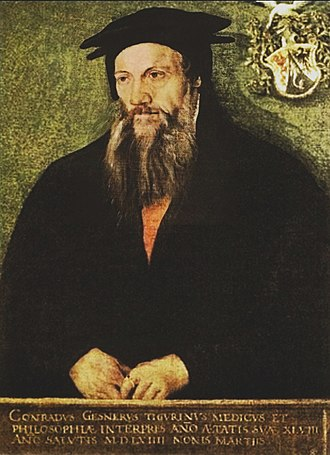
Name: Konrad Gesner
Achievements: Systematic compilations of information on animals and plants.
Born: March 26, 1516; Zurich, Switzerland
Died: December 13, 1565; Zurich, Switzerland (Aged 49)
Field & Discipline: Science; Botany; Physician; Naturalist
Language: French
Father: Ursus Gesner
Mother: Agathe Frick
Siblings: Unknown
Spouse: Name unknown
Children: Unknown
Education: Carolinum and Fraumunster seminary, Zurich; University of Bourges; University of Paris; University of Basel
Major Work:
"Opera botanica"
"Historia Animalium"
Life & Times:
Gesner's Latin professor in Zurich, Johann Jakob Amman, considered him so promising he took him into his home for three years, instructing him in both Latin and Greek. In 1530 Gesner moved on to the Fraumunster seminary.
In 1531, the two men closest to Gesner lost their lives in the Swiss Civil War: his father, a faithful follower of Reformed religion, and his godfather, the Protestant reformer [godfather was] Zwingli*.
In 1533, Gesner began to study medicine, taking courses at various universities, and receiving his doctorate in 1541. Along the way, he studied ancient languages, and in 1537, was the first occupant of the chair of Greek in the newly-established Lausanne Academy.
During his three-year tenure, he published his first works: a Greek dictionary (1537) and two botanical works, "Enchiridion historiae plantarum" (1541) and "Catalogus plantarum" (1541), based on the plants he had collected during his travels. He also published a compendium of Galen's work on the composition of medicines.
In 1541, at 25, Gesner settled permanently in Zurich, where he was appointed professor of philosophy and then of natural history at the Collegium Carolinum and set up his own medical practice. In 1544, he was made chief physician.
Gesner also took an interest in bibliography, and during the 1540s, worked on his monumental "Bibliotheca universalis", an index to about 1,800 Greek, Latin, and Hebrew texts and the first record of all books published during the first century of printing. The work brought him into correspondence with major scholars.
His next work attempted to group the recorded knowledge of the world into 21 subjects. The first 19 books were published in 1548, and the 20th (on theological thought) in 1549. The 21st, on medicine, was never completed. He also published a description of the roughly 130 then-known languages (the volume included The Lord's Prayer translated into 22 languages), followed by an edition of the works of the 3rd-century Roman writer Claudius Aelian (1556).
Throughout his life, Gesner worked tirelessly on his major work: a huge treatise on his favorite subject, natural history. Published as "Opera botanica" (two volumes, 1555-71), it contained nearly 1,500 plates that he drew himself. He proved himself to be virtually the only botanist of his time to realize that floral structures were the key to classifying vegetables. He was also the first to study the nature of seeds as a way of establishing the kinship of apparently-dissimilar plants. Later, [influenced] Linnaeus* would frequently acknowledge his debt to Gesner.
Gesner's huge range of interests also included zoology. His "Historia Animalium" (five volumes, 1551-1558), attempted to sift and arrange the knowledge to that point of the animal kingdom. The massive work (more than 4,500 pages) received immediate acclaim.
It was particularly praised by early-19th-century anatomist/paleontologist [influenced] Cuvier*, who believed it marked the beginning of modern zoology. The work contained sections on viviparous quadrupeds (four-footed animals that bear living young, published 1551), oviparous quadrupeds (those that hatch the young from eggs, 1554), birds (1555), and fishes and aquatic animals (1556), with two other sections (on serpents and insects) published posthumously in 1558.
In each, Gesner arranged the animal species alphabetically, and divided his descriptions uniformly into eight chapters, with an illustration of every animal in woodcut. The work detailed: names, in all dead and modern languages; a description, morphological and anatomical; geographical range and habitat; length of life, growth, development, procreation; diseases; habits and instincts; uses in medicine and usefulness generally; and finally the place of the animal in literature and history.
Gesner's attempt to regroup animals was directly related to his classification of the vegetable kingdom according to flowering and non-flowering plants, vascular and nonvascular plants, and so on.
Gesner also took an interest in paleontology, and is believed to be the first naturalist to have sketched fossils. In addition, he studied crystallography and was one of the first to include printed plates of crystals in his works.
Meanwhile, like his contemporary, the German botanist [edited work of] Cordus*, he was an enthusiastic traveler, and during the 1540s explored the Alps and the Adriatic coast, bringing back many specimens and documents that he used in his treatises on botany and zoology.
In 1552, Gesner set up a museum at his house containing his collections of specimens and his drawings and books, and turned his yard into a botanical garden in which he cultivated many rare plants, including the newly-arrived tulips, which he described for the first time in "De Hortis Germaniae Liber" (1561).
Extra Connections: His tulip work influenced [influenced] Lady Mary Wortley Montagu*
His work was influenced by that of [influenced by] Melanchthon*
A fellow-student was [fellow-student was] Rheticus*
His material was used by [work used by] Izaac Walton*
Assessment: An immensely influential and prolific natural historian, who exhibited interest in all sciences. At his death he had published 72 works and left 18 others in progress.
Oneliner: Conrad Gesner, the ‘father of bibliography’
Bibliography:
- Bay, J. C., "Conrad Gesner: The Father of Bibliography", in Papers of the Bibliographical Society of America, 10/ 2 (1916), pp. 53-86.
- Blunt, Wilfrid, Tulips and Tulipomania, London: Basilisk Press, 1977.
- Dictionary of Scientific Biography.
- Encyclopedia Britannica.
- Morley, Henry, "Conrad Gesner", in Clement Marot and Other Studies, Vol. 2., London: Chapman & Hall, 1871.
Tuliomania: Money, Honor, and Knowledge in the Dutch Golden Age (2007) by Anne Goldgar; Tulipomania (1950) by Wilfrid Blunt; Too Much to Know: Managing Scholarly Information before the Modern Age (2010) by Ann M. Blair.