Melanchthon
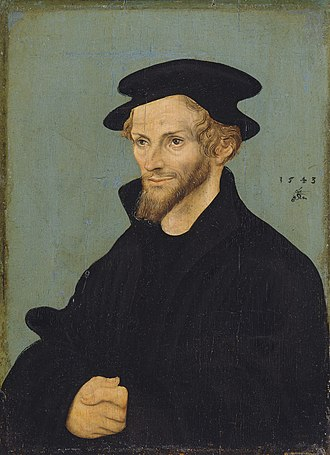
Name: Philipp Melanchthon
Nickname/Alias: Born: Philipp Schwartzerd
Achievements: Protestant Reformation
Born: February 15, 1497; Bretten, Palatinate, Germany
Died: April 19, 1560; probably Wittenberg, Saxony, Germany (Aged 63)
Field & Discipline: Religion; Pedagogy; Theologian
Language: German
Father:: Father: Georg Schwartzerd
Mother: Barbara Reuter
Siblings: 1 brother; 3 sisters
Spouse: Katherine Krapp
Children: 2 sons: Philipp; Georg. 2 daughters: Anna; Magdalen
Education: Pforzheim Latin school; Heidelberg University; Tubingen University
Major Work:
"Rudiments of the Greek Language" (1518)
"Loci communes" (1521)
"Confession of Augsburg" (1530)
"Apology of the Confession of Augsburg" (1531)
Life & Times:
Melanchthon’s father died when he was a boy and his great-uncle, Johannes [great-uncle was] Reuchlin* who was a well-known humanist and Hebrew scholar, took charge of his education.
Following humanist practice, Melanchthon adopted the Greek form of his family name (= ‘black earth’). After receiving his master's degree in 1514, he lectured on the classics and wrote textbooks, including "Rudiments of the Greek Language" (1518) which was a great success among humanist educational reformers and was reprinted many times.
Melanchthon became increasingly disenchanted with Tubingen where ecclesiastical conservatism had taken hold and he was beginning to be seen as dangerously radical.
Luckily, [protector was] Frederick III the Wise* of Saxony asked Reuchlin for a recommendation for a new language chair and accepted Melanchthon's nomination. He was appointed as Wittenberg University's first professor of Greek in 1518 and immediately put forward his ideas for educational reform on humanist lines in an address to the university entitled "The Improvement of Studies".
He met [collaborated with] Martin Luther* and became an open supporter of Luther's crusade for reform of the church. Melanchthon adopted the crucial tenet that true faith is enough in itself to gain the grace of God, and he rejected the fundamental Roman Catholic doctrine of transubstantiation which held that the bread and wine used in the mass actually becomes the body and blood of Christ.
In 1521 he published the "Loci Communes", a book which was translated into the vernacular, reprinted numerous times and put on the reading list at Cambridge University in England. It was also said to have been a favorite of [wrote a favorite book of] Queen Elizabeth* of England who used it to prepare herself for religious debate. It was the first systematic examination of evangelical doctrine, covering sin, law, grace, free will, vows, confession, and other related topics.
Melanchthon's views on sin reflected his humanistic thought. He stated that sin is a state of mind as well as an act, and that it cannot be wiped out by simply performing good deeds. Original sin exists in humankind, but the grace of God, given to all who have faith, brings forgiveness; any good works undertaken are an expression of gratitude for God's grace and are not in themselves a passport to heaven.
By now Luther's supporters were subject to the death sentence by decree of the Holy Roman Emperor, but in 1521 Melanchthon defended Luther against the scholars of the Sorbonne University in Paris with his treatise, "Against the Furious Decree of the Parisian Theologasters," illustrated with woodcuts by worked with] Cranach* . In the same year, Melanchthon wrote "Passion of Christ and Anti-christ" an attack on the Pope’s lifestyle, contrasted with the austere and humble life led by Christ.
Melanchthon was regarded as the leader of the Reformation at Wittenberg and in 1526 he was chosen as one of the commissioners to visit those states within the German Empire which had undertaken ecclesiastical reforms for the purpose of regulating the constitution of their churches. In connection with this task, he wrote (1528): "Instructions for Visitors," a statement of evangelical doctrine. He also included a scheme for elementary education. Adopted by law in Saxony, it brought the first viable Protestant public-school system.
At the Second Diet of Speyer in 1529, where there was a Roman Catholic majority, Melanchthon was present when the reformers put forward their claim to freedom of conscience. It took the form of a protest from which the term "Protestant" was born.
In the same year, a conference was held at Marburg in an attempt to resolve the doctrinal differences between the evangelicals. Melanchthon attended together with other reformers such as [worked with] Bucer*, [worked with] Osiander*, Luther and [worked with] Zwingli*.
The following year Melanchthon wrote the "Augsburg Confession" for presentation at the Diet of Augsburg. The confession was a statement of the evangelical position and it became one of the key documents of the Protestant faith.
After Augsburg, he represented the Protestant cause in the negotiations about adoption of the confession and reform of the Roman Catholic church. His quiet scholarly manner made him acceptable to the traditionalists, and together with Martin Bucer he worked for union within the reformers as well as conciliation with hardline Catholics. Like Bucer, Melanchthon was regarded with suspicion by some reformers.
In his 1531 "Apology of the Confession of Augsburg" he held to his original statement and in 1536-37 he wrote the "Appendix on the Papacy" which put forward the Lutheran position on papal power. Melanchthon rejected the idea that the pope had been given primacy by divine right, but he did accept papal jurisdiction as long as teaching according to the Gospel was allowed.
During the 1530's Melanchthon became interested in the writings of the Greek physician Galen and in anatomy during the course of his investigations into the nature of the soul. In his book on the soul, "Commentary on the Soul" he stated that anatomy was a proper subject for study.
Melanchthon used non-Christian material in this way to demonstrate an evangelical position:- that to know God's creation is to appreciate the greatness of God.
Luther died in 1546 and the following year the Protestant forces were defeated by[work related to] Charles V* at Muhlberg. In the wake of these events the Augsburg Interim was issued in which a compromise between evangelicals and Roman Catholics was set out. Melanchthon would not accept the document until it specifically allowed justification by faith. Having won this battle he was prepared to compromise on lesser issues.
He accepted the sacraments so long as they were presented as part of church ritual and not as the tools of salvation in themselves. He accepted the idea of doing good works as long performing them was not seen as the mark of virtue. Melanchthon spent the rest of his life debating these questions, arbitrating within the Protestant cause and negotiating with Roman Catholic authorities.
His education system was copied all over Germany and he gained the title "Preceptor of Germany". He was involved as an advisor to over fifty new schools founded according to his ideas, and he helped to found the universities of Konigsberg, Jena and Marburg. He was also part of the movement to reform many other universities, including those at Heidelberg, Leipzig and Tubingen.
Extra Connections:
His work influenced that of [influenced] Gesner*.
[colleague of] Cordus* was a colleague.
Admired [a fan of] Agricola*.
Taught [taught] Cruciger*.
A descendent was Frege
Opposed publication of [opposed publication of] Copernicus’* book.
In lecturing on the Librorum de judiciis astrologicis of Ptolemy in 1535–1536, Melanchthon expressed to students his interest in Greek mathematics, astronomy and astrology. He considered that a purposeful God had reasons to exhibit comets and eclipses.[24] He was the first to print a paraphrased edition of Ptolemy's Tetrabiblos in Basel, 1554.[25]
Natural philosophy, in his view, was directly linked to Providence, a point of view that was influential in curriculum change after the Protestant Reformation in Germany.
Assessment: One of the most prominent Protestant reformers and theologians. He also introduced to Germany the first public school system of education since the time of ancient Rome.
Oneliner: Philipp Melanchthon, major figure in the Protestant Reformation
Bibliography:
- Manschreck, Clyde Leonard, Melanchthon, The Quiet Reformer, Abingdon Press, New York, 1958.