Schwann T
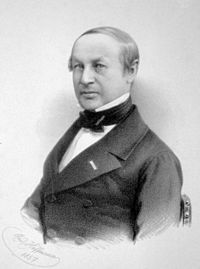
ACHIEVEMENTS: Cell theory
DATE AND PLACE OF BIRTH: 7 December 1810, Neuss, Germany
DATE AND PLACE OF DEATH AND AGE AT DEATH: 11 January 1882, Cologne, Germany. Aged 72
DISCIPLINE: Physiologist
FIELD: Physiology
LANGUAGE: German
EDUCATION:
Local schools, Neuss
University of Bonn
University of Wurzburg
MAJOR WORK:
"Microscopic Researches into Accordance in the Structure and Growth of
Animals and Plants" (1839)
LIFE AND TIMES:
Inn 1829 Schwann enrolled at Bonn University, where the great physiologist Muller* was one of his tutors. In 1831 Schwann moved to Wurzburg where he studied under Schonlein* before completing his studies at Berlin. Muller had also moved to Berlin and from 1834-39 Schwann worked in Muller's laboratory and contributed to his major work on physiology.
Unlike Muller, Schwann followed an extreme mechanistic method of study. He planned, for example, to measure the secretion of a gland, in this way reducing the physiological processes of an organ to physical measurement. His first success was with muscle tissue. He succeeded in measuring the differing length of a muscle as it contracted under stimulus with a variety of loads, and was also able to compare the intensity of its contraction with that of the stimulus causing it to contract. This experiment had a major influence on the development of physiology.
One of Schwann's successors at Berlin, DuBois-Reymond*, praised him for being the first to examine a “vital force” as a physical phenomenon and to state its action in quantitative terms. At the same time, Schwann was studying the digestive organs and processes.
These led to his discovery of the substance responsible for stomach digestion, which he named pepsin. Schwann was also investigating the processes of fermentation and putrefaction. After investigating why no putrefaction appeared in boiled meat he was convinced that it was the destruction of germs (live organisms) which prevented putrefaction.
He then conducted experiments on the alcoholic fermentation of yeast in a sugar solution and concluded that alcoholic fermentation in yeast was also the work of a live organism and was related to the metabolism of yeast.
During the nineteenth century, there had been various theories put forward by scientists such as Purkinje*, about a common structure for all live organisms which involved the grouping of elementary units such as particles and nuclei. In 1830, improved microscopic techniques led Robert Brown* to recognise that the nucleus was the essential characteristic of the plant cell.
In 1838 Schlieden*, a friend of Schwann's, advanced a cell theory for plants. Schwann's work on putrefaction and fermentation led to his cell theory which states that the cell is the basic unit of all animal structure. During his experiments he had established that different forms of tissue, including skin, nerve, cartilage, bone, tooth, muscle, fat, hoof and feather, were all cellular.
He came to the conclusion that there was no pre-meditated divine external influence on the development of cells, although he believed that cells developed according to the forces of physics created by a superior intelligent being. He coined the term 'metabolism' for the chemical changes which take place in living tissue.
He published his findings in 1839 in his "Microscopic Research into Accordance in the Structure and Growth of Animals and Plants". His theory that the cell contains all the characteristics of life was accepted and developed by his successor Remak* who corrected Schwann and Schleiden's belief that cells were formed inside a blastema.
Schwann became discouraged by attacks on his theory and from this time was increasingly drawn back into the mystical theology of his childhood. In 1839 he failed to get a chair at Bonn and moved to Louvain where he became professor of anatomy. His last physiology works, on the biliary fistula, were in 1844 and '45. In 1848 he moved to the industrial region of Lieges in Belgium, encouraged by the promise of a large increase of salary and the establishment of an institute of anatomy.
Neither of these transpired and Schwann's focus shifted to religious meditation and invention. He developed instruments for pumping water from mines and a respiratory apparatus for rescue operations which was a forerunner of the systems used by divers and physiologists measuring human metabolism.
Schwann retired in 1877 but remained in Lieges. He died of a stroke while visiting relatives in Cologne.
ASSESSMENT: Schwann's theory of the cell as the common unit of all animal structure established the modern science of histology.
EXTRA CONNECTIONS: Influenced Virchow*.
Oken* foreshadowed some of his work.
He was a fellow student with William Adams*
ONELINER: Theodor Schwann, originator of the cell theory
BIBLIOGRAPHY:
Encyclopedia Britannica
Dictionary of Scientific Biography