Virchow
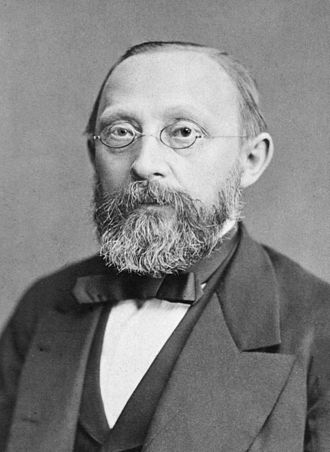
Achievements: Established the view that disease arose primarily in the individual cells of organs and tissues. One of the founders of anthropology as a modern science
Born: October 13, 1821; Schivelbein, Pomerania, Germany
Died: September 5, 1902; Berlin, Germany (Aged 81)
Field & Discipline: Science; Pathology; Politics
Language: German
Education: Primary school, Schivelbein; High school, Koeslin; University of Berlin
Major Work:
"Cellular Pathology as Based upon Physiological and Pathological Histology" (1858)
Life & Times:
After leaving high school Virchow was accepted for free medical training at the Friedrich-Wilhems Institute at Berlin University where [studied under] Muller* was dean. He graduated in 1843 and an attempt to make him clinical pathologist at the Charite hospital was blocked by [opposed by] Schoenlein* who wanted to appoint his pupil [rival was] Remak*. In 1845 Virchow published an important paper in which he reported on one of the earliest known cases of leukemia.
In the same year he addressed a distinguished audience at the medical institute and stated his rejection of the prevalent idea (held by most of those present) that the human system was dependent on a balance of four vital fluids, the so-called “humors.”
He declared his own belief that research should be based on experiment and observation, which should include microscopy and post-mortems. He dismissed any idea of spontaneous generation and urged his audience to concentrate on the cell as the basic unit of study.
In these views, Virchow was influenced by the work of [influenced by] Schwann*, another ex-pupil of Muller, and [influenced by] Schleiden*, a botanist who had stated in 1837 that all plants consist of cells.
A year later, Virchow attacked the theories of [attacked theory of] Rokitansky* who was then the leading pathological anatomist in Europe and who held the view that most diseases are caused by disorders in the blood.
Virchow disproved the commonly held view that phlebitis (inflammation of a vein) was the cause of most diseases. He coined the term "thrombosis" which he demonstrated as a cause of clotting in blood vessels and he showed that when a piece of a thrombus became detached to form what he called an "embolus" it could travel through the circulation and could block a narrow blood vessel.
To promote the progressive views he held, Virchow co-founded and edited a new medical journal ("Archives for Pathological Anatomy and Physiology, and for Clinical Medicine").
In 1848 he was sent to Upper Silesia on behalf of the Prussian government to investigate an outbreak of typhus fever. Silesia was a Prussian province inhabited by a poor Polish minority and Virchow's report concluded that the causes of the outbreak were the social conditions, which he blamed on the government. During the uprisings of 1848 he fought on the side of the revolutionaries at the barricades and published a weekly paper ("The Reform of Medicine").
In 1849 he moved to Wurzburg where he became the first professor of pathological anatomy in Germany. During his time at Wurzburg the reputation of its medical school was re-established and the number of its pupils increased dramatically. Among his better known students were the anatomists [taught] Hensen* and [taught] Haeckel*.
In 1854 he began publication of his six-volume "Handbook of Special Pathology and Therapeutics". Virchov was influenced by new advances in cellular pathology, such as the work of Remak, who in 1852 was the first to notice that cells multiplied by division. The theory of cellular pathology which Virchov arrived at stimulated new research and made the subject a key area of investigation. During the seven years he spent at Wurzburg Virchow also began his anthropological studies on skulls.
In 1856 he returned to Berlin where a chair of pathological anatomy was established for him. In 1858 he published his theory in "Cellular Pathology as Based upon Physiological and Pathological Histology".
His views changed the concept of biology and many progressive medical men, like the Italian physician [influenced] Lombroso* and the American psychiatrist [influenced] William James*, were inspired by his writing and teaching.
Virchow also took up his political interests again. In 1859 he was elected to the Berlin City Council, where he focussed on public health issues and was responsible for reforms in areas which included sewage disposal, meat inspection and school hygiene. He oversaw the design of two new hospitals in the city, opened a school for nurses and designed Berlin's new sewer system. Virchow was a co-founder of the German Progressive Party and in 1861 he was elected to the Prussian Parliament, where he led the fight against the militaristic German unification programme of the prime minister of [opposed] Bismarck*. In 1865 Bismarck attempted to end Virchow's attacks by challenging him to a duel, an offer which Virchow declined to accept.
On the medical front, he conducted investigations on the process of inflammation, the pathology of tumours and the role of animal parasites in causing disease in humans. Virchow was enthusiastic about educating the public and in 1868 co-founded the series "Collection of Popular Scientific Lectures" for which he wrote several papers.
During the Franco-Prussian war of 1870-1 he was involved with the building of military hospitals and equipping hospital trains. He was one of the founders of the German Anthropological Society. He conducted a nationwide racial survey of school children which was the first of its kind.
In 1875 he was excavating hill forts in East Prussia and found himself working next to [disagreed with theories of] Koch* with whom he later fell out over their different views on bacteriology. Virchow was a personal friend of [a pal of] Schliemann* (who discovered the site of Troy) and was instrumental in persuading Schliemann to bequeath his collection of antiquities to Berlin.
In 1881 Virchow made his first visit to the Caucasus, which since the time of the German anthropologist [developed work of] Blumenbach* had been declared the cradle of the bronze culture. Virchow discovered that Caucasian culture was not primary.
Virchow was much in demand internationally and was a leading figure at medical congresses in all the European capitals. He visited Britain regularly where he formed a friendship with the surgeon [a pal of] Lister* and had tea with the poet [met] Robert Browning*. He worked for German-Franco reconciliation and was an enthusiastic admirer of [a fan of] Pasteur*. In 1880 he was elected to the Reichstag (the German Parliament) and two years later was made President of the Berlin Medical Society.
Extra Connections: [assistant was] Weigert* and [assistant was] Kuhne* were his assistants
[anticipated by] Morgagni* laid the ground for his work.
Virchow’s was opposed to Bismarck’s excessive military budget, which angered Bismarck sufficiently to challenge Virchow to a duel. Virchow, being entitled to choose the weapons, chose two pork sausages: a cooked sausage for himself and an uncooked one, loaded with Trichinellalarvae, for Bismark. Bismarck, the Iron Chancellor, declined the proposition as too risky.
Assessment: His view that disease arose primarily in the individual cells of organs and tissues led to a growth in surgery and became a stimulus for modern chemotherapy.
Oneliner: Rudolf Virchow, powerful 19th-century medical authority
Bibliography:
- Ackerknecht, Erwin H.,Rudolf Virchow, Doctor, Statesman, Anthropologist, University of Wisconsin Press, Madison, 1953.
Emerg Infect Dis. 2008 Sep; 14(9): 1480–1481.
http://www.ncbi.nlm.nih.gov/pmc/articles/PMC2603088/
Multimedia:
Connections 2 #13 "The Big Spin"
Father: Father: Carl Christian Siegfried Virchow
Mother: Johanna Maria Hesse
Siblings: None
Spouse: Rose Mayer
Children: 6