Schleiden
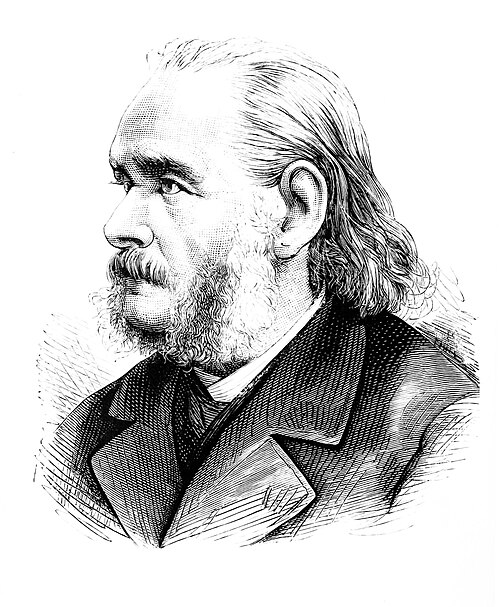
ACHIEVEMENTS:
Cell theory of plants
NICKNAME/ALIAS:
None
DATE AND PLACE OF BIRTH:
5 April 1804, Hamburg, Germany
DATE AND PLACE OF DEATH AND AGE AT DEATH:
23 June 1881, Frankfurt, Germany. Aged 77
DISCIPLINE:
Botanist
FIELD:
Botany
PARENTS:
Father: municipal physician of Hamburg
SIBLINGS:
?
SPOUSE:
?
CHILDREN:
?
EDUCATION:
University of Heidelberg
University of Gottingen
University of Berlin
MAJOR WORK:
"Contributions to Phytogenesis" (1838)
"Grundzuge der wissenschaftlichen Botanik" ("Foundations of Botanical
Knowledge") (1842)
LIFE AND TIMES:
Schleiden studied for a law degree and established a legal practice in Hamburg before turning to natural science. After attending Gottingen University he went to Berlin where the explorer and natural scientist <influenced by> Alexander von Humboldt* and the botanist <influenced by> Robert Brown* were in residence.
Schleiden studied in the laboratory of the distinguished physiologist <studied under> Muller* and became friendly with <a pal of> Schwann*, another of Muller's assistants. Schleiden completed his doctorate at Jena University where in 1838 he published the article on phytogenesis in plants which made his name.
A paper written by Brown in 1832 on his discovery of the cell nucleus was the starting point for Schleiden's theory of cell formation in plants in which he showed that every different part of a plant is made up of cells or derivatives of cells. Schwann later independently extended this to cover all animal life.
The importance of Schleiden's theory was that he was the first to state the cell theory as a principle of biology. After his publication, plant cytology became the starting point of all botanical text books and his cell theory influenced the work of other eminent scientists such as the pathologist influenced> Virchow*.
(Schleiden recognized the importance of the nucleus for cell propagation but his theory of the development of the cell mistakenly stated that it crystallized within a liquid, containing sugar, gum and mucus, which he called the “blastema.”)
His lectures at Jena were packed, and he wrote on a wide range of scientific subjects. In 1842 the Swiss botanist <collaborated with> Naegeli* came to Jena to study under Schleiden and together they published a botanical journal.
In 1842 Schleiden published his major work, the botany textbook: "Grundzuge der wissenschaftlichen Botanik". In it he criticised earlier botanists for their vitalist belief that the fundamental processes of life could not be measured.
He also lambasted the nature philosophy of <criticized views of> Schelling* and <criticized views of> Hegel*. The structure of his textbook was groundbreaking, with a first section on the material elements making up the plant followed by a section of plant cytology and finishing with a section on morphology and organiology. The book changed the teaching of botany and was reprinted frequently and translated into many different languages.
Schleiden refused an offer from Giessen University, in 1846 became professor of botany at Jena in 1850. He had always been interested in microscope-based research and is thought to have been one of the founders of initiators of the Zeiss optical works in Jena.
Schleiden eventually felt restricted at Jena and left in 1862.
He took the professorship of anthropology at Dorpat in the Russian Empire (now Tartu, Estonia) for a short time in 1863 but then became very well-known as a travelling public lecturer and writer. He was a great popularizer and his lectures were published in book form. In addition, he wrote a number of detailed monographs on single subjects (such the salt, and the rose) in which he wrote about the economic and social history and the symbolism of his subject.
He also wrote on anthropological subjects and on the history of the Jews. He was one of the first German scientists to recognize <early supporter of> Charles Darwin's* theory of evolution.
Schleiden had an aggressive nature and was constantly engaged in quarrels with other leading academics, among them <had row with> Liebig* and Schelling.
ASSESSMENT: Schleiden is remembered for his statement of the cell theory for plants which revolutionized the study of botany and for his innovative teaching methods.
EXTRA CONNECTIONS: Taught <taught> DuBois-Reymond*
His work related to that of <work related to> Brucke*
Although Schleiden was not Jewish nor a historian by profession, he was noted for his defense of Judaism and against antisemitism.
ONELINER: Matthias Schleiden, who discovered plant cells
BIBLIOGRAPHY:
Encyclopedia Britanica
Dictionary of Scientific Biography