Du Bois-Reymond
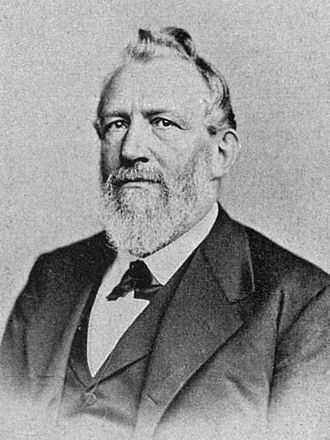
NAME: Du Bois-Reymond, Emil
ACHIEVEMENTS:
Advances in electrophysiology
NICKNAME/ALIAS:
None
DATE AND PLACE OF BIRTH:
7 November 1818, Berlin, Germany
DATE AND PLACE OF DEATH AND AGE AT DEATH:
26 December 1896, Berlin, Germany. Aged 78
DISCIPLINE: Physiologist
FIELD: Physiology
LANGUAGE:
French/German
PARENTS:
Father: Felix Henri Du Bois-Reymond
Mother: Minette Henry
SIBLINGS:
2 brothers
2 sisters
SPOUSE:
Jeanette Claude
CHILDREN:
4 sons, five daughters
EDUCATION:
French high school, Berlin
School in Neuchatel
University of Berlin
University of Bonn
MAJOR WORK:
"Researches on Animal Electricity" (1848-1884)
LIFE AND TIMES:
In 1839, after studying various subjects at Bonn and Berlin universities, Du Bois-Reymond decided on medicine.
At Berlin, his teachers included Schwann* and Schleiden*. From 1840 he worked in the laboratory of the great physiologist Muller, Johannes P* where he assisted in anatomical and physiological experiments and developed his microscopic technique.
From the beginning of his career, Du Bois-Reymond was concerned with animal electricity. His degree dissertation was on the history of studies of electric discharges from fish. His own research in this field was first directed to verifying the observations made by previous scientists and involved experiments in electrophysiology.
He discovered that when he applied an electric stimulus to the electropositive surface of a nerve membrane this caused an impulse to travel along the nerve "as a wave of relative negativity". He was then able to demonstrate the same phenomenon in muscle tissue. He traced the passage of an electric current in muscle to individual muscle fibres and showed that on the surface of the fibres, the current was positive while inside the fibres, the current was negative. The contracting muscle had therefore produced a "negative fluctuation" of the initial stimulus.
This research created the basis for the modern science of electrophysiology.
The success of Du Bois-Reymond in this field was due in large measure to the new equipment he used for generating and measuring electric current, much of it developed by himself.
In 1845, together with Brucke*, Du Bois-Reymond founded the Physics Centre in Berlin. Both men were anti-vitalists and believed that the life processes of an organism could be explained by its physical, molecular and atomic mechanisms. In 1846 Du Bois-Reymond qualified as a lecturer at Berlin and in 1848 he also acted as instructor in anatomy at the Berlin Academy of Art. He gave up this job in 1853 and from then on concentrated exclusively on physiology.
Five years later he succeeded Muller as professor of physiology at Berlin. Facilities were so poor that Du Bois-Reymond was forced to conduct most of his experiments in his own home with students, who included Boll*. Du Bois-Reymond continued to develop new equipment for his experiments.
He was the first to successfully establish the procedure for measuring weak bio-electric currents without loss. In 1877, after much lobbying, a new institute for physiology was completed in Berlin. At the same time, a separate publication for physiological papers was set up, with Du Bois-Reymond as editor.
In 1882 Du Bois-Reymond became rector of Berlin University for a second term and offended many people with his inaugural speech in which he attacked Goethe’s* nature philosophy.
His lectures were popular and he had many distinguished pupils, including the statistician Pearson* who attended Du Bois-Reymond's lectures on Darwinism.
ASSESSMENT: Du Bois-Reymond was the founder of modern electrophysiology in Germany and the majority of his findings and experimental techniques have remained
valid. He is best known for his research in nerve and muscle fibres.
EXTRA CONNECTIONS: Wrote devastating critique of Meissner*
He met Ludwig*
His lab assistant was Kuhne*
He worked at the lab of Muller*
He was a fellow-student of Helmholtz*
BIBLIOGRAPHY:
DSB, EB