Tompion
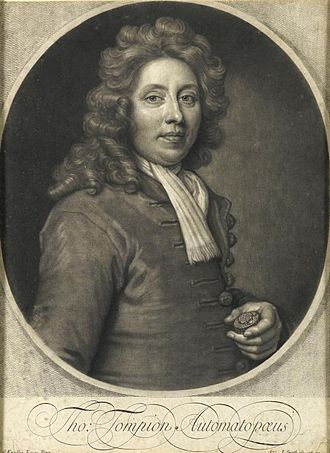
NAME: Tompion, Thomas
ACHIEVEMENT(S): Clocks
NICKNAME/ALIAS: None
DATE/PLACE OF BIRTH: baptized 25 July 1639, at Ickwell Green, Northhill, Bedfordshire, England
DATE/PLACE/AGE AT DEATH: 20 November 1713, at London, England. Aged 74
DISCIPLINE: Horologist
FIELD: Horology
LANGUAGE: English
EDUCATION: Unknown
MAJOR WORK: ?
LIFE AND TIMES:
The first definite information concerning Tompion’s life is his seven-year apprenticeship to a London clockmaker from 1664.
In September 1671, he was admitted to the Clockmakers' Company as a 'Great Clockmaker' (which meant a maker of wrought iron turret clocks) but despite these skills he also rapidly established a reputation as a watchmaker.
Three years later he had set up his own clock-making business at the sign of 'The Dial and Three Crowns', in Blackfriars, London, where his business prospered and he remained for the rest of his life.
Tompion lived in an age when great advances were being made in clockmaking, which his great skill as a craftsman allowed him to exploit. In 1674, he met and befriended the experimental physicist <a pal of> Hooke*, who introduced
him to <commissioned by> Flamsteed*, the first Astronomer Royal. Hooke commissioned Tompion to make an extremely accurate quadrant.
Hooke was so pleased with the result that in 1675 he commissioned Tompion to construct a watch according to his design and specifications (1758) - one of the first English watches to be regulated by a balance spring. In an (unsuccessful) attempt to settle a priority dispute with the Dutch physicist <involved in row with> Christiaan Huyghens* over the invention of the spiral balance spring, or hairspring, this watch was then presented by Hooke to Charles II inscribed 'Robert Hooke inven. 1658. T. Tompion fecit 1675'.
Although this watch was not particularly successfully it made Tompion aware of the potential of the balance spring, and he became the first person in England to apply Huyghens spiral spring to the balance of a watch, and from this point Tompion rapidly rose to be the leading watch and clock maker of his day.
In 1676, Tompion was commissioned to provide part of the equipment for the new Royal Observatory at Greenwich: two clocks with 13-foot pendulums and a 2-second beat.
During the 1680s, Tompion's reputation grew as the superior quality of his wheel work, enhanced by Hooke's wheel-cutting engine, became in demand in France - despite the fact that Huyghens’ own balance spring watches were already in production in Paris by the famous watch maker Thuret - and two of Tompion's watches were even bought by the French Crown Prince.
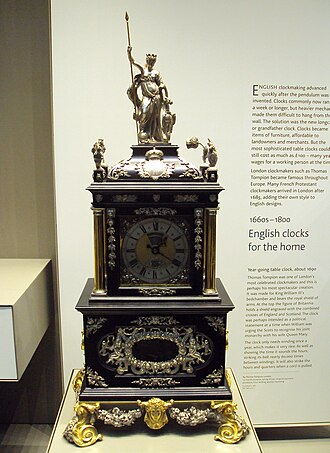
During this period he also began working closely with Charles II's clockmaker Edward Barlow, whose inventions contributed to improved clock and watch mechanisms, and in March 1687 an early repeating watch made by Tompion under Barlow's direction (a type that could be made to sound the nearest hour and nearest quarter hour by pushing two pieces extending from the sides of the watch) was produced in court in support of Barlow's application for a patent.
Altogether, assisted by journeymen and up to eleven apprentices at any one time, the output from Tompion's workshop totalled over 5,000 watches and 600 clocks.
In 1690 Tompion moved his business premises to 67 Fleet Street, where he remained until his death, constructing not only watches and clocks, some with astronomical and perpetual calendar devices, but also many barometers and sundials.
During the early 1690s Tompion began receiving commissions from the new king, <clockmaker for> William of Orange*, for whom he constructed a barometer and sundial for Hampton Court Palace, and for whom he was later appointed official clockmaker.
In 1695 Tompion, with Barlow and William Houghton, patented the cylinder or horizontal escapement (a controlling device).
This substituted a horizontal-wheel cylinder escapement for the vertical crown wheel escapement, allowing Tompion to make the first flat-bodied, and therefore more compact watches, that replaced the earlier bulbous style. Also in 1695, Tompion developed the first clock with equation work (i.e. showing the difference between solar and mean time), which again required winding only once a year, which was made for William of Orange and is still in Buckingham Palace.
The anchor escapement (which reduced the amplitude of the pendulum's swing) was first
applied to clocks around this time and produced further improvements in accuracy which Tompion and other clockmakers were able to use. However, the anchor escapement, like the verge escapement, produced recoil (i.e. the clock was momentarily driven in reverse), and Tompion's many attempts to overcome this defect were unsuccessful.
The problem was eventually solved by his partner from 1711, <niece married> George Graham* (who married his niece) , who both introduced the dead-beat escapement for clocks (in which the escape wheel remains stationary when not moving forward).
In 1704 Tompion became master of the Clockmakers' Company but, although it has been claimed that he was a fellow of the Royal Society, his name does not appear on any of the Society's lists.
Thomas Tompion died on 20 November 1713 and was buried in Westminster Abbey, George Graham being buried alongside him in 1751. There is also a memorial to him within Westminster Abbey.[4] Many of his clocks are still operational today, including two of his one-year clocks in Buckingham Palace. Many of his watches survive and due to their sound construction still continue to work, as predicted by Hatton in 1773.
ASSESSMENT: The greatest clockmaker of his day.
EXTRA CONNECTIONS:
In the 1986 film Clockwise, the school of which John Cleese's character is headmaster was named for Thomas Tompion, appropriate given the headmaster's attention to punctuality.
In 'Pickwick Papers, by Charles Dickens, the pump room at Bath is said to have a Tompion clock.
ONELINER: Thomas Tompion, famous early clockmaker
BIBLIOGRAPHY:
DSB, EB, DNB
Bruton, Eric, History of Clocks and Watches, London: Orbis Publishing, 1979
Symonds, R.W., Thomas Tompion: His Life and Work, London: B.T. Batsford,
1951.
PARENTS: Thomas Tompion and Margaret ?
SIBLINGS: James and Margaret
SPOUSE: None
CHILDREN: None