Flamsteed
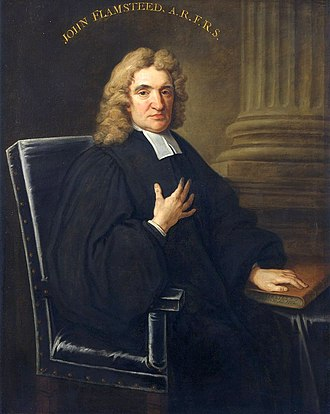
Name: John Flamsteed
Achievements: Star catalogue (stars today are given a Flamsteed number, to record them, although this numbering system probably was not developed by Flamsteed himself).
Born: August 19, 1646; Denby, Derbyshire, England
Died: December 31, 1719; Greenwich, England
Field & Discipline: Science; Astronomy
Language: English; Latin
Father: Stephen Flamsteed
Mother: Mary Spateman
Siblings: three siblings who died young; half-sister Katherine (mother was Elizabeth Bate, Stephen Flamsteed’s second wife)
Spouse: Margaret (nee Cooke)
Children: None
Education: Free School at Derby (until 16); home studies while ill; Cambridge (MA in 1674)
Major Work:
“Historia Coelestis”
“Historia Coelestis Britannica” (published posthumously in 1725)
“Atlas Coelestis”
Life & Times:
Flamsteed’s mother died while he was still young. At the age of 14 he was afflicted with an illness of the legs and knees and left school in 1662 at least partly because of this illness. He continued to study at home, translating the parts of Sacrobosco’s Spheres that he needed for his mathematical study, and read Fale’s “Art of Dialling.” (which lead him the task of calculating a table of the sun’s altitudes at all hours.
He had intended to join the clergy (and was ordained in 1675, receiving the living of Burstow, Surrey, in 1684) but in 1674 he made a favorable impression on King [appointed by] Charles II* and his brother the Duke of York by making a barometer and thermometer for them.
On March 14, 1675, Charles II appointed Flamsteed the first Astronomer Royal, after Jonas Moore arranged for them to meet. As a result, the Royal Observatory was built at Greenwich by [a pal of] Wren,* the leading architect of the time, assisted by [knew] Hooke*.
Wren was also a keen mathematician and astronomer, and the two appear to have become friends, although Wren also seems to have become entangled in Flamsteed’s later rows with Isaac Newton. Flamsteed began work at the Observatory (now called Flamsteed House) in 1676, the same year he was elected Fellow of the [fellow of] Royal Society*.
For most of his life, Flamsteed was not on good terms with the leading scientist of his day, [not friendly with] Isaac Newton*. They had originally been friends, having collaborated early on to try and understand the Moon’s seemingly erratic orbit and Flamsteed had provided Newton with extensive observation data from Greenwich.
However, a theory to explain the orbit eluded Newton at this stage, and eventually Newton came to see Flamsteed as an enemy, partly because he believed Flamsteed had withheld some observations. By the early 1700s, arguments between Newton and Flamsteed primarily surrounded the publication of Flamsteed’s observations.
Flamsteed believed they were his observations, and being something of a perfectionist did not want them published with errors. However Newton and others believed that since his appointment as Astronomer Royal his observations should be publicly available.
In 1704, Newton received from Prince George of Denmark (Queen Anne’s consort) money and a mandate to publish Flamsteed’s information. By the time the prince died in 1708 publication had still not occurred, although work had been proceeding for the previous couple of years. A number of pages had been typeset and corrected, but there were any number of impediments, from numerous sources, preventing the work from going ahead.
The Prince’s death meant Flamsteed no longer had a royal obligation to continue the work of publication. In 1711, however, [commissioned by] Arbuthnot,* Queen Anne’s physician, told Flamsteed on the Queen’s behalf that publication was to proceed.
The “Historia Coelestis” was eventually published in 1712, mostly from a sealed catalogue (i.e. not intended for publication) that Flamsteed had given the Royal Society. In 1715, however, Flamsteed managed to acquire 300 copies (of 400) of the catalogue, and burned them because they contained mistakes and because he had not authorised their publication.
Flamsteed’s enmity with Newton also saw the latter expel the former from the Royal Society in 1713, although Flamsteed was probably not overly concerned about this.
The preface to the “Historia Coelestis” was written by another man with whom Flamsteed had previously been friends, [collaborated with] Halley.* They had fallen out primarily for moral reasons. Flamsteed, as a man of the church, could not condone Halley’s “libertine lifestyle,” his heavy drinking and blasphemy.
The preface to the work is evidence of how far their friendship had waned, with Halley criticizing Flamsteed’s work and claiming it contained many errors (despite the fact that the catalogue was essentially a pirated document, and Flamsteed had had almost nothing to do with it reaching publication).
Correspondence was a large part of Flamsteed’s professional life, as he shared observations and insights and gained them in return. He knew and wrote to a large number of prominent, and not so prominent, men. One of these was [corresponded extensively with] Stephen Gray*, a dyer and amateur astronomer. Gray appears to have helped Flamsteed with a number of his observations.
At least some of Flamsteed’s correspondence was through the good offices of to [helped by] Oldenburg,* the Royal Society Correspondence Secretary, who set up the correspondence between Flamsteed and [corresponded with] Cassini*. Flamsteed used Cassini’s Table (published in 1668), for finding eclipses and the configuration of Jupiter’s satellites when he himself began observing satellites.
He also corresponded with [corresponded with] Wallis*, Savilian Professor of Geometry at Oxford (succeeded by Halley), and [corresponded with] John Collins,* another member of the Royal Society.
Margaret Cooke was the daughter of a lawyer, and grand-daughter of the former rector at Burstow (which living Flamsteed received in 1684). They married when Flamsteed was 48, and she 40. She also had scientific interests, and helped her husband with his astronomical observations.
After Flamsteed died in 1719, Margaret and one of his assistants, Joseph Crosthwaite vowed to complete publication of Flamsteed’s star catalogue. It was finally published as “Historia Coelestis Britannica” in 1725. It secured Flamsteed’s reputation as “the most able astronomer of the seventeenth century,” his influence being a large part of why Greenwich was finally chosen to mark the zero meridian in 1884.
The largest star atlas ever produced, Flamsteed’s “Atlas Coelestis,” was published in 1729 and measured 24 by 20 inches.
Extra Connections:
He received two clocks for Greenwich from [received clocks from] Tompion*..
[his work used by] Gregory* used Flamsteed’s observations without acknowledging Greenwich as their source.
Flamsteed visited [visited] Barrow.*
He met [met] Roemer* in 1679.
In 1698, his observatory was visited by [visited by] Peter the Great,* Tsar of Russia.
He taught [taught] Swedenborg*.
As Astronomer Royal, Flamsteed spent some forty years observing and making meticulous records for his star catalogue, which would eventually triple the number of entries in Tycho Brahe's sky atlas. Unwilling to risk his reputation by releasing unverified data, he kept the incomplete records under seal at Greenwich. In 1712, Isaac Newton, then President of the Royal Society, and Edmond Halley again obtained Flamsteed's data and published a pirated star catalogue.[13] Flamsteed managed to gather three hundred of the four hundred printings and burned them.
Assessment: Flamsteed was the first Astronomer Royal.
Oneliner: John Flamsteed, first Astronomer Royal
Bibliography:
- Clark, David H and Stephen P H., Newton’s tyranny: the suppressed scientific discoveries of Stephen Gray and John Flamsteed, New York: WH Freeman, 2001.
- O'Connor, J J and E F Robertson. “John Flamsteed.” http://www-gap.dcs.st-and.ac.uk/~history/Mathematicians/Flamsteed.html~.
- The Horological Foundation, www.antique-horology.org/_Editorial/woodburntompionknibb/TompionKnibb.htm