Hooke, Robert
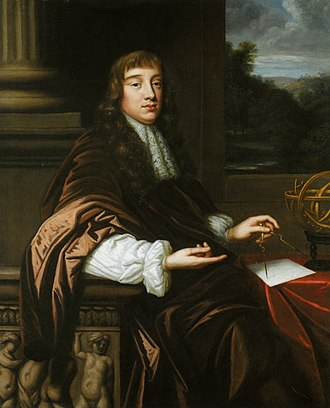
NAME: Hooke, Robert.
ACHIEVEMENT(S): Discovered the law of elasticity, known as Hooke's Law.
NICKNAME/ALIAS: None.
DATE/PLACE OF BIRTH: 18th July 1635, in Freshwater, Isle of Wight, England.
DATE/PLACE/AGE AT DEATH: 3rd March 1703, in London, England. Aged 67.
DISCIPLINE: Physicist.
FIELD: Physics.
LANGUAGE: English.
PARENTS: John Hooke and Catherine Cicely Gyles.
SIBLINGS: Katherine (b. 1628) and John (b. 1630).
SPOUSE: None.
CHILDREN: None.
EDUCATION: Westminster School, London; Christ Church College,
University of Oxford.
MAJOR WORK: 'Micrographia', 1665.
LIFE AND TIMES:
In the mid-1650s, Oxford was the home of a brilliant circle of scientists and intellectuals who held regular meetings. By 1655, Hooke had met <a pal of> Wilkins*, <a pal of> Willis*, <a pal of> Petty*, <a pal of> Wallis*, <a pal of> Wren*, <a pal of> Sprat* and <a pal of> Boyle*.
This group soon recognized Hooke's talents in mechanics and geometry and, after having assisted Willis for a short time, he was recommended to Boyle, who needed help in building an air pump.
Hooke provided a much improved version of the pump originally designed by Guericke*. With it, Boyle (with Hooke's assistance) carried out the experiments which resulted in Boyle's Law, published in 1662.
In 1658, Hooke took on the challenging task of designing an accurate portable clock. His aim was to make a chronometer that would solve the navigational problem of determining longitude.
His first innovation was to attach a coiled spring to the arbor of the balance wheel. Hooke discovered, as did <parallel work with> Christiaan Huyghens* around the same time, that the oscillations of the spring were regular. He then replacing the pendulum, first proposed as a timing device by <improved idea of> Mersenne*, with a vibrating wheel that could be moved, because it oscillated around its own centre of gravity.
With these developments, Hooke created the basic principle of the watch. Based on his design, a marine chronometer accurate enough to measure longitude was eventually
constructed by <facilitated work of> John Harrison* in the 18th century.
In 1659, the Oxford group split up, with the collapse of the Cromwell Protectorate, and most members moved back to London. They continued their meetings, which became formalized between 1660 and chartered in 1662 as the <curator of> Royal Society*.
Hooke was given the position of Curator of Experiments and from late 1662, his job was to provide each weekly meeting ‘with three or four considerable Experiments’, and to test other experiments that might be suggested.
During the early 1660s, Hooke made important improvements to the compound microscope and in 1665, he published his great scientific work, 'Micrographia' ('Small Drawings'). This was the first work devoted to microscopic observations and in it, the descriptions were accompanied by many beautiful illustrations produced by Hooke himself.
'Micrographia' included Hooke’s studies and illustrations of the crystal structure of snowflakes, discussed the possibility of making artificial fibres by a process similar to the spinning of the silkworm and examined the honeycomb structure of cork, coining the modern biological term ‘cell’.
In his great work, Hooke gave birth to the study of animal anatomy with his startling illustrations of the flea, the louse, the gnat and its larvae, and he revealed the structure of the compound eye of the fly.
His groundbreaking studies of microscopic fossils led Hooke to move towards a theory of evolution, when he realised that fossils represented the remains of once-living organisms that could be studied to understand the history of life.
Hooke explained his own scientific ideas in 'Micrographia', among them a theory of combustion with an analogy to respiration, and his mechanical theory of light as pulses of motion transmitted through a material medium, which made him a forerunner of the wave theory of light.
<inspired> Newton* was inspired by 'Micrographia' to develop the experiments that became the foundation of Book Two of Newton’s 'Opticks', the source of the concept of periodicity in modern optics. Seven years later, this connection would become the reason for the first of several bitter disputes between Hooke and Newton, over who had thought of it first.
In 1666, immediately after the Great Fire of London, Hooke became one of three surveyors given the job of re-establishing property lines and supervising the massive rebuilding work. Hooke still found time to design scientific instruments, which eventually included the modern air pump, the wheel barometer, on which the pivoted needle registered the pressure, the double barometer, the marine barometer, an adding machine and the micrometer.
He added telescopic sights to surveying instruments and invented many others, including the first dividing engine, the first spiral gear, used to adjust the setting of telescopes, the universal joint, the iris diaphragm and a lens-grinding machine.
He invented a few purely mechanical systems, among them a variety of carriages, a windmill that would turn itself to the wind, a new type of horizontal sail for windmills, a system of optical telegraphy, a springy saddle and an air gun.
During this period, Hooke’s output was phenomenal. He suggested the freezing point of water as the zero point on the thermometer, then developed an instrument to calibrate the temperature, invented a weather clock, which recorded barometric pressure, temperature, rainfall, humidity and wind velocity on a rotating drum.
He proposed an equatorial quadrant, a depth-sounding machine, a refractometer to measure the index of refraction of liquids and a ‘way-wiser’, an instrument attached to a carriage to measure distances.
In 1677, Hooke and the plant anatomist <collaborated with> Grew* had followed <succeeded> Oldenburg* as secretaries of the Royal Society, but Hooke was unsuccessful in the job and resigned after five years.
Hooke continued lecturing throughout the 1670s, during which time he published a series of six works which, at the end of the decade, were collected in a single volume called 'Lectiones Cutlerianae'.
These Cutlerian lectures contained at least two important scientific discoveries, the first being the law of elasticity, which states that the stretching of a solid body, such as metal or wood, is proportional to the force applied to it. Known as Hooke's Law, it laid the foundation for studies of stress and strain and of elastic materials.
The second, in 1678, proposed the Inverse Square Law of Gravitation to explain planetary motions, but Hooke wasn’t able to prove the law mathematically. He claimed priority over the inverse square law and this led to a serious dispute with Newton, who modified Hooke's law to develop his own Universal Law of Gravitation and removed all references to Hooke.
During the late 1680’s and 1690’s, apart from playing an important role in the dispute between <involved in dispute about> Leibniz* and Newton over priority regarding calculus, he became more and more of a recluse, producing only a few more scientific papers.
ASSESSMENT: Hooke was perhaps the greatest experimental scientist of the seventeenth century.
EXTRA CONNECTIONS:
Hooke met and befriended <a pal of> Ray*, and <a pal of> Aubrey*.
He corresponded regularly with <corresponded with> Leeuwenhoek*.
Developed a version of the <improved> camera obscura*
Influenced <influenced> Haukesbee* and <influenced> Eiffel*
Knew (and fancied) Nell <knew> Gwyn*
Knew <knew> Winthrop*
He worked with <worked with> Halley*
Was a friend of <a pal of> Tompion*
<assistant was> Papin* was an assistant
Worked for <worked for> Flamsteed*
ONELINER: Robert Hooke, famous 17th century experimental scientist
BIBLIOGRAPHY:
Nicols, Richard, Robert Hooke and the Royal Society, Lewes, Sussex, The Book Guild Ltd., 1999.