Transcontinental Railroad
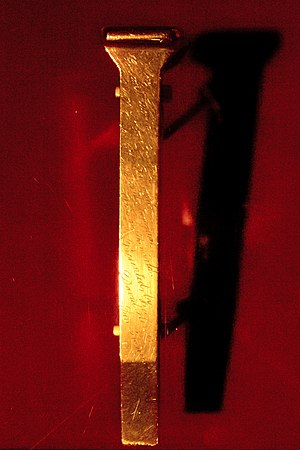
The golden spike (also known as The Last Spike[1]) is the ceremonial 17.6-karat gold final spike driven by Leland Stanford to join the rails of the first transcontinental railroad across the United States connecting the Central Pacific Railroad from Sacramento and the Union Pacific Railroad from Omaha on May 10, 1869, at Promontory Summit, Utah Territory. The term last spike has been used to refer to one driven at the usually ceremonial completion of any new railroad construction projects, particularly those in which construction is undertaken from two disparate origins towards a common meeting point. The spike is now displayed in the Cantor Arts Center at Stanford University.[2]
History
See also: First Transcontinental Railroad § The "Last Spike" ceremony
Completing the last link in the transcontinental railroad with a spike of gold was the brainchild of David Hewes, a San Francisco financier and contractor.[3] The spike had been manufactured earlier that year especially for the event by the William T. Garrett Foundry in San Francisco. Two of the sides were engraved with the names of the railroad officers and directors.[3] A special tie of polished California laurel was chosen to complete the line where the spike would be driven.[3] The ceremony was originally to be held on May 8, 1869 (the date actually engraved on the spike), but it was postponed two days because of bad weather and a labor dispute that delayed the arrival of the Union Pacific side of the rail line.[3]
[
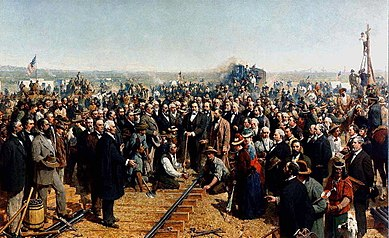
The Last Spike, 1881 painting by Thomas Hill (enbiggen)

On May 10, in anticipation of the ceremony, Union Pacific No. 119 and Central Pacific No. 60 (better known as the Jupiter) locomotives were drawn up face-to-face on Promontory Summit.[4] It is unknown how many people attended the event; estimates run from as low as 500 to as many as 3,000; government and railroad officials and track workers were present to witness the event.[3]
Before the last spike was driven, three other commemorative spikes, presented on behalf of the other three members of the Central Pacific's Big Four who did not attend the ceremony, had been driven in the pre-bored laurel tie:
- a second, lower-quality gold spike, supplied by the San Francisco News Letter, was made of $200 worth of gold and inscribed: With this spike the San Francisco News Letter offers its homage to the great work which has joined the Atlantic and Pacific Oceans.
- a silver spike, supplied by the State of Nevada; forged, rather than cast, of 25 troy ounces (780 g) of unpolished silver.
- a blended iron, silver and gold spike, supplied by the Arizona Territory, engraved: Ribbed with iron clad in silver and crowned with gold Arizona presents her offering to the enterprise that has banded a continent and dictated a pathway to commerce.*[5] This spike was given to Union Pacific President Oliver Ames following the ceremony. The spike was donated to the Museum of the City of New York in 1943, by a descendant of Sidney Dillon.[6] It was, for a time, on display at the Union Pacific Railroad Museum in Council Bluffs, Iowa.[7] The Museum of the City of New York sold the spike in January 2023, via auction, to benefit other items in its collection. The winning bid totaled US$2.2 million[6]
The golden spike was made of 17.6-karat (73%) copper-alloyed gold, and weighed 14.03 troy ounces (436 g). It was dropped into a pre-drilled hole in the laurel ceremonial last tie, and gently tapped into place with a silver ceremonial spike maul. The spike was engraved on all four sides:
- The Pacific Railroad ground broken January 8, 1863, and completed May 8, 1869.*
- Directors of the C. P. R. R. of Cal. Hon. Leland Stanford. C. P. Huntington. E. B. Crocker. Mark Hopkins. A. P. Stanford. E. H. Miller Jr.*
- Officers. Hon. Leland Stanford. Presdt. C. P. Huntington Vice Presdt. E. B. Crocker. Atty. Mark Hopkins. Tresr. Chas Crocker Gen. Supdt. E. H. Miller Jr. Secty. S. S. Montague. Chief Engr.*
- May God continue the unity of our Country, as this Railroad unites the two great Oceans of the world. Presented by David Hewes San Francisco.*[3]
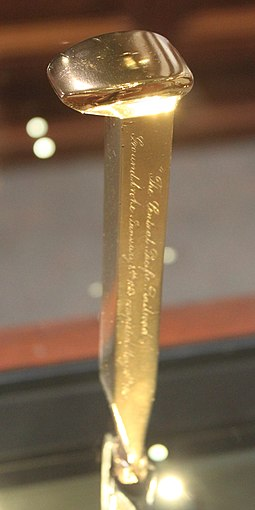
Hewes Family Golden Spike at the California State Railroad Museum
The spike was removed immediately after being hammered in to prevent it from being stolen. A second golden spike, exactly like the one from the ceremony (except for the date), was cast at the same time, and probably engraved at a later time with the correct Promontory date of May 10, 1869. It has been noted that the first Golden Spike engraving appeared "rushed", and the Hewes family spike lettering appeared more polished. It was held, unknown to the public, by the Hewes family until 2005. This second spike is now on permanent display, along with Thomas Hill's famous painting The Last Spike, at the California State Railroad Museum in Sacramento.[8]
With the locomotives drawn so near, the crowd pressed so closely around Stanford and the other railroad officials that the ceremony became somewhat disorganized, leading to varying accounts of the actual events. On the Union Pacific side, thrusting westward, the last two rails were laid by Irishmen; on the Central Pacific side, thrusting eastward, the last two rails were laid by the Chinese!* [9]
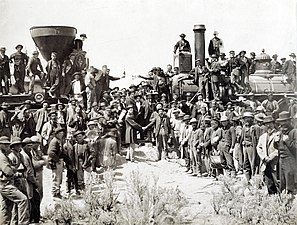
A.J. Russell stereoview No. 539 shows the "Chinese at Laying Last Rail UPRR". Eight Chinese workers laid the last rail, and three of these men, Ging Cui, Wong Fook, and Lee Shao, lived long enough to also participate in the 50th anniversary parade. At the conclusion of the ceremony, the participating Chinese workers were honored and cheered by the CPRR officials and that road's construction chief, J.H Strobridge, at a dinner in his private car.[10]
To drive the final spike, Stanford lifted a silver spike maul and drove the spike into the tie, completing the line. Stanford and Hewes missed the spike, but the single word "done" was nevertheless flashed by telegraph around the country(the spike had been wired to send the signal when struck). In the United States, the event has come to be considered one of the first nationwide media events. The locomotives were moved forward until their cowcatchers met, and photographs were taken. Immediately afterwards, the golden spike and the laurel tie were removed, lest they be stolen, and replaced with a regular iron spike and normal tie. At exactly 12:47 pm, the last iron spike was driven, finally completing the line.[3]
After the ceremony, the Golden Spike was donated to the Stanford Museum (now Cantor Arts Center) in 1898. The last laurel tie was destroyed in the fires caused by the 1906 San Francisco earthquake.[3]
...
Aftermath
Although the Promontory event marked the completion of the transcontinental railroad line, it did not actually mark the completion of a seamless coast-to-coast rail network: neither Sacramento nor Omaha was a seaport, nor did they have rail connections until after they were designated as the termini. The Mossdale Bridge, which was the final section across the San Joaquin River near Lathrop, California, was finally completed in September 1869 connecting Sacramento in California.[11][12][13][14]
Passengers were required to cross the Missouri River between Council Bluffs, Iowa, and Omaha, Nebraska, by boat until the building of the Union Pacific Missouri River Bridge in 1872. In the meantime, a coast-to-coast rail link was achieved in August 1870 in Strasburg, Colorado, by the completion of the Denver extension of the Kansas Pacific Railway.[15]
In 1904 a new railroad route called the Lucin Cutoff was built by-passing the Promontory location to the south. By going west across the Great Salt Lake from Ogden, Utah, to Lucin, Utah, the new railroad line shortened the distance by 43 miles and avoided curves and grades. Main line trains no longer passed over Promontory Summit.

Transcontinental Railroad 75th Anniversary Issue of 1944
In 1942, the old rails over Promontory Summit were salvaged for the war effort; the event was marked by a ceremonial "undriving" of the last iron spike. The original event had been all but forgotten except by local residents, who erected a commemorative marker in 1943. The following year a commemorative postage stamp was issued to mark the 75th anniversary. The years after the war saw a revival of interest in the event; the first re-enactment was staged in 1948.
In 1957, Congress established the Golden Spike National Historic Site to preserve the area around Promontory Summit as closely as possible to its appearance in 1869. O'Connor Engineering Laboratories in Costa Mesa, California, designed and built working replicas of the locomotives present at the original ceremony for the Park Service. These engines are drawn up face-to-face each Saturday during the summer for a re-enactment of the event...
Transcontinental railroad - Wikipedia
...A transcontinental railroad in the United States is any continuous rail line connecting a location on the U.S. Pacific coast with one or more of the railroads of the nation's eastern trunk line rail systems operating between the Missouri or Mississippi Rivers and the U.S. Atlantic coast. The first concrete plan for a transcontinental railroad in the United States was presented to Congress by Asa Whitney in 1845.[2]
A series of transcontinental railroads built over the last third of the 19th century created a nationwide transportation network that united the country by rail. The first of these, the 3,103 km (1,928 mi) "Pacific Railroad", was built by the Central Pacific Railroad and Union Pacific Railroad to link the San Francisco Bay at Alameda, California, with the nation's existing eastern railroad network at Council Bluffs, Iowa/Omaha, Nebraska, thereby creating the world's first transcontinental railroad when it opened in 1869. Its construction was made possible by the US government under Pacific Railroad Acts of 1862, 1864, and 1867. Its original course was very close to current Interstate 80.
Transcontinental Railroad
Main article: First transcontinental railroad
The U.S.'s first transcontinental railroad was built between 1863 and 1869 to join the eastern and western halves of the United States. Begun just before the American Civil War, its construction was considered to be one of the greatest American technological feats of the 19th century. Known as the "Pacific Railroad" when it opened, this served as a vital link for trade, commerce, and travel and opened up vast regions of the North American heartland for settlement. Shipping and commerce could thrive away from navigable watercourses for the first time since the beginning of the nation. Much of this route, especially on the Sierra grade west of Reno, Nevada, is currently used by Amtrak's California Zephyr, although many parts have been rerouted.[3]
The transcontinental railroad provided fast, safe, and cheap travel. The fare for a one-week trip from Omaha to San Francisco on an emigrant sleeping car was about $65 for an adult. It replaced most of the far slower and more hazardous stagecoach lines and wagon trains. The number of emigrants taking the Oregon and California Trails declined dramatically. The sale of the railroad land grant lands and the transport provided for timber and crops led to the rapid settling of the "Great American Desert".[4]
The Union Pacific recruited laborers from Army veterans and Irish immigrants, while most of the engineers were ex-Army men who had learned their trade keeping the trains running during the American Civil War.[5]
The Central Pacific Railroad faced a labor shortage in the more sparsely settled West. It recruited Cantonese laborers in China, who built the line over and through the Sierra Nevada mountains and then across Nevada to their meeting in northern Utah. Chinese workers made up ninety percent of the workforce on the line.[6] The Chinese Labor Strike of 1867 was peaceful, with no violence, organized across the entire Sierra Nevada route, and was carried out according to a peaceful Confucian model of protest.[7] The strike began with the Summer Solstice in June, 1867 and lasted for eight days.[8]
Land Grants
The Transcontinental Railroad required land and a complex federal policy for purchasing, granting, conveying land....
In popular culture
The joining of the Union Pacific line with the Central Pacific line in May 1869 at Promontory Summit, Utah, was one of the major inspirations for French writer Jules Verne's book entitled Around the World in Eighty Days, published in 1873.[123]
While not exactly accurate, John Ford's 1924 silent movie The Iron Horse captures the fervent nationalism that drove public support for the project. Among the cooks serving the film's cast and crew between shots were some of the Chinese laborers who worked on the Central Pacific section of the railroad.

Postcard for the film Union Pacific, released in May 1939
The feat is depicted in various movies, including the 1939 film Union Pacific, starring Joel McCrea and Barbara Stanwyck and directed by Cecil B. DeMille, which depicts the fictional Central Pacific investor Asa Barrows obstructing attempts of the Union Pacific to reach Ogden, Utah.
The 1939 movie is said to have inspired the Union Pacific Western television series starring Jeff Morrow, Judson Pratt and Susan Cummings which aired in syndication from 1958 until 1959.
The 1962 film How the West Was Won has a whole segment devoted to the construction; one of the movie's most famous scenes, filmed in Cinerama, is of a buffalo stampede over the railroad.
The construction of what presumably is – or is suggested to be – the transcontinental railroad provides the backdrop of the 1968 epic Spaghetti Western Once Upon a Time in the West, directed by Italian director Sergio Leone...
The American Experience series' 2002–2003 season documents the railway in the episode titled "Transcontinental Railroad".
The building of the railway is covered by the 2004 BBC documentary series Seven Wonders of the Industrial World in episode 6, "The Line".
The popular sci-fi television show Doctor Who featured the transcontinental railroad in a 2010 BBC audiobook entitled The Runaway Train, read by Matt Smith and written for audio by Oli Smith.
The construction of the transcontinental railroad provides the setting for the AMC television series Hell on Wheels. Thomas Durant is a regular character in the series and is portrayed by Star Trek actor Colm Meaney.