Uchatius
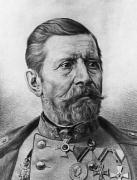
ACHIEVEMENT(S): First projector of moving pictures
NICKNAME/ALIAS: None
DATE/PLACE OF BIRTH: 20 October 1811, at Theresienfeld, Lower Austria
DATE/PLACE/AGE AT DEATH: 4 June 1881, at Vienna, Austria. Aged 69
DISCIPLINE: Soldier
FIELD: Military
LANGUAGE: German
EDUCATION: Unknown
MAJOR WORK: "The Lantern Wheel of Light" 1854
LIFE AND TIMES:
In 1845, on the suggestion of his commander, Colonel von Hauslab, Uchatius began developing a projector of moving pictures as an aid to military instruction. Uchatius began his experiments by pointing a series of candle-powered slide projectors at the same screen, each projector containing a single image in a "motion sequence". He then quickly moved a candle from one projector to the next and discovered that as the pictures flashed on the screen one after another, the illusion of motion was created and projected on the screen. Uchatius then combined a magic lantern with the principle of an early stroboscopic device, the Belgian inventor Joseph Plateau's optical toy known as the "Magic Disk" or Phenakistiscope (1836). Plateau's invention consisted of a disc with radial slits which was turned while viewing a rotating wheel: when the rotational speed of the disc and the wheel matched exactly, the wheel appeared motionless.
Uchatius appears to have adopted Plateau's idea of using a slotted glass disc with an opaque shutter, to which he added a kerosene lamp and two lenses, providing the very first projection of moving pictures. By 1850 he had created what became known the ‘Lantern Wheel of Light.’ Having arranged a number of magic lanterns in a semicircle so that they were focused on a wall screen, Uchatius then filled them with drawings and moved a kerosene lamp very rapidly around the semicircle behind them. The combination of a weak lamp and a shutter with very narrow slits proved unable to project a clear image larger than six inches square, which was too small and dim for use as a teaching aid.
By 1852 Uchatius was using as many as 12 different glass slides arranged in a circle on a disc, each containing a single transparent picture and with its own lens focused upon the same point on a screen. He had also taken the important step of rotating the pictures instead of the light source, and used a single, stationary light source.
In 1853 he decided to eliminate the shutter and to use Drummond’s* more powerful limelight as the light source, and that year constructed a Lantern Wheel of Light in which the transparencies were positioned around a fixed disc, a projection lens allocated to each picture, and the light source and condenser again revolved in a circle so that one picture after the other was thrown on the screen.
In 1854 when he presented his device to the Vienna Academy of Sciences, a Viennese optician named Prokesh recognized the superiority of Uchatius's Lantern Wheel of Light because it could show its projected images to a whole room of spectators (a significant technical advance) and began commercial production. Around the same time, a Viennese magician named Ludwig Doebler purchased the original apparatus and became the first professionally to exhibit moving pictures in his travels all over Europe.
Fifteen years later, in 1869, Uchatius' projector was taken to the United States by A. B. Brown, who incorporated into the machine a Maltese cross arrangement and shutter, and patented his design. These improvements ensured the intermittent movement required between frames, and proved to be essential to the development of modern cinematography.
Uchatius was not only a military man, but also a trained chemist and photographer, and physicist. However, despite rapid advancement in the army, he felt he had received little recognition for his scientific work and, deeply dissatisfied with his life, he ultimately committed suicide in Vienna in 1881. During the same year, Muybridge* and Marey* began their six-month collaborative study of motion in Paris, using their series of photographs showing motion and an Uchatius Lantern Wheel of Light.
ASSESSMENT: Franz von Uchatius was an Austrian inventor and weapons engineer
who is now remembered as an early pioneer of cinematography.
EXTRA CONNECTIONS: None
ONELINER: Franz von Uchatius, pioneer of cinematography
BIBLIOGRAPHY:
Ceram, C. W., Archaeology of the Cinema, trans. by Richard Winston, New York: Harcourt, Brace & World, Inc., 1965
Liesegang, Franz Paul, Dates and Sources: A Contribution to the History of the Art of Projection and to Cinematography, orig. publ. 1926 - English translation with additional notes by Hermann Hecht, London: The Magic Lantern Society of Great Britain, 1986
Macgowan, Kenneth, Behind the Screen, New York: Dell Publishing, 1965
PARENTS: Unknown
SIBLINGS: Unknown
SPOUSE: Unknown
CHILDREN: Unknown