Marey, EJ
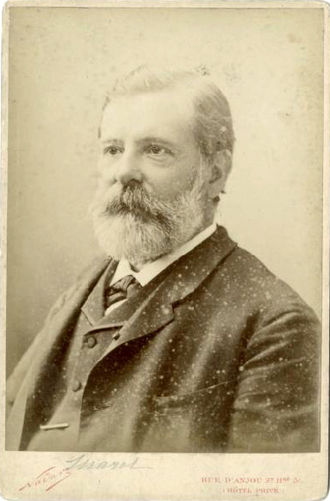
ACHIEVEMENT(S): The development of physiology in France and the first scientific cinematography.
DATE/PLACE OF BIRTH: 5th March 1830, Beaune, France.
DATE/PLACE/AGE AT DEATH: 15th May 1904, Paris, France. Aged 74.
DISCIPLINE: Physiologist
FIELD: Physiology.
LANGUAGE: French.
PARENTS: Marie-Josephine Bernard and Claude Marey.
SIBLINGS: None.
SPOUSE: None.
CHILDREN: Francesca, an illegitimate daughter. An illegitimate son.
EDUCATION: Faculty of Medicine, Paris.
MAJOR WORK: Invention of the cine camera.
LIFE AND TIMES: At the Paris Faculty of Medicine Marey was a brilliant student with a talent for clinical research and, after graduating, he became an intern at the Hôpital Cochin. In 1859, his doctoral thesis, ‘The circulation of blood in normal and pathological states’, used data from recording instruments based on those of the German physiologist <used instruments by> Ludwig*.
Marey then established himself in his own medical practice, which failed after a year, so he set up as a consultant physiologist, funding his laboratory with royalties earned from a pulse-recorder named a sphygmograph which he had developed in 1859.
In his early researches, he studied the mechanics and hydraulics of the circulatory system. Since physiology wasn’t yet an advanced science, Marey often designed his own instruments and, with Auguste Chauveau, he developed the cardiographic tracer, which established the relationship between heart rate and blood pressure.
Marey often noted the movements of an organ or body system with a recording stylus and then used the data to build a model of the organ or system, following on the work of <work related to> Helmholtz* and <work related to> Vierodt*.
In 1868, he was appointed to the Chair of Natural History of organized bodies at the Collège de France. At this time, Marey’s research into human and animal locomotion turned to the movements of the wings of birds and insects. He showed that the upward or forward motion of a creature in flight happened, not by the contracting or extending of the wing muscles, but by changes in the form of the wing which modified its air resistance.
Marey also studied the length and frequency of steps taken by humans and quadrupeds. In this study, he examined skeletal structure, the length of bones, the size and insertion of muscles, and the various joint angles used in movement.
To help in this research, he invented “Marey’s Tambour” (still in use until the 1950’s). The tambour was an air-filled metal capsule covered by a rubber membrane. Movement of a subject’s muscles compressed the membrane, forcing air into a fine, flexible tube, attached to another capsule membrane that reacted to the variation in air pressure and moved a recorder pen.
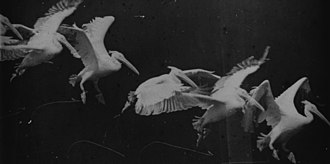
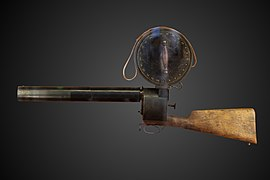
In October 1878, Marey came across <influenced by> Muybridge’s* photographic study of the movement of a horse. This prompted him to develop his own photographic equipment in 1882 and his first camera, the fusil photographique, used a rotating photographic glass plate, that allowed him to produce twelve sequenced pictures of flying birds.
His next camera, the chambre chronophotographique was, in effect, the first modern cine-camera and used silver bromide solution on a paper ribbon, and a rotating shutter. In early tests in 1890, Marey photographed waves breaking, and the movement of fish and spiders.
To take pictures fast enough to record the wing movements of flying insects he narrowed the shutter and concentrated the light of a heliostat onto the camera lens. This resulted in pictures taken at 1/25,000 of a second.
In the same year, he invented time-lapse photography, which, together with his animal photography, laid the foundations for all subsequent scientific photography. At the Universal Exposition of 1899, held in Paris, France, Marey met <inspired> Edison* and provided the inspiration for Edison’s kinetescope.
ASSESSMENT: His single-lens, slotted-disk camera is the technical basis of cinematography.
EXTRA CONNECTIONS: His work related to that of <work related to> Martinville*, <work related to> Louis * and <work related to> Erasmus Darwin*.
He used <used equipment of> Uchatius'* equipment
ONELINER: E.J. Marey, first to film slow motion
BIBLIOGRAPHY:
Marta Braun, Picturing Time: the Work of Etienne-Jules Marey (1830-1904), University of Chicago Press, Chicago and London, 1992.