Allston, W
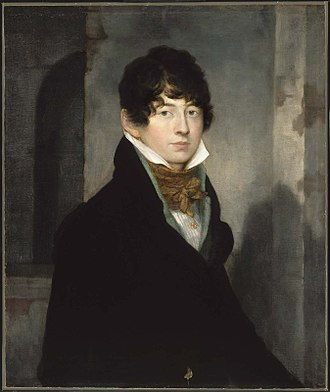
Name: Washington Allston (self-portrait)
Achievements: A pioneer of American Romantic art
Born: November 5, 1779; Georgetown, South Carolina
Died: July 9, 1843; Cambridge, Massachusetts (Aged 63)
Field & Discipline: Art; Painter
Education: Mrs. Calcott's School, Charleston; School in Newport, Rhode Island; Harvard University; Royal Academy, London
Major Work: "Belhazzar's Feast"
Life & Times:
Determined to study art, Allston defied his parents and at the age of 22 sailed to London, where he came under the protection of the well-established American artist [was taken up by] Benjamin West*. Allston was admitted to the Royal Academy, where he studied for three years with West and [studied with] Henry Fuseli*, both Romantic artists. In 1802, Allston exhibited three pictures at the British Institution. In 1803, he and fellow American artist, John Vanderlyn, traveled to Paris, where Allston spent some months studying the Louvre collections.
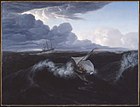
In 1804, in Paris, Allston painted his first important piece, "The Rising of a Thunderstorm at Sea.” Inspired by the seascapes of British painter [inspired by] J.M.W. Turner*, the work is considered the first great seascape by an American. Allston continued alone to Italy, stopping off in Siena to learn Italian, then visiting Venice and Florence before arriving in Rome in late 1804. In Rome, he struck up friendships with British poet [was a pal of] Samuel Taylor Coleridge* and American writer [friend of] Washington Irving*, and impressed the Roman art world with his classical landscapes,
Allston began to imitate the style of the Venetian Renaissance artists, whose use of color and light influenced him. In 1808, he returned to America, set up a studio in Boston, and painted portraits. But three years later, he returned to England with his wife and his pupil, [taught painting to]Samuel Morse,* and found that West was now making a name for himself by painting enormous canvases with religious-moral messages.
Following in West's footsteps, Allston established himself as a major historical and Biblical painter. He created such master-works as "The Dead Man Restored to Life by Touching the Bones of the Prophet Elisha,” "Saint Peter in Prison" and "Jacob's Dream.” In 1814, Allston and his wife fell seriously ill with a mysterious stomach ailment which killed his wife. Allston fell into a deep depression, turned to religion and was confirmed Episcopalian. In this period of grief he painted some of his major works: "Elijah in the Desert" and "The Agony of Judas" (which he eventually destroyed, thinking it might be construed as immoral, though he considered it the best head he had ever done). Two other masterpieces of the period were: "Uriel in the Sun" and "Jacob's Ladder.” He also painted Coleridge's portrait and published a book of verse: "The Sylphs of the Season with other Poems.” In 1817, he began his greatest undertaking: "Belhazzar's Feast,” which he was to work on for the rest of his life. He was elected an honorary member of the American Academy of Fine Arts in New York City in 1818. In the same year, the Royal Academy elected him an associate member.
Lack of money obliged Allston to return to the U.S., where, despite his reputation as America's greatest artist, he found he could not sell his paintings because they were considered too esoteric. In 1821, Allston changed his style, producing smaller landscapes and figural work, in a more subdued and sentimental tone. He tried to complete his great canvas: "Belhazzar's Feast,” but found himself hobbled by his new style. Friends gave him $10,000 so that he could work on "Belhazzar,” but Allston would never finish the painting. He was still working on it on the day he died.
In 1830, Allston turned down a commission to work on the Rotunda of the United States Capitol in Washington, DC. The subject (a battle from the War of Independence) did not interest him, because, although it would have enabled him to work in the monumental style, it did not allow for the brooding, meditative qualities typical of his larger works. In 1830, Allston married Martha A. Dana, the sister of poet Richard Henry Dana, and moved to Cambridgeport. Among the best of his works of these later years were "The Spanish Girl,” "The Evening Hymn,” and "Roman Lady Reading." He also painted a number of pastoral landscapes.
A prolific artist, Allston exhibited 47 paintings at a Boston gallery in 1839. In 1841, he published a Gothic tale he had written nearly 20 years earlier, "Monaldi.” Four lectures he wrote on the philosophy of art were published posthumously in 1843. In 1841, he was elected first president of the Boston Artists' Association. Toward the end of that year he became ill again, although he continued to work. When his "Belhazzar's Feast" was exhibited after his death, it caused a sensation, and was an inspiration to other monumental painters.
Assessment: Demonstrated American Romanticism better than any other painter between 1800 and 1840
Oneliner: Washington Allston, one of the first American Romantic painters
Bibliography:
- Richardson, Edgar Preston, Washington Allston: a Study of the Romantic Artist in America. The University of Chicago Press; Chicago, 1948.