Jefferson, Thomas
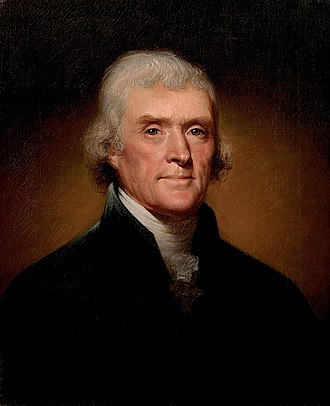
Nickname/Alias: Sage of Monticello; Father of the Declaration of Independence; Long Tom
Achievements: Third President of the United States.
Born: April 13, 1743; Shadwell, Albermarle County, Virginia
Died: July 4, 1826; Monticello, Virginia (Aged 83)
Field & Discipline: Politics; Government; President
Education: William and Mary College, Williamsburg, Virginia
Major Work: Drafting of the Declaration of Independence
Life & Times:
In 1767, at 24, Jefferson was admitted to the Virginia bar and two years later elected to the Virginia House of Burgesses, where he served between 1769 and 1775. After Britain began to tax America via the [influenced by] Townshend* Acts and the Tea Act, Jefferson began to take an anti-British stance.
In 1774, he wrote "A Summary View of the Rights of British America," an influential and eloquently-written tract in support of the right of American citizens to independence from Britain. From 1775 to 1777, Jefferson served as a Virginia delegate to the first Continental Congress, where Jefferson and four others were asked to describe the break between America and Britain in a document for the world at large. The result was the Declaration of Independence, principally drafted by Jefferson, who said his ideas for the document were drawn from the liberal and Enlightenment philosophies of the time. The Declaration was adopted on July 4, 1776.
Jefferson returned to Virginia, where he was instrumental in the framing of a state constitution, which expanded suffrage. He proposed the abolition of the slave trade and sponsored bills which would bring about a more equitable distribution of land. He also proposed reducing the privileges of the Anglican church in Virginia, but it was not until 1786 that his "Statute for Religious Freedom" was passed.
Between 1779 and 1781, Jefferson was Governor of Virginia and did not contribute greatly to the course of the American Revolution. His small attempts to organize resistance against the British during the war were generally unsuccessful. When the British invaded Virginia, Jefferson was forced to flee the capital of Richmond. Criticism of his governorship was harsh, and Jefferson resolved never to return to public life. His retirement was brief, but he made use of it to work on "Notes on Virginia", a natural and civil history of the state. It was published in 1785. In it Jefferson meticulously documented the natural resources of Virginia and fiercely opposed the proposition of the French naturalist Georges Louis Leclerc, Comte de Buffon, whose authoritative Histoire Naturelle stated that nature, plant life, animal life, and human life degenerate in the New World in contrast with their state in the Old World.[3] ^He made an epic effort to ship a whole moose to Buffon prove his point.
After his wife died suddenly in 1782, (they had been happily married for 10 years), Jefferson decided a return to politics would ease his grief. In 1783, he was voted back into the Continental Congress, where he drafted the first ordinance for governing the West. In 1783, he oversaw the adoption of a decimal system of coinage originally suggested by politician [influenced by] Gouverneur Morris* .
In 1784, Jefferson went to France to join U.S. envoys [was a Declaration of Independence co-signer with ] Franklin* and [ was a Declaration of Independence co-signer with ] Samuel Adams* in negotiations of commercial treaties. The following year he was appointed American Minister to France at the court of [US Minister to] Louis XVI*, where he served until 1789. His main duty lay in achieving preferential treatment for American trading interests.
Ill at ease at first, Jefferson eventually got used to Parisian society (in spite of a major disagreement with [row with] Buffon*) and by mid-1786, entertained the cultural world at his house (including the artist [entertained] Trumbull*) and attended the philosophical salons, where he met [met] Condorcet.* He also met [a pal of] PS Du Pont* Nemours, with whom he would continue a lifelong friendship and correspondence and whose company ([helped set up] Du Pont IE Co*) he helped to set up. Jefferson witnessed and strongly supported the French Revolution in 1789.
Jefferson left France intending to return, but [Sec. of State under] Washington* asked him to become Secretary of State, and, with some reluctance, Jefferson agreed. The Constitution had only recently been written, and its interpretation was still ambiguous. In Jefferson's view, it gave the states greater power and autonomy over central government. Secretary of the Treasury [opposed] Alexander Hamilton* thought otherwise, and preferred a strong federal government. Their different outlooks were to bring the two men into conflict over various issues.
Hamilton wanted to fund the national debt by paying back the bonds that had been sold during the War of Independence. Jefferson opposed this, reasoning that northern speculators had the most to gain. But Hamilton's bill was passed. The proposal to create a national bank infuriated Jefferson, who disputed the government's right to form such an institution, saying not only was there nothing in the Constitution to support it, but it would also greatly increase the power of central government. Again, Congress passed the bill.
In 1793, Jefferson resigned, to spend more time at his estate Monticello, which he had begun to build in 1770. The design and construction of his house, which kept him busy for 35 years, was greatly influenced by Italian architect [influenced by] Palladio's "Four Books of Architecture".
Jefferson, who could not stay away from the political scene for very long, decided he was needed as an alternative to Hamilton. He united with Madison to form the liberal democratic-republican party, and was named leader.
In 1796, Jefferson became Vice-President to [Vice-President under] John Quincy Adams*. He established legislative procedure, and compiled a Manual of Parliamentary Practice which still influences the operation of the Senate and House of Representatives.
War between Britain and France caused continued political wrangling. The United States was officially neutral under Washington, but private loyalties were now being voiced publicly. Jefferson supported France, and once again Hamilton represented the opposite view. Adams resisted Hamilton's strong pressure to go to war against France, but the party split under the strain.
Jefferson ran for President in 1800. He beat Adams, but polled the same number of electoral votes (73) as [won election over] Burr,* his running mate. The decision was then up to the House of Representatives. The Federalists backed Burr, but Jefferson was finally elected on the 36th ballot (ironically, with the support of Hamilton, who broke a tie in Jefferson's favor).
As President, Jefferson worked towards reconciliation with the Federalists, but he generally preferred Republican appointees. Much of his administration was characterized by the limiting of central government and economy. The budget was balanced, the national debt reduced from $83 million to $59 million, even though taxes were repealed, and the army and navy were dramatically reduced in numbers.
At Jefferson's instruction, the Louisiana Purchase was arranged in Paris by [bought “Louisiana” through] Robert L Livingston*. The deal almost doubled the size of the land area of the United States. Jefferson sent the Lewis and Clark Expedition to explore the new trans-Mississippi domain.
Jefferson achieved another foreign policy success when the navy won the battle against Tripoli, over the actions of the Barbary pirate states of North Africa. But Jefferson's Embargo Act of 1807 was highly unpopular because it prohibited American exports to Britain and proved costly to the American economy, especially in New England. The embargo remained in effect for 15 months before Congress repealed it late in Jefferson's presidency. This failed foreign policy would eventually escalate into the War of 1812.
In 1809, Jefferson left office and retired to Virginia, where he continued to try to effect democratic reform. At Monticello, he pursued his scholarly and scientific interests, in 1825 founding the University of Virginia. He also designed the Virginia State capitol (for which he hired [hired] Clerisseau*) and a number of mansions.
In his epitaph, Jefferson described himself as the author of the Declaration of American Independence and of the Virginia Statute for Religious Freedom, and as the Father of the University of Virginia.
Extra Connections:
Jefferson met: actor [met] Garrick*, engineer [met] Smeaton*, cotton-gin inventor [met] Eli Whitney*, Swiss scientist [met] Saussure*, explorers [met] Alexander von Humboldt* and [met] Bonpland*; chemist [met] Liebig*, economist [met] Price*, [met partner of] Watt’s* partner [met] Boulton* and French philosopher [met] Helvetius*
He knew the work of [knew work of] Thomas Paine*
Commissioned work from [commissioned] Fulton*
Knew work of] Rowland Hill’s* work.
Friend of [a pal of] James Monroe* and geologist [a pal of] Maclure*
Critical of [critical of] Andrew Jackson*
Influenced by [influenced by]Beccaria 2*
Supported [supported] Beaumarchais PA 2’* efforts to help the War of Independence.
Vaccinated his family and neighbors with [used vaccination by] Jenner’s* smallpox vaccine
He was a Declaration of Independence co-signer with [was a Declaration of Independence co-signer with] Rush*
He authorized the [authorized] Louisiana Purchase*
At one point he worked for Foreign Secretary John [worked for] Jay*
He was a colleague of [a colleague of] Lafayette*
His home was requisitioned by [home requisitioned by] Cornwallis*?
Assessment: Worked for the independence of the American states, and the non-interference of government..
Oneliner: Thomas Jefferson, President of the United States
Language: English
Father: Peter Jefferson
Mother: Jane Randolph
Siblings: Jane; Randolph
Spouse: Martha Wyles Skelton
Children: Martha Randolph; Jane; another son, name unknown; Maria Eppes; Lucy; Lucy (named after dead sister)
Bibliography:
- Brown, David S. Thomas Jefferson A Biographical Companion. ABC-CLIO Biographical Companion. Santa Barbara, California. 1998.
Lee Alan Dugatkin Mr. Jefferson and the Giant Moose: Natural History in Early America
AMERICAN CONNECTIONS
THOMAS JEFFERSON (VA) was thirty-three. A young
lawyer with only seven years' experience in politics, he already had a
reputation for clear thinking and better writing. So he got the job of
drafting The Document. One committee, one Congress, and eighty-six text
changes later they scribbled their signatures and it was all over bar
the shooting.
Jefferson's career (governor of Virginia, vice president, and twice
president) wasn't roses all the way. Apart from successes like fighting
off the old guard who didn't want anything to change, making sure the
country stayed democratic, liberalizing America's international trade,
and introducing decimal coinage with dollars and cents, most of the
reforms Jefferson tried back home in Virginia failed (except the one setting up the university), which made the strict short list he prescribed for his tomb:
Here was buried
Thomas Jefferson
Author of the Declaration of American Independence
of the statute of Virginia for Religious Freedom
and Father of the University of Virginia
(toasted as such at its inaugural by Madison and Lafayette; EA Poe was a student).
He also specified the tomb be made of coarse local stone so "that no one might be tempted hereafter to destroy it for the value of the materials."
In 1785, after a major row, the Virginia Assembly rejected (by one vote)
Jefferson's proposal to scrap the death penalty. Jefferson got the idea
from a minor government official in Milan, Italy. Cesare Beccaria was a
shy little man who in 1764 anonymously published a small book: On
Crimes and Punishments. An instant rave with such as Catherine
the Great of Russia, Empress Maria Theresa, Voltaire, John Adams, and
all intellectuals.
Beccaria effectively invented modern criminology and penology. His key
criticism of capital punishment: "It's absurd that laws which punish
murder should commit one."
Beccaria also standardized Milan's measures, basing his idea on
astronomy and suggesting that there ought to be an internationally
accepted "universal" measurement system. At this time France had seven
hundred different kinds of measures, depending on city and materials
being measured, so for the French revolutionaries (with their mania for
standardization), Beccaria was music to the ears.
The astronomical bit of Beccaria's idea called for setting up a standard
international length equal to one-ten-millionth of a line from either
pole to equator. Not easy to measure, given the oceanic interruptions.
The only way to do the job without falling in the water was to use just
a tenth of the pole-equator distance (for example from Dunkirk to
Barcelona, which was all land and mostly France). Two measurers were
chosen, Jean-Baptiste Joseph Delambre and Pierre-François-André Méchain.
Delambre would go Dunkirk to Rodez, Méchain Rodez to Barcelona (Cassini was supposed to be in charge, but he fell from favor when he objected to the arrest of Louis XVI ; Mechain was arrested because his instruments were mistaken for weapons).
In 1799 they finished and the meter was established. "Méchain's error" represents in each metre an error of approximately 0.23 millimetres[3] – slightly more than the width of a single strand of human hair.
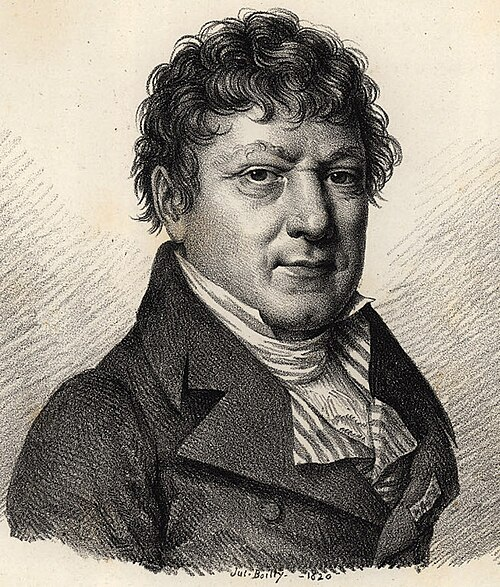
Delambre was famous for the incredible accuracy of his noodling. In the
Dunkirk-Rodez case (which involved calculations to an eyesmarting
nineteen decimal points), each of Delambre's measurements along the
route was accurate to 1/36,000. By 1801 Delambre was secretary to the
French Science Academy and a very big scientific fromage and
winner of every honor in zee book. So in 1809 the French minister of war
jumped when Delambre said let that Englishman go.
The chap in question was James Macie, a minerals freak on one of his
frequent trips to Europe (in spite of Napoleon-versus-England war) to
look at guess what. Got caught playing with crystals in Hamburg (French
at the time) and jailed. Then freed by Delambre. The illegitimate Macie
became famous for three things. One: He discovered calamine (eventually renamed smithsonite, used in making brass. He also studied the chemistry of human tears, snake venom and other natural occurrences).
He explored Kirkdale Cave, successfully challengimg previous beliefs that the fossils within the formations at the cave were from the Great Flood.[17]
Two: After he changed his name to that of his natural father (Duke of
Northumberland), whose family name was Smithson, he then left
$508,318.46 to be used to establish the Smithsonian Institution. He hung out with Priestly, Lavoisier and Banks)
And three: In 1791 he published a paper on a queer stone (tabasheer) found
in bamboo joints.
In 1819 tabasheer caught the interest of the great David Brewster,
Scottish science king of all reflection-refraction-diffraction matters
(he also invented the kaleidoscope). If something related to light
Brewster was on it like a ferret. In the case of tabasheer he discovered
it was a form of opal that phosphoresced when hot, reflected a curious
bluish-white light, and was more holes than solid, so it absorbed
liquid. In India it was used to suck out reptile venom and was known as
"snake-stone."
Brewster had wanted to be a preacher but once at a dinner fainted when
asked to say grace, so opted for science. In the end he jolted St.
Andrews University (third oldest in English-speaking world, established in 1413, alums include signer James Wilson and Andrew Carnegie) out of its medieval torpor, founded the British Association for the Advancement of Science (host of the famous Huxley - Wilberforce evolution rumble), and for years was editor of the *Edinburgh Encyclopaedia*. (rival of the Britannica). One of his less-famous contributors was Dr. John Bostock, sneezer.
Bostock studied under Priestly at the Unitarian school at Hackney, then was an Edinburgh U (established 1582 by James I ) grad living in Liverpool and keen on botany and literature. Bostock was one of the first chemical pathologists, interested in bile and urine. For two months in the summer of 1819 (and then every
year thereafter) Bostock developed itchy eyes, runny nose, wheezy
breathing, and sneezes. Over the next nine years he found and studied
twenty-eight others who were doing the same. In 1828 he published his
results, identifying what he called catarrhus aestivus (hay
fever).
[Fellow sufferer was William Cavendish, 6th Duke of Devonshire (devastated when his cousin Caroline chose future PM William Lamb after an affair with Byron). The hay fever was inconvenient, as he was into gardening. His pal Paxton built him a greenhouse that was the model for the Crystal Palace. He also helped establish Kew Gardens, and the Cavendish Banana is named for him, which replaced the superior Gros Michel because of bad management. "Yes! We Have No Bananas" is a novelty song said to have been inspired by a shortage of Gros Michel bananas, which began with the infestation of Panama disease early in the 20th Century.]
Since neither he nor any other GP had noticed this (today,
common) ailment of hay fever, it was probably caused by pollution in the newly
industrializing environment of the time.
A fact confirmed a little later by the irascible Dr. John Elliotson.
Elliotson was a hot-shot clinician who also published on prussic acid
treatment, opium medication, and the medical properties of creosote.
He was always at the 'leading edge' of his profession: he was one of the first in Britain to use and promote the stethoscope,[4] and one of the first to use acupuncture.[5]
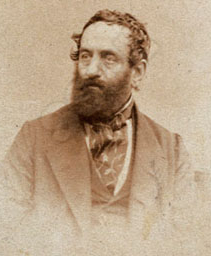
Barely 5 ft (152 cm) tall, with dark complexion and a very large head,[11] he was also lame (following an 1828 carriage accident). His appearance presented a strong contrast to his 'intramural enemy' Robert Liston, one of the fastest surgeons of all time.
He expressed his unconventionality (first doc to wear a beard, and donning
trousers rather than breeches) by getting deeply into head-bump-reading (phrenology)
and then mesmerism. By 1837 he was professor at University College
Hospital, London, and used the hospital theater for some astonishing
mesmeric shows attended by the rich and famous (pal of Dickens and Thackeray). Elliotson would mesmerize and then cure sufferers from all kinds of diseases. In 1838
the authorities decided this might be charlatanism and threw him out.
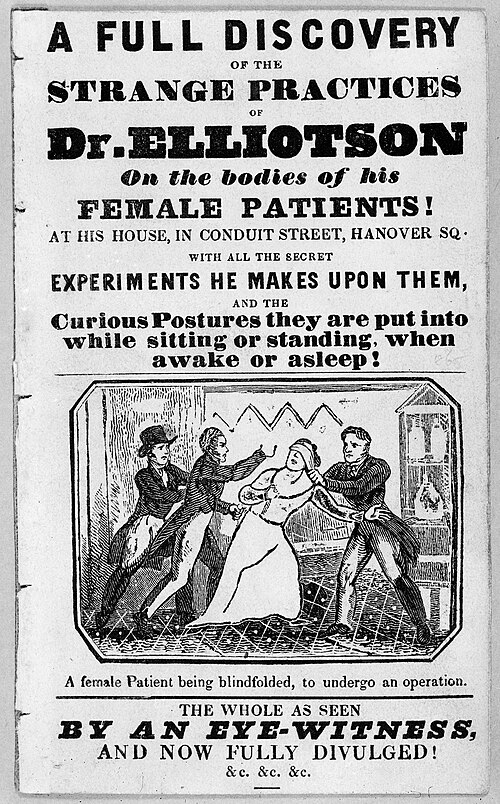
Elliotson dreamed about one kind of mesmeric treatment he was never
going to be allowed to do. It was practiced in India where Dr. James
Esdaile (of the East India Company) was carrying out hundreds of surgical procedures with the anesthetic aid of the mesmeric technique (waving hands over the body and breathing onto the face and head). Finally, in 1850 at the Calcutta Hospital, his
down-to-earth bosses (all Brits) watched him do it and said it seemed to
work. Then chloroform arrived on the medical scene and that was the end
of "look-into-my-eyes-and-feel-sleepy" operations.
Both Esdaile and Elliotson had been influenced by the "mystery force"
discovered by German count Karl von Reichenbach in 1844. Reichenbach was
a scientific entrepreneur who invented a more efficient charcoal oven
and analyzed the gunk by-product. In which he found (and named) creosote
and paraffin. He also built metallurgical factories, grew sugar beet,
and investigated meteorites. Reichenbach's mystery force was called "Od"
and was supposed to be an invisible kind of gravity that allowed some
sensitive people (mostly women) to see (in the dark) the "Odic light"
being given off by objects. Naturally enough, Reichenbach was
slaughtered by his science peers, especially the one he visited in
Leipzig and failed to convince.
Mind you, Gustav Fechner had his own little foibles. In 1838 Fechner
started thinking about the relationship between psychology and
physiology, especially the origin and meaning of the afterimages people
saw when they'd been staring at bright light. He chose the sun and
stared. And went blind for three years. On recovery he "saw" the "souls"
of plants. This led (of course) to investigation of the link between
mind and body. And to experiments with light, weights, and sounds.
Fechner was looking to quantify awareness: How much extra light, weight,
or sound did you need before you noticed things had changed? He
discovered there was a constant. With light the just-noticeable increase
had to be more than one-hundredth of the original, with weight
one-fortieth, and with sound one-tenth. He called this stuff
"psychophysics."
Fechner's work on subjective impressions got universalized by Austrian
physicist Ernst Mach, who by 1873 had a paper bag on his head while
being spun round on a revolving chair. Mach's observation: Once you were
up to speed the awareness of spinning went away. You felt no movement at
all. Within your own frame of reference and with no external clues to
help, it felt as if you weren't moving. So this had to be true about the
entire universe and any observations we might make about it. Everything
was affected by our frame of reference and the frame of reference was
affected by where it was and what it was doing in relation to the rest
of the universe. Everything, in other words, was relative. Enter
In 1909 Mach was recommended for (and got) a Nobel because his proposer
(German chemist Wilhelm Ostwald, already a Nobel) thought Mach could do
with the money. Ostwald was the guy who standardized color. In 1920 his
Atlas of Color was used by two Americans to produce today's
definitive Color Harmony Manual. Ostwald also invented his
own artificial language ("Ido" a rival of Esperanto), and developed a theory about
"Energetics" (everything could be explained in terms of energy). He also
got deeply into social theory with the idea that the individual was a
cell in the collective human organism.
Ostwald's day job was chemical catalysis (for which, the Nobel). So he
got very excited by the work on chemical reactions being done by fellow
geek William Ramsay. Ramsay was another one of those Victorian
multi-talents, fluent in several languages, member of the British royal
sewage commission, and popular science writer.
And he was hot stuff with frozen air. Which he allowed to boil off, then distilled out the known ingredients like oxygen, nitrogen, carbon dioxide, and so on, then
examined what was left. By 1898 this technique had revealed the
existence of gases that were so "do-nothing" (inert, so no evidence of
their presence) they were really hard to find. Besides which, there were
only teeny-weeny amounts of them in air: argon was one part in a
hundred, neon was one part in eighteen million, krypton was one part in
a million, and xenon was one-tenth of one part in a million. So Ramsay
got a Nobel.
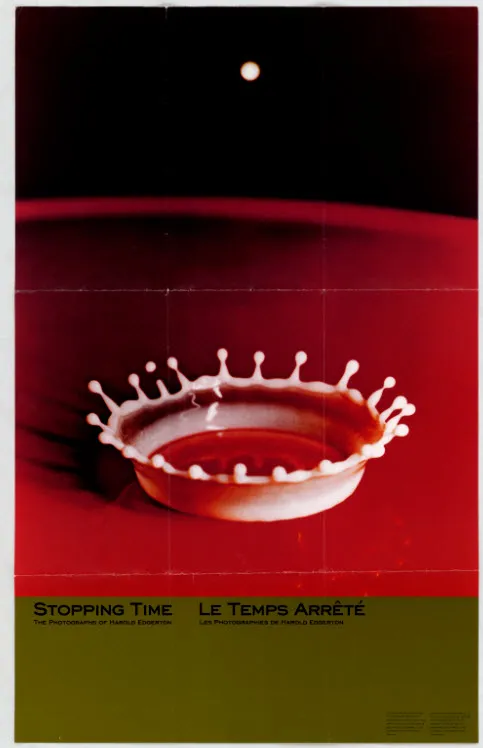
Xenon turned out to be just what Harold Edgerton
(Mayflower descendant of Bradford ) was looking for.
Electrical engineer Edgerton had begun in the Nebraska Power and Light
Company and faced the problem of diagnosing malfunctions in power
generators while they were still spinning. Moving target was putting it
mildly. In 1926 Edgerton had begun research (which continued when he
joined the faculty at MIT) that ended with the stroboscope: illuminating
spinning turbine blades with a light flashing at the same speed as they
were spinning, thus "freezing" the image of a single blade for
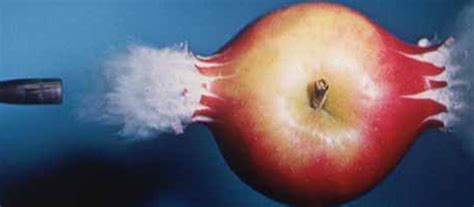
examination. By 1938, using a xenon discharge lamp, Edgerton could flash
a million times a second and produce famous photos like the bullet
hitting the apple.
Then Edgerton got into oceanography, sailing with Jacques Cousteau,
developing underwater cameras and a towable side-scan sonar that mapped
a profile of the ocean floor (searched for Loch Ness Monster).
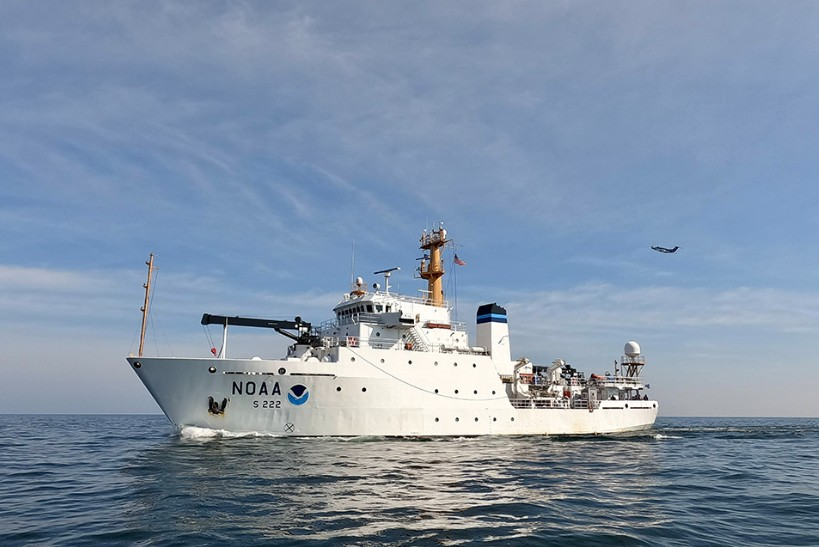
By 1994 this gizmo was being used (together with a multibeam version) on board the *USNS Littlehales* naval oceanographic survey vessel to make very
high-resolution maps of the seabed off the coast of Albania.
Four years later, the U.S. Navy was able to use these maps to position ships
accurately enough to fire Tomahawks into Yugoslavia during the Balkan
conflict. In 2003 the Littlehales was given to the National
Oceanic and Atmospheric Administration.
It took on a new name: that of the president who sponsored the first
U.S. coastal survey back in 1807: THOMAS JEFFERSON.
He signed the Declaration of Independence with [was a Declaration of Independence co-signer with]John Hancock*, [was a Declaration of Independence co-signer with]Josiah Bartlett*, [was a Declaration of Independence co-signer with]William Whipple*, [was a Declaration of Independence co-signer with]John Adams*, [was a Declaration of Independence co-signer with]Robert Treat Paine*, [was a Declaration of Independence co-signer with]Stephen Hopkins*, [was a Declaration of Independence co-signer with]William Ellery*, [was a Declaration of Independence co-signer with]Roger Sherman*, [was a Declaration of Independence co-signer with]Samuel Huntington*, [was a Declaration of Independence co-signer with]William Williams*, [was a Declaration of Independence co-signer with]William Floyd*, [was a Declaration of Independence co-signer with]Philip Livingston*, [was a Declaration of Independence co-signer with]Francis Lewis*, [was a Declaration of Independence co-signer with]Lewis Morris*, [was a Declaration of Independence co-signer with]Richard Stockton*, [was a Declaration of Independence co-signer with]John Witherspoon*, [was a Declaration of Independence co-signer with]Francis Hopkinson*, [was a Declaration of Independence co-signer with]John Hart*, [was a Declaration of Independence co-signer with]Abraham Clark*, [was a Declaration of Independence co-signer with]Robert Morris*, [was a Declaration of Independence co-signer with]John Morton*, [was a Declaration of Independence co-signer with]George Clymer*, [was a Declaration of Independence co-signer with]James Smith*, [was a Declaration of Independence co-signer with]George Taylor*, [was a Declaration of Independence co-signer with]James Wilson*, [was a Declaration of Independence co-signer with]George Ross*, [was a Declaration of Independence co-signer with]Caesar Rodney*, [was a Declaration of Independence co-signer with]George Read*, [was a Declaration of Independence co-signer with]Samuel Chase*, [was a Declaration of Independence co-signer with]William Paca*, [was a Declaration of Independence co-signer with]Thomas Stone*, [was a Declaration of Independence co-signer with]Charles Carroll*, [was a Declaration of Independence co-signer with]Thomas Jefferson*, [was a Declaration of Independence co-signer with]Benjamin Harrison*, [was a Declaration of Independence co-signer with]Thomas Nelson*, [was a Declaration of Independence co-signer with]Francis Lightfoot Lee*, [was a Declaration of Independence co-signer with]Carter Braxton*, [was a Declaration of Independence co-signer with]William Hooper*, [was a Declaration of Independence co-signer with]Joseph Hewes*, [was a Declaration of Independence co-signer with]John Penn*, [was a Declaration of Independence co-signer with]Edward Rutledge*, [was a Declaration of Independence co-signer with]Thomas Heyward*, [was a Declaration of Independence co-signer with]Thomas Lynch Jr.*, [was a Declaration of Independence co-signer with]Arthur Middleton*, [was a Declaration of Independence co-signer with]Button Gwinett*, [was a Declaration of Independence co-signer with]Lyman Hall*, [was a Declaration of Independence co-signer with]George Walton*, [was a Declaration of Independence co-signer with]George Wythe*, [was a Declaration of Independence co-signer with]Elbridge Gerry*, [was a Declaration of Independence co-signer with]Richard Henry Lee*, [was a Declaration of Independence co-signer with]Oliver Wolcott*, [was a Declaration of Independence co-signer with]Matthew Thornton*, [was a Declaration of Independence co-signer with]Thomas McKean*