West, Benjamin
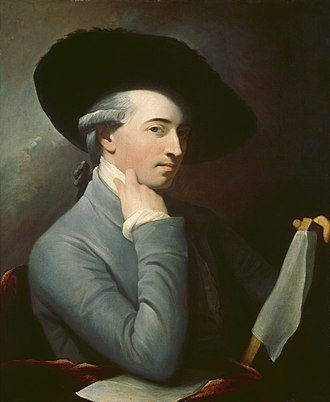
(self-portrait)
Name: Benjamin West
Nickname/Alias: Benny
Achievements: American art
Born: October 10, 1738; Springfield, Massachusetts
Died: March 11, 1820; London, England. Aged 78
Field & Discipline: Art; Painter
Language: English
Father: John West (innkeeper)
Mother: Sarah Pearson
Siblings: Thomas; Rachel
Spouse: Elizabeth Sewell (m. 1764)
Children: Benjamin; Raphael
Education: College of Philadelphia (now the University of Pennsylvania)
Major Work:
“The Death of General Wolfe” (1771)
Life & Times:
West told the novelist John Galt, with whom, late in his life, he collaborated on a memoir, The Life and Studies of Benjamin West (1816, 1820), that, when he was a child, Native Americans showed him how to make paint by mixing some clay from the river bank with bear grease in a pot. West was an autodidact; while excelling at the arts, "he had little [formal] education and, even when president of the Royal Academy, could scarcely spell".[3] One day, his mother left him alone with his little sister Sally. Benjamin discovered some bottles of ink and began to paint Sally's portrait. When his mother came home, she noticed the painting, picked it up and said, "Why, it's Sally!", and kissed him. Later, he noted, "My mother's kiss made me a painter".
At eighteen, West painted the portrait of a William Henry and his new wife, in Lancaster, Pennsylvania. Henry was pleased with the result, so West showed him an engraving of Hubert Gravelot’s “Death of Socrates” which West adapted. This was shown to the Provost of the Philadelphia Academy, William Smith, who invited West to attend a special course to help him find classical subjects for his art.
West had a number of commissions at this time, but decided to go to New York to try and make enough money to study in Europe. His work became known to William Allen, the great shipping merchant, who paid for West’s European trip.
West expanded his repertoire by copying works of Italian painters such as Titian and Raphael direct from the originals. In Rome he met a number of international neo-classical artists including German-born Anton Rafael Mengs, Scottish Gavin Hamilton, and Austrian Angelica Kauffman.
Arriving in Rome in 1760, he toured for three years, visiting Florence, Parma, Bologna and Venice, studying the great masters. He also studied under the neo-classicist, [studied under] Mengs*, who had a great influence on his work.
He arrived in London in 1763 with no intention of staying, but remained for the next fifty-seven years. His first English work, “Angelica and Medoro,” together with “Cymon and Iphegenia” and a portrait of General Monckton, were exhibited in 1764 and caused a small sensation. By now he was meeting the influential men of the day and receiving commissions for such subjects as “The Parting of Hector and Andromache,” and “The Return of the Prodigal Son.”
His career as a painter of high art subjects really began in 1768, when Robert Hay Drummond, archbishop of York and an art connoisseur, commissioned him to paint “The Landing of Agrippina at Brundisium with the Ashes of Germanicus.”
Drummond hoped to be able to raise funds which would free West from portrait painting, so that he could establish a new historical school of art. When Drummond failed to manage this, he showed West’s "Agrippina" to King George III, who commissioned “The Departure of Regulus from Rome.”
On the 10th December 1768, the King signed a charter authorizing the founding of a Royal Academy of Art, and West was made a charter member. Both "Agrippina" and "Regulus" were shown at the Academy’s first exhibition in 1769. George III helped to ensure the establishment of a school of history painting in England by commissioning sixty paintings by West over the years 1768-1801.
In 1772, West became “History Painter to the King” and remained in this role until 1801. His works during this period included an altarpiece, cartoons for stained glass windows, biblical pieces for St George’s Chapel at Windsor. In addition, he completed various royal portraits, as well as seven large scenes set in the fourteenth century for the Audience Chamber of Windsor Castle, showing the victories at Cressy and Poitiers.
In 1769 West broke with tradition with his “Death of General James Wolfe at Quebec.” Wolfe had only been dead ten years, and such a modern scene was not considered to count as high art. The powerful and influential artist [opposed by] Sir Joshua Reynolds* was hostile to it, and Drummond also tried to talk West out of painting scenes in modern dress. West went ahead and exhibited the piece in 1771.
The picture was bought by Lord Grosvenor. George III had objected to the subject matter but soon afterwards regretted this decision and commissioned a second version, together with the “Death of Epaminondas” and the “Death of the Chevalier Bayard.”
By the middle of the 1760s, West was becoming famous, exhibiting every year at the Royal Academy. In some newspapers his work was placed ahead of that of [work related to] Gainsborough*, or even Reynolds. Over the course of the 1770s and 1780s, he won various commissions for large altarpieces, most notably for Trinity College, Cambridge and the Royal Naval Hospital in Greenwich.
Perhaps West’s greatest work was a series of paintings for a new royal chapel in Windsor Castle on the subject: "The History of Revealed Religion from Genesis to the Last Judgment." West produced several paintings, all of which were shown at the Royal Academy, but never hung at Windsor.
He then began a second contemporary series, in 1783, painting scenes from the American Revolution but, possibly due to George III’s disapproval, this trend was short-lived.
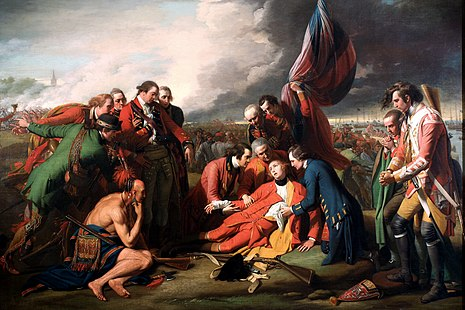
“The Death of General Wolfe” (1771)
Following the death of Reynolds in 1792, West became President of the Royal Academy, a post he held for twenty-seven years.
In 1801, his royal patronage began to decline, in part due to the madness of King George, but also to West’s admiration of [an admirer of] Napoleon*, who threatened to invade England.
In the new century West’s chief source of inspiration became the Bible. His style also changed, tending more towards Romanticism, and his canvases became enormous. One of his best known works of this genre is “Christ Healing the Sick,” painted in 1811. According to one of his devotees, [a fan was] Samuel Morse*, the new style breathed new life into West’s work.
Two of his most famous works in this style were “Christ Rejected” and “Death on the Pale Horse,” which strongly influenced the American Romantic painter [influenced] Allston.* But he completion of this piece in 1817 marked the beginning of West’s decline.
Many American artists studied under him in London, including Ralph Earl and later his son, Ralph Eleaser Whiteside Earl, Samuel Morse, Robert Fulton, Charles Willson Peale, Rembrandt Peale, Matthew Pratt, Gilbert Stuart, John Trumbull, Washington Allston, Thomas Sully,[29] John Green, and Abraham Delanoy.
The death of his wife on December 6, 1817 left him a broken man and after a general collapse of his health, he died and was buried in St Paul’s Cathedral, London.
Extra Connections:
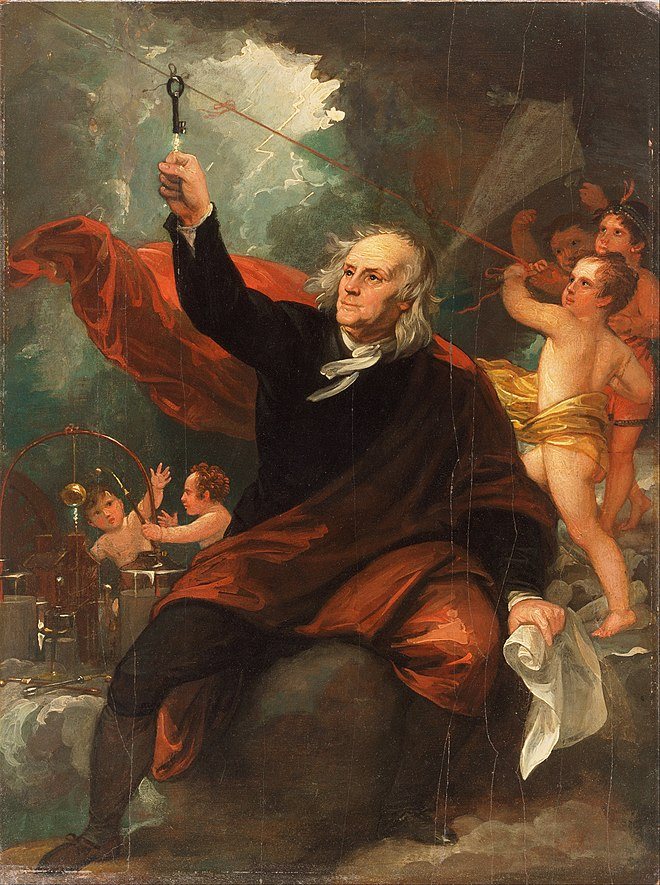
West was a close friend of Benjamin Franklin, whose portrait he painted. Franklin was the godfather of West's second son, Benjamin.
Knew American painters [knew] Trumbull* and [knew] Sir Thomas Lawrence*, as well as collector [knew] Thomas Bruce Elgin* and chemist [knew] Silliman Snr*
Encouraged painter [encouraged] Constable*
Taught US boat-builder [taught] Fulton*
Influenced painter [influenced] Fuseli*.
He supported [supported] Charles Bell*
He helped Francis [helped Declaration of Independence signer] Hopkinson*
Assessment: West raised the standing of British art through his introduction of more elevated subjects.
Oneliner: Benjamin West, American artist President of British Royal Academy
Bibliography:
- Robert C. Alberts. Benjamin West, a biography, Houghton Mifflin Company, Boston, 1978.