Lighthouse
A lighthouse is a tower, building, or other type of physical structure designed to emit light from a system of lamps and lenses and to serve as a beacon for navigational aid, for maritime pilots at sea or on inland waterways.
Lighthouses mark dangerous coastlines, hazardous shoals, reefs, rocks, and safe entries to harbors; they also assist in aerial navigation. Once widely used, the number of operational lighthouses has declined due to the expense of maintenance and has become uneconomical since the advent of much cheaper, more sophisticated and effective electronic navigational systems.
History
Main article: History of lighthouses
Ancient lighthouses
 The Tower of Hercules lighthouse in northwest Spain.
Before the development of clearly defined ports, mariners were guided by fires built on hilltops. Since elevating the fire would improve visibility, placing the fire on a platform became a practice that led to the development of the lighthouse.[1] In antiquity, the lighthouse functioned more as an entrance marker to ports than as a warning signal for reefs and promontories, unlike many modern lighthouses. The most famous lighthouse structure from antiquity was the Pharos of Alexandria, Egypt, which collapsed following a series of earthquakes between 956 CE and 1323 CE.
The intact Tower of Hercules at A Coruña, Spain gives insight into ancient lighthouse construction; other evidence about lighthouses exists in depictions on coins and mosaics, of which many represent the lighthouse at Ostia. Coins from Alexandria, Ostia, and Laodicea in Syria also exist.
Modern construction
The modern era of lighthouses began at the turn of the 18th century, as the number of lighthouses being constructed increased significantly due to much higher levels of transatlantic commerce. Advances in structural engineering and new and efficient lighting equipment allowed for the creation of larger and more powerful lighthouses, including ones exposed to the sea. The function of lighthouses was gradually changed from indicating ports to the providing of a visible warning against shipping hazards, such as rocks or reefs.
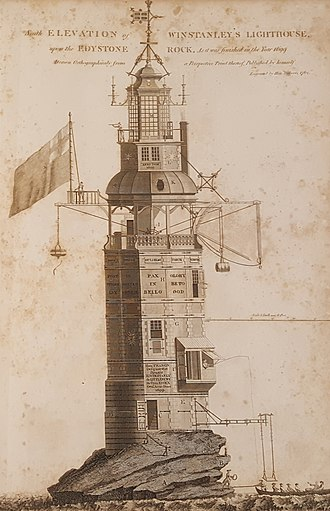
 Original Winstanley lighthouse, aka Eddystone Lighthouse, by Jaaziell Johnston, 1813.
The Eddystone Rocks were a major shipwreck hazard for mariners sailing through the English Channel.[2] The first lighthouse built there was an octagonal wooden structure, anchored by 12 iron stanchions secured in the rock, and was built by Henry Winstanley from 1696 to 1698. His lighthouse was the first tower in the world to have been fully exposed to the open sea.[3]
The civil engineer John Smeaton rebuilt the lighthouse from 1756 to 1759;[4] his tower marked a major step forward in the design of lighthouses and remained in use until 1877. He modeled the shape of his lighthouse on that of an oak tree, using granite blocks. He rediscovered and used "hydraulic lime", a form of concrete that will set under water used by the Romans, and developed a technique of securing the granite blocks together using dovetail joints and marble dowels.[5] The dovetailing feature served to improve the structural stability, although Smeaton also had to taper the thickness of the tower towards the top, for which he curved the tower inwards on a gentle gradient. This profile had the added advantage of allowing some of the energy of the waves to dissipate on impact with the walls. His lighthouse was the prototype for the modern lighthouse and influenced all subsequent engineers.[6]
 John Smeaton's rebuilt version of the Eddystone Lighthouse, 1759. This represented a great step forward in lighthouse design.
One such influence was Robert Stevenson, himself a seminal figure in the development of lighthouse design and construction.[7] His greatest achievement was the construction of the Bell Rock Lighthouse in 1810, one of the most impressive feats of engineering of the age.[citation ^needed] This structure was based upon Smeaton's design, but with several improved features, such as the incorporation of rotating lights, alternating between red and white.[8] Stevenson worked for the Northern Lighthouse Board for nearly fifty years[7] during which time he designed and oversaw the construction and later improvement of numerous lighthouses. He innovated in the choice of light sources, mountings, reflector design, the use of Fresnel lenses, and in rotation and shuttering systems providing lighthouses with individual signatures allowing them to be identified by seafarers. He also invented the movable jib and the balance-crane as a necessary part for lighthouse construction.
 Marjaniemi Lighthouse, the 19th-century lighthouse in the Hailuoto island, neighbouring municipality of Oulu, Finland
Alexander Mitchell designed the first screw-pile lighthouse – his lighthouse was built on piles that were screwed into the sandy or muddy seabed. Construction of his design began in 1838 at the mouth of the Thames and was known as the Maplin Sands lighthouse, and first lit in 1841.[9] Although its construction began later, the Wyre Light in Fleetwood, Lancashire, was the first to be lit (in 1840).[9]
Lighting improvements
Until 1782 the source of illumination had generally been wood pyres or burning coal. The Argand lamp, invented in 1782 by the Swiss scientist Aimé Argand revolutionized lighthouse illumination with its steady smokeless flame. Early models used ground glass which was sometimes tinted around the wick. Later models used a mantle of thorium dioxide suspended over the flame, creating a bright, steady light.[10] The Argand lamp used whale oil, colza, olive oil[11] or other vegetable oil as fuel, supplied by a gravity feed from a reservoir mounted above the burner. The lamp was first produced by Matthew Boulton, in partnership with Argand, in 1784, and became the standard for lighthouses for over a century.[12]
South Foreland Lighthouse was the first tower to successfully use an electric light in 1875. The lighthouse's carbon arc lamps were powered by a steam-driven magneto.[13] John Richardson Wigham was the first to develop a system for gas illumination of lighthouses. His improved gas 'crocus' burner at the Baily Lighthouse near Dublin was 13 times more powerful than the most brilliant light then known.[14]
 An 85 millimetres (3.3 in) Chance Brothers *Incandescent Petroleum Vapour
Installation* which produced the light for the Sumburgh Head lighthouse until 1976. The lamp (made in approx. 1914) burned vaporized kerosene (paraffin); the vaporizer was heated by a denatured alcohol (methylated spirit) burner to light. When lit, some of the vaporised fuel was diverted to a Bunsen burner to keep the vaporizer warm and the fuel in vapor form. The fuel was forced up to the lamp by air; the keepers had to pump the air container up every hour or so, pressurizing the paraffin container to force the fuel to the lamp. The "white sock" pictured is an unburnt mantle on which the vapor burned.
The vaporized oil burner was invented in 1901 by Arthur Kitson, and improved by David Hood at Trinity House. The fuel was vaporized at high pressure and burned to heat the mantle, giving an output of over six times the luminosity of traditional oil lights. The use of gas as illuminant became widely available with the invention of the Dalén light by Swedish engineer Gustaf Dalén. He used Agamassan (Aga), a substrate, to absorb the gas, allowing the gas to be stored, and hence used, safely. Dalén also invented the 'sun valve', which automatically regulated the light and turned it off during the daytime.[This ^paragraph ^needs ^citation(s)] The technology was the predominant light source in lighthouses from the 1900s to the 1960s, when electric lighting had become dominant.[15]
Optical systems
 Diagram depicting how a spherical Fresnel lens collimates light
With the development of the steady illumination of the Argand lamp, the application of optical lenses to increase and focus the light intensity became a practical possibility. William Hutchinson developed the first practical optical system in 1763, known as a catoptric system.[citation ^needed] This rudimentary system effectively collimated the emitted light into a concentrated beam, thereby greatly increasing the light's visibility.[16] The ability to focus the light led to the first revolving lighthouse beams, where the light would appear to the mariners as a series of intermittent flashes. It also became possible to transmit complex signals using the light flashes.
French physicist and engineer Augustin-Jean Fresnel developed the multi-part Fresnel lens for use in lighthouses. His design allowed for the construction of lenses of large aperture and short focal length, without the mass and volume of material that would be required by a lens of conventional design. A Fresnel lens can be made much thinner than a comparable conventional lens, in some cases taking the form of a flat sheet. A Fresnel lens can also capture more oblique light from a light source, thus allowing the light from a lighthouse equipped with one to be visible over greater distances.
The first Fresnel lens was used in 1823 in the Cordouan lighthouse at the mouth of the Gironde estuary; its light could be seen from more than 20 miles (32 km) out.[17] Fresnel's invention increased the luminosity of the lighthouse lamp by a factor of four and his system is still in common use.
Modern lighthouses
The introduction of electrification and automatic lamp changers began to make lighthouse keepers obsolete. For many years, lighthouses still had keepers, partly because lighthouse keepers could serve as a rescue service if necessary. Improvements in maritime navigation and safety such as satellite navigation systems such as GPS led to the phasing out of non-automated lighthouses across the world.[18] In Canada, this trend has been stopped and there are still 50 staffed light stations, with 27 on the west coast alone.[19]
Remaining modern lighthouses are usually illuminated by a single stationary flashing light powered by solar-charged batteries mounted on a steel skeleton tower.[20] Where the power requirement is too great for solar power, cycle charging by diesel generator is used: to save fuel and to increase periods between maintenance the light is battery powered, with the generator only coming into use when the battery has to be charged.[21]
Famous lighthouse builders
John Smeaton is noteworthy for having designed the third and most famous Eddystone Lighthouse, but some builders are well known for their work in building multiple lighthouses. The Stevenson family (Robert, Alan, David, Thomas, David Alan, and Charles) made lighthouse building a three-generation profession in Scotland. Richard Henry Brunton designed and built 26 Japanese lighthouses in Meiji Era Japan, which became known as Brunton's "children".[22] Blind Irishman Alexander Mitchell invented and built a number of screw-pile lighthouses. Englishman James Douglass was knighted for his work on the fourth Eddystone Lighthouse.[23]
United States Army Corps of Engineers Lieutenant George Meade built numerous lighthouses along the Atlantic and Gulf coasts before gaining wider fame as the winning general at the Battle of Gettysburg. Colonel Orlando M. Poe, engineer to General William Tecumseh Sherman in the siege of Atlanta, designed and built some of the most exotic lighthouses in the most difficult locations on the U.S. Great Lakes.[24]
French merchant navy officer Marius Michel Pasha built almost a hundred lighthouses along the coasts of the Ottoman Empire in a period of twenty years after the Crimean War (1853–1856).[25]
Technology
In a lighthouse, the source of light is called the "lamp" (whether electric or fuelled by oil) and the light is concentrated, if needed, by the "lens" or "optic". Power sources for lighthouses in the 20th–21st centuries vary.
Power
Originally lit by open fires and later candles, the Argand hollow wick lamp and parabolic reflector were introduced in the late 18th century.
Whale oil was also used with wicks as the source of light. Kerosene became popular in the 1870s and electricity and carbide (acetylene gas) began replacing kerosene around the turn of the 20th century.[20] Carbide was promoted by the Dalén light which automatically lit the lamp at nightfall and extinguished it at dawn.
During the Cold War, many remote Soviet lighthouses were powered by radioisotope thermoelectric generators (RTGs). These had the advantage of providing power day or night and did not need refuelling or maintenance. However, after the breakdown of the Soviet Union, there are no official records of the locations or condition of all of these lighthouses.[26] As time passes, their condition is degrading; many have fallen victim to vandalism and scrap metal thieves, who may not be aware of the dangerous radioactive contents.[27]
Energy-efficient LED lights can be powered by solar panels, with batteries instead of a diesel generator for backup.[28]
Light source
Many Fresnel lens installations have been replaced by rotating aerobeacons which require less maintenance.
In modern automated lighthouses, the system of rotating lenses is often replaced by a high intensity light that emits brief omnidirectional flashes, concentrating the light in time rather than direction. These lights are similar to obstruction lights used to warn aircraft of tall structures. Later innovations were "Vega Lights", and experiments with light-emitting diode (LED) panels.[20]
LED lights, which use less energy and are easier to maintain, had come into widespread use by 2020. In the United Kingdom and Ireland about a third of lighthouses had been converted from filament light sources to use LEDs, and conversion continued with about three per year. The light sources are designed to replicate the colour and character of the traditional light as closely as possible. The change is often not noticed by people in the region, but sometimes a proposed change leads to calls to preserve the traditional light, including in some cases a rotating beam. A typical LED system designed to fit into the traditional 19th century Fresnel lens enclosure was developed by Trinity House and two other lighthouse authorities and costs about €20,000, depending on configuration, according to a supplier; it has large fins to dissipate heat. Lifetime of the LED light source is 50,000 to 100,000 hours, compared to about 1,000 hours for a filament source.[28]
Laser light
 Point Danger lighthouse, Queensland, 1971
Experimental installations of laser lights, either at high power to provide a "line of light" in the sky or, utilising low power, aimed towards mariners have identified problems of increased complexity in installation and maintenance, and high power requirements. The first practical installation, in 1971 at Point Danger lighthouse, Queensland, was replaced by a conventional light after four years because the beam was too narrow to be seen easily.[29][30]
Light characteristics
See also: Light characteristic
In any of these designs an observer, rather than seeing a continuous weak light, sees a brighter light during short time intervals. These instants of bright light are arranged to create a light characteristic or pattern specific to a lighthouse.[31] For example, the Scheveningen Lighthouse flashes are alternately 2.5 and 7.5 seconds. Some lights have sectors of a particular color (usually formed by colored panes in the lantern) to distinguish safe water areas from dangerous shoals. Modern lighthouses often have unique reflectors or Racon transponders so the radar signature of the light is also unique.
Lens
See also: Fresnel lens
Cape Meares Lighthouse in Oregon; first-order Fresnel lens.
Before modern strobe lights, lenses were used to concentrate the light from a continuous source. Vertical light rays of the lamp are redirected into a horizontal plane, and horizontally the light is focused into one or a few directions at a time, with the light beam swept around. As a result, in addition to seeing the side of the light beam, the light is directly visible from greater distances, and with an identifying light characteristic.
This concentration of light is accomplished with a rotating lens assembly. In early lighthouses, the light source was a kerosene lamp or, earlier, an animal or vegetable oil Argand lamp, and the lenses rotated by a weight driven clockwork assembly wound by lighthouse keepers, sometimes as often as every two hours. The lens assembly sometimes floated in liquid mercury to reduce friction. In more modern lighthouses, electric lights and motor drives were used, generally powered by diesel electric generators. These also supplied electricity for the lighthouse keepers.[20]
Efficiently concentrating the light from a large omnidirectional light source requires a very large diameter lens. This would require a very thick and heavy lens if a conventional lens were used. The Fresnel lens (pronounced /freɪˈnɛl/) focused 85% of a lamp's light versus the 20% focused with the parabolic reflectors of the time. Its design enabled construction of lenses of large size and short focal length without the weight and volume of material in conventional lens designs.[32]
Fresnel lighthouse lenses are ranked by order, a measure of refracting power, with a first order lens being the largest, most powerful and expensive; and a sixth order lens being the smallest. The order is based on the focal length of the lens. A first order lens has the longest focal length, with the sixth being the shortest. Coastal lighthouses generally use first, second, or third order lenses, while harbor lights and beacons use fourth, fifth, or sixth order lenses.[33]
Some lighthouses, such as those at Cape Race, Newfoundland, and Makapuu Point, Hawaii, used a more powerful hyperradiant Fresnel lens manufactured by the firm of Chance Brothers.
Building
Components
 Lighthouse lantern room from mid-1800s
While lighthouse buildings differ depending on the location and purpose, they tend to have common components.
A light station comprises the lighthouse tower and all outbuildings, such as the keeper's living quarters, fuel house, boathouse, and fog-signaling building. The Lighthouse itself consists of a tower structure supporting the lantern room where the light operates.
The lantern room is the glassed-in housing at the top of a lighthouse tower containing the lamp and lens. Its glass storm panes are supported by metal muntins (glazing bars) running vertically or diagonally. At the top of the lantern room is a stormproof ventilator designed to remove the smoke of the lamps and the heat that builds in the glass enclosure. A lightning rod and grounding system connected to the metal cupola roof provides a safe conduit for any lightning strikes.
Immediately beneath the lantern room is usually a Watch Room or Service Room where fuel and other supplies were kept and where the keeper prepared the lanterns for the night and often stood watch. The clockworks (for rotating the lenses) were also located there. On a lighthouse tower, an open platform called the gallery is often located outside the watch room (called the Main Gallery) or Lantern Room (Lantern Gallery). This was mainly used for cleaning the outside of the windows of the Lantern Room.[34]
Lighthouses near to each other that are similar in shape are often painted in a unique pattern so they can easily be recognized during daylight, a marking known as a daymark. The black and white barber pole spiral pattern of Cape Hatteras Lighthouse is one example. Race Rocks Light in western Canada is painted in horizontal black and white bands to stand out against the horizon.
Design
...
See Eddystone Lighthouse
The Bell Rock Lighthouse, off the coast of Angus, Scotland, is the world's oldest surviving sea-washed lighthouse.[4] It was built between 1807 and 1810 by Robert Stevenson on the Bell Rock (also known as Inchcape) in the North Sea, 11 miles (18 km) east of the Firth of Tay. Standing 35 metres (115 ft) tall, its light is visible from 35 statute miles (56 km) inland.[1]
The masonry work on which the lighthouse rests was constructed to such a high standard that it has not been replaced or adapted in 200 years.[5] The lamps and reflectors were replaced in 1843; the original ones are now in the lighthouse at Cape Bonavista, Newfoundland, where they are currently on display.[6] The working of the lighthouse has been automated since 24 October 1988.[1] The Northern Lighthouse Board, which has had its headquarters at 84 George Street in Edinburgh since 1832, remotely monitors the light.
The lighthouse previously operated in tandem with a shore station, the Bell Rock Signal Tower, built in 1813 at the mouth of Arbroath harbour. Today this building houses the Signal Tower Museum, a visitor centre that offers a detailed history of the lighthouse.
Because of the engineering challenges that were overcome to build the lighthouse, it has been described as one of the Seven Wonders of the Industrial World.[7]
History
According to legend, Bell Rock got its name because, in the 14th century, the Abbot of Arbroath had had a warning bell installed on it, which was stolen a year later by a Dutch pirate. (This legend is immortalised in "The Inchcape Rock", a poem by the 19th-century poet Robert Southey.)
Before the construction of the lighthouse, the rock had caused many shipwrecks because, except for a few hours a day at low tide, it lies just below the surface of the sea. By the turn of the 19th century, it was estimated that, in a typical winter, as many as six ships were wrecked on the rock. (In one storm, seventy ships had been lost off the east coast of Scotland.)
In 1799, the Masters of Trinity House in Leith (who oversaw most of the shipping issues on the eastern coast) determined to build a light on the Bell Rock, due to the high numbers of losses. They commissioned Scottish engineer Robert Stevenson to devise a design for a lighthouse on the Bell Rock, but the proposal was shelved due to concerns about cost, the relatively radical nature of the proposed design and Stevenson's relative youth. The cost would be borne severally by the east coast towns (as it was not only Dundee ships being lost).[8]
However, after the warship HMS *York* was wrecked on the rock in 1804 (and all aboard perished)—causing a furore in Parliament—Stevenson sent his design to the renowned engineer John Rennie. Rennie approved the design and cost estimate, which led to the passage of legislation in 1806 approving the proposal and enabling construction to begin.[9]
The Northern Lighthouse Board awarded Rennie the contract to design and build the lighthouse and appointed Stevenson as chief assistant.[10] The design was based on the earlier Eddystone Lighthouse, which had been designed by John Smeaton, and which Stevenson had visited and studied in detail in 1801[11]—it too was built on an offshore reef using interlocking stones.[12] But the Bell Rock lighthouse also contained several newer features, such as the rotating lights alternating between red and white that were designed by the carpenter Francis Watt.[13] Stevenson's written account of the work gave little or no credit to Rennie, and questions about "[t]he apportionment of responsibility for this work led to prolonged disputes between their respective descendants, but it is now certain that while Stevenson designed the lighthouse in the main, Rennie's role too was significant."[14]
Construction
 Engraving of the lighthouse under construction in 1809, next to the temporary beacon that was constructed alongside it to accommodate the workers and serve as a temporary lighthouse.
In 1807, Stevenson hired 60 men (including a blacksmith so that the pickaxes used to cut the foundations could be re-sharpened on site). Stevenson did not want to use black powder as it might have damaged the rock on which the lighthouse was to stand. The workers set sail for the rock on 17 August 1807, and would be away for two months.[15] While initially some workers had been reluctant to agree to work even on the Sabbath in order to complete the lighthouse on time and on budget, in the end, all but four of the workers agreed to do it, and even those four (who were stonemasons) eventually also worked on Sundays.[16]
Because the rock was covered by water for 20 hours each day (up to 12 feet (3.7 m) of water at high tide), the men lived at first on a ship moored 1 mile (2 km) off the rock, requiring the workers to row out to the rock and back in boats each day, which was time-consuming, and at one point, one of the boats went adrift and was lost. So the workers’ first task was to build a beacon house on tall wooden struts on the reef surrounding the rock, with places for up to 15 men, so that workers would have a place to stay on site. The foundations and beacon legs were raised during the first season. Then, in the winter, work at the rock was paused as stonemasons cut rocks for the lighthouse out of Cairngall granite.[17][15]
In early 1808, work at the rock resumed. The beacon house barracks was completed and the first three courses of stone for the lighthouse were laid. In the whole of this second season only 80 hours of building work took place on the rock. During this time, while the beacon house barracks were still under construction, a young worker was knocked unconscious by a buoy ring and drowned. As he had been the primary breadwinner for his family, Stevenson offered the now-vacant position to his younger brother, Alexander Scott, who accepted.
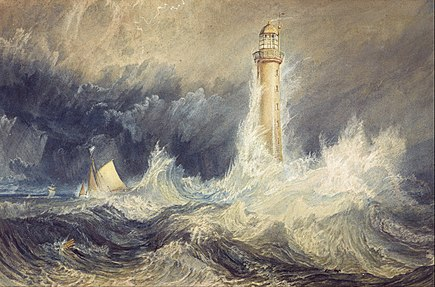
Watercolour of the lighthouse by J. M. W. Turner (1819), Scottish National Gallery using new cobalt blue paint.
In September 1808 John Bonnyman, a stonemason, had to have a finger amputated following an accident with the beam crane on the Rock; as recompense for this mishap he was later appointed one of the first lighthouse keepers.[19]
Stevenson was frustrated by a visit from Rennie, in 1809, whom he saw as interfering with his work. As a strategy to ward off further visits, he wrote Rennie a total of 82 letters, asking detailed questions about a large range of construction issues (including what type of window putty and locks to use). Rennie replied in detail to every letter, but Stevenson largely ignored the replies.
In June 1809 one of the principal builders, Michael Wishart, was caught beneath a crane when it collapsed, and his feet were severely injured, preventing him from working further on the project.[20] He asked Stevenson if he could be appointed lighthouse keeper and he ultimately took up a position as assistant keeper in 1811.[21]
Work stopped on 22 August 1809, by which time a large part of the tower had been completed.[15]
In January 1810, Stevenson's twins died of whooping cough, and a fortnight later his youngest daughter Janet also died of this disease. Rennie wrote Stevenson a consoling letter. During this final period of construction the lighthouse became something of a tourist attraction. Many people were anxious to see the completion of the tallest off-shore lighthouse in the world. In this final season, while the men were staying in the beacon house, a 7-hour storm struck. Worker Charles Henderson was lost, and his body was never found. Work was finally completed after having consumed about 2500 granite stones, all carried by one horse, Bassey.[15]
Ultimately, the project came in 50 per cent above the original estimate of £42,000 (2009: £2,490,000) budget.[22] Since the construction of the lighthouse the only recorded shipwrecks have been that of HMS *Argyll* during wartime blackouts in 1915 and the Banff-registered cargo vessel Rosecraig that ran aground in fog on the evening of 21 September 1908, and sank. Her seven crew members were saved.[23]
Loss of HMS Argyll

The lighthouse on the rock had been ordered to switch its lights off during the First World War for fear of assisting German U-boats in their operations, and the light was only turned on by special permission. On 28 October 1915 while in view of the lighthouse, HMS *Argyll* under the command of Captain James Tancred sent a signal requesting the light to be turned on. The ship proceeded on its course believing the signal had been received, but it had not and the light was not switched on.
Soon afterwards, Argyll ran aground, suffering extensive damage to much of the hull. Two destroyers – HMS *Hornet* and HMS *Jackal* – assisted in the rescue of her crew. Despite the damage, there were no fatalities among her crew. After all valuable items onboard had been salvaged, including her 6-inch (150 mm) guns, she was blown up by the naval salvage team. In 1970, her two large propellers were recovered by divers and sold for scrap....
In music and literature
Scottish musician Alastair McDonald re-worded a traditional song called The Mermaid's Tale, and set the scene on Bell Rock instead of the Eddystone light. The first verse runs:
My father was the keeper of the Bell Rock LightAnd he married a mermaid one dark nightAnd from this union there came threeA codling and a kipper and the other was me
Arbroath musician Ian Lamb also slightly reworked the melody for the traditional song "Come All Ye Tramps and Hawkers" and wrote
"The Bell Rock Light" to mark the lighthouse's bicentenary in 2011. The first verse runs:
We left the town of old Arbroath and set out on the seaThe wind blew from the east that day it proved cold companyThe Inchcape Reef was our plain aim where many lives were lostCountless ships had hit the rock at dreadful human cost
R. M. Ballantyne's novelThe Lighthouse (1865) is centred on the construction of the Bell Rock Lighthouse.