Ferdinand II Tuscany
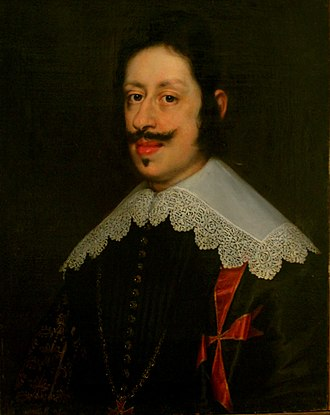
Name: Ferdinand II, 5th Grand Duke of Tuscany
Achievements: Enlarged Pitti Palace, Florence
Born: July 14, 1610; Tuscany, Italy
Died: May 24, 1670; , Tuscany, Italy (Aged 60)
Field & Discipline: Royalty; Ruler
Language: Italian
Father: Cosimo II, 4th Grand Duke of Tuscany
Mother: Maria Magdalena of Austria
Siblings: Leopoldo; Mattias; Gian Carlo; Maria; Margherita; Francesca; Anna
Spouse: Vittoria della Rovere
Children: Cosimo; Francesco Maria
Education: Private
Life & Times:
Ferdinand was given a good education which included science lessons with [taught by] Galileo*, who had been given sanctuary in Florence by Ferdinand’s father. When he was thirteen Ferdinand was betrothed to Vittoria, the granddaughter and heir of the Duke of Urbino. The betrothal contract specifically stated that the inheritance of Urbino was part of Vittoria’s dowry. But this was challenged by Pope Urban VIII, the Barberini pope who hated the Medicis.
At the age of seventeen, Ferdinand was sent to complete his education first in Rome and then in Vienna where his uncle, Emperor Ferdinand II, attempted unsuccessfully to mediate with the Pope over Urbino.
Ferdinand returned to as ruler of Tuscany in 1628. He was a plump, easy-going young man who enjoyed playing bowls, hunting and fishing. He became popular with the ordinary people in Florence when, unlike most nobles, he and his brothers stayed in the city during an outbreak of plague in 1630. Ferdinand organized money and provisions for the people and set up a Board of Health.
With the help of his brothers he also forced the large numbers of nuns and monks in Florence to play their part in helping the population. This challenge to his ecclesiastical authority outraged the Pope and Ferdinand was required to do penance. Two years later, when the old duke of Urbino died, papal troops took possession of Urbino and Ferdinand had to give up his future wife’s dowry.
He was also unable to help Galileo, who was called to Rome in 1633 and made to withdraw his support of the Copernican theory. When Galileo returned to Florence, however, Ferdinand visited him and allowed him to live in the Medici villa at Arcetri.
Ferdinand married Vittoria in 1634 and his grandmother died in 1636, but he was still not able to break away from Urban’s meddling and the power of the Inquisition. Ferdinand now turned his attention to improving his possessions. In 1640 he enlarged the Pitti Palace and engaged a number of artists to decorate the new apartments. [employed] Cortona* was hired to work on the ceilings of a series of rooms, inspired by astronomical discoveries including those of Galileo.
In 1644 Urban died and was succeeded by Innocent X who was friendly towards Ferdinand and made one of his brothers a cardinal. Around this time, at the mid-point of his reign, Ferdinand made an arrangement to give each of his brothers one branch of State to administer. Mattias had a high reputation after service in Germany during the Thirty Years’ War, and he took over the military. Gian Carlo took control of financial affairs and was a great collector of art. Leopold, the most capable brother, was given charge of political affairs but it was his sponsorship of science which was so important for Florence.
In this, he was enthusiastically backed by Ferdinand. As an expansion of a philosophical society Ferdinand had established, Leopold set up the famous scientific society, the [helped set up] Accademia del Cimento*, which began to meet at the Pitti Palace. He corresponded with leading men of science throughout Europe, and both he and Ferdinand followed the research of [a fan of] Torricelli*, who invented the barometer. They both took an active part in the affairs of the Accademia, experimented with telescopic lenses and other scientific instruments, and commissioned the construction of instruments including thermometers, astrolabes, quadrants, colorimeters and hygrometers.
Ferdinand also promoted various experimental ways of improving agriculture in the country. The most unusual was his idea of introducing camels into Tuscany because he thought they would be cheaper and more robust than horses.
With his brothers Ferdinand formed the Palatine Library which holds Galileo’s papers, and also the art galleries at the Uffizi and the Pitti Palace.
Extra Connections: [employed] Dudley* worked for him
He was a patron of [patron of] Viviani*, [patron of] Stensen* and [patron of] Borelli*
Gave professorship to [made a professor] Malpighi*
Assessment: Ferdinand was a great patron of science and the arts but his lack of strong government weakened Tuscany and brought hardship to his people.
Oneliner: Ferdinand II of Tuscany, patron of Galileo
Bibliography:
- Hibbert, Christopher, The Rise and Fall of the House of Medici, Penguin Books, Ltd., Harmondsworth, Middlesex, 1979.
- Young, G.F., The Medici, The Modern Library, New York, 1930.
Ferdinando II de' Medici, Grand Duke of Tuscany - Wikipedia