Galileo
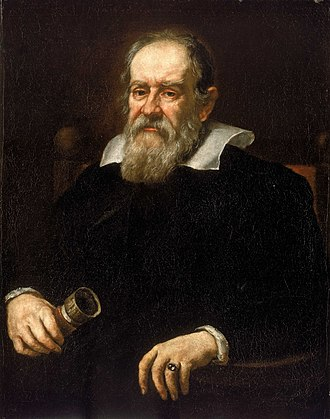
Galileo Galilei
Achievements: Law of falling bodies; Moons of Jupiter
Born: 15 February 1564, at Pisa, Italy
Died: 8 January 1642, in Arcetri, Italy. Aged 78
Field & Discipline: Science; Physics; Astronomy; Mathematics; Astronomer
Language: Italian
Father: Vincenzio Galilei (d. 1591)
Mother: Giulia Ammananti (m. 1562)
Siblings: Six younger siblings, including Virginia, Michelangelo and Livia
Spouse: None
Children: with Marina de Antonio Gamba: Virginia (b. 1600; later Sister
Maria Celeste); Livia Antonia (b. 1601, later Sister Arcangela); Vincenzo (b. 1606)
Education: Private tutor; Santa Maria Monastery, Vallombrosa (1575-81); University of Pisa (1581-85)
Major Work:
“Sidereus nuncius” (1610)
Life & Times:
From 1585 to 1589 Galileo gave lessons in mathematics in Florence and Siena, and in 1586 he published an essay (describing his invention of a hydrostatic balance) which made him known throughout Italy, and won him the support of a wealthy patron, the Marchese del Monte, for whom he wrote a treatise on the centre of gravity in
solids (1588) and who got him the job of lecturer in mathematics at the University of Pisa.
In Pisa, Galileo began a controversial campaign to discredit accepted Aristotelian physics. He also composed an untitled treatise on motion, now generally referred to as “De motu,” which disproved the Aristotelian theory that bodies of different weights fall at different speeds, and instead developed a theory of falling bodies derived from the
buoyancy principle of Archimedes, an idea previously published by [anticipated by] Benedetti* .
In 1591 on his father’s death he resigned from Pisa and returned to Florence. The following year his patron succeeded in getting him the chair of mathematics at the University of Padua, where he was to remain for the next 18 years (1592-1610), attracting pupils from all over Europe to his lectures.
During these years he became convinced of the truth of the [a believer in] Copernicus’* theory (that the planets revolve about the Sun) but was deterred from going public - as shown in his letter of 4 April 1597 to [corresponded with] Kepler* - because of fear of the church (the Italian philosopher, [knew of execution of] Bruno* had been arrested in 1592 and would in 1600 be burned at the stake for defending Copernicus.
At Padua, the leading scientific centre of the day, Galileo continued his research on motion, and around 1604 proved theoretically that falling bodies obey what came to be known as the law of uniformly accelerated motion (a body speeds up or slows down uniformly with time).
During his time in Padua, he took a Venetian mistress, Marina Gamba, by whom between 1600 and 1606 he had two daughters and a son. He also corresponded with the Italian physician [corresponded with] Santorio* and the Italian physicist [corresponded with] Baliani*.
In July 1609, while visiting Venice, Galileo learned of the recent invention
of the [developed] telescope* by the Dutch lens-grinder [copied telescope by] Lippershey* in 1608, and on his return to Padua built one. Late in August, Galileo arrived back in Venice with a nine-power telescope, three times as effective as those from Holland.
Over the next few months he continued to work on the telescope, and by the end of 1609 he had improved it to a power of thirty-two, the practicable limit for a refracting telescope of this type, in which a convex (converging) objective lens and a concave (diverging) lens in the eyepiece together produce a magnified, upright image.
Galileo's method for checking the curvature of his lenses made it possible to use the telescope for astronomical observation.
He announced in March 1610, in his “Sidereus nuncius” (“The Starry Messenger”), a series of astronomical discoveries that made him famous all over Europe: that the Moon shone by reflection, and that its surface was not smooth but had valleys and mountains; that the Milky Way is made up of countless stars; and that the planet Jupiter is accompanied by at least four moons. Galileo named them the Medicean Stars in honor of his former pupil and future employer, Cosimo II de' Medici, grand duke of Tuscany.
In the summer of 1610 Galileo resigned from Padua, and returned to Florence as mathematician and philosopher to Cosimo II, with no teaching duties and a large salary.. In Florence he continued his astronomical observations, and discovered spots on the surface of the Sun's disc, the oval appearance of Saturn, and that the planet Venus has crescent phases like the moon.
In particular, Galileo saw in the moons of Jupiter a miniature planetary system, thanks to which it could no longer be argued (as critics of Copernicus did) that all moving heavenly bodies revolved exclusively around the Earth, Within two years he had constructed approximately accurate tables of the orbits of Jupiter's moons and suggested their frequent eclipses as a means of calculating longitude.
Early in 1611 Galileo travelled to Rome, where he spent several months demonstrating his discoveries, and winning the approval of the Jesuits of the Roman College, the pope and several cardinals.
On his return, Galileo turned again to physics, and published a book on the behaviour of bodies placed in water: “Discourses on Things that Float” (1612). While working on this, he was sent a short treatise on sunspots by the Jesuit [disproved theory of] Scheiner* whose ideas - in particular the idea that the spots were tiny planets - Galileo demolished in three long letters, published in 1613 as “Letters on Sunspots.”
The “Letters” also confirmed Galileo's earlier criticism of Aristotelian cosmology, as he maintained that the movement of the spots across the face of the Sun proved that Copernicus’ system was correct, and also that the Sun rotated.
Having now spoken out publicly and decisively for the Copernican system Galileo faced increasing attacks from church authorities because of contradictions between the Copernican theory and the Scriptures, and in 1614 he was reported to the Inquisition.
In his defence, Galileo wrote two letters for publication, one to his pupil Castelli and the
other to the Dowager Duchess Christina (both 1615), in which he argued that
neither the Bible nor nature could speak falsely and that whereas the investigation
of nature was the province of the scientist, the reconciliation of scientific facts with the language of the Bible was that of the theologian.
No action was taken, but Galileo was alarmed enough by the news from Rome to decide in December 1615 to present his views there himself. It is not clear whether this trip precipitated the ultimate crisis, but in March 1616 a committee of consultors to the Holy Office declared that the proposition that the Sun is the immovable centre of the universe was heretical, and that the proposition of a moving Earth was theologically "erroneous.” The Holy Office then told its leading Roman theologian, [warned by] Bellarmine*, to ask Galileo to abandon "realist" Copernicanism, which was declared "false and erroneous,” and Copernicus': “De Revolutionibus” was put on the list of prohibited books.
Galileo spent the next seven years (1616-23) in retirement at his house in Bellosguardo near Florence, in 1618-23 becoming involved in a dispute with Orazio Grassi over the nature of comets, which ended with the publication of his famous work, “Il Saggiatore” (“The Assayer”), a brilliant piece on physical reality, and an exposition of the new scientific method which included his famous pronouncement that the "Book of Nature is… written in mathematical characters.”
In 1624 Galileo returned to Rome, to visit the new pope, Urban VIII, who had been a longtime friend (and to whom he had dedicated “Il Saggiatore”) and got permission to write about "the systems of the world,” both of [disproved view of] Ptolemy* and Copernicus, as long as he discussed them noncommittally and came to the conclusion dictated to him in advance by the pope - i.e. that humans cannot presume to know how the world is really made, because God could have brought about the same observable effects in ways unimagined by them.
Galileo then returned to Florence and spent the next several years working on his great book, “Dialogo sopra i due massimi sistemi del mondo, tolemaico e copernicano” (“Dialogue Concerning the Two Chief World Systems - Ptolemaic and Copernican”), which he completed in 1630 and was permitted to publish in 1632. Inevitably, after a comparison of these two systems, Galileo came down heavily on the side of Copernicanism, and Urban VIII, feeling he had been tricked, summoned the old scientist to Rome in February 1633. From April to June 1633 Galileo was tried before the Holy Office and was found "vehemently suspect of heresy,” forced to abjure Copernicanism publicly, and sentenced to imprisonment.
With the special indulgence with which he was treated throughout the trial, this was commuted to house arrest on his small estate (provided by his ex-pupil [house provided by] Ferdinand II of Tuscany* at Arcetri near Florence, where he returned in December 1633. This sentence of house arrest remained in effect throughout the last eight years of Galileo's life.
During these last years, Galileo continued his research, even after his hearing and sight began to fail. In 1634 he completed his “Discorsi e dimostrazioni mathematiche intorno a due nuove scienze attenenti alla meccanica” (“Dialogue Concerning Two New Sciences”), which was smuggled out of Italy and published at Leiden in 1638, and inspired much experimental work by such scientists as [inspired] Torricelli*, [inspired] Berti* and [inspired] Ricci*
Galileo's last telescopic discovery - that of the Moon's diurnal and monthly librations (wobbling from side to side) - was made in 1637, only a few months before he became blind.
Once he was totally blind (1638), Galileo was permitted to have his two friends, the geometrician [a pal of] Viviani* and Torricelli, to live with him, to whom he was dictating his latest ideas on the theory of impact when he was seized with the slow fever that resulted in his death.
Extra Connections: His work related to that of [work related to] Oresme*, [work related to] Buridan* [work related to] William of Ockham*, [work related to] Al Battani*, [work related to] Cortona*, [work related to] Tartaglia*, [work related to] Roberval*, [work related to] Boyle*, [work related to] Milton* , [work related to] Mersenne*, [work related to] Gassendi*, and [work related to] Peiresc*.
[biography written by] Brewster* wrote his biography
He met [met] Campanella*
The [work developed by] Cassini* family improved on his measurements
His problems influenced [influenced] Descartes*, [influenced] Hobbes*, [influenced] Mariotte* and [influenced] Newton*
He was later corrected by [work corrected by] Fermat*
Praised work of [admired work of] Gilbert*
He advised [advised] Christiaan Huyghens* to patent his clock
He was influenced by [influenced by] Witelo* and the [influenced by] Council of Trent*
[written about by] Venturi* wrote about him
His astronomy was followed up by [work followed up by] Borelli*
Assessment: Perhaps the most far-reaching of his achievements was his insistence that the "Book of Nature is . . . written in mathematical characters." From this base, he was able to found the modern experimental method.
Oneliner: Galileo, genius astronomer
Bibliography:
- Collier’s Encyclopedia.
- Dictionary of Scientific Biography.
- Encyclopedia Britannica.
- Reston Jr., James, Galileo: A Life, London: Cassell, 1994.