Chiang Kai Chek
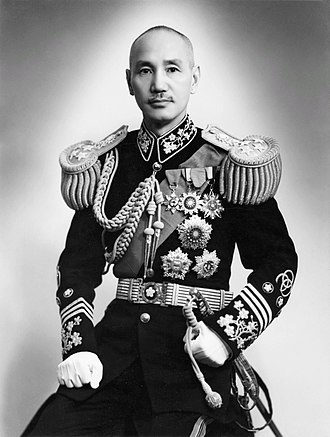
Chiang Kai-shek
Achievements: Head of Chinese Nationalist Government in China and in exile in Taiwan
Born: October 31, 1887; Chekiang province, China
Died: April 5, 1975; Taipei, Taiwan (Aged 87)
Field & Discipline: Military; Government; Politics; General; Statesman
Language: Chinese
Father: Chiang Su-an
Mother: Unknown
Siblings: Unknown
Spouse: 1) Mao Fu-mei; 2) Soong Mayling (who became a world figure, known as Madame Chiang Kai-shek); 3) possible 3rd wife
Children: Chiang Ching-kuo (succeeded Chiang Kai-shek)
Education: Pavilion of Literature, Fenghua; Dragon River Middle School, Fenghua; Paoting Military Academy, North China; Military training in Tokyo, Japan
Life & Times:
The son of a salt merchant, Chiang joined the revolutionary forces in 1911 and helped depose Yuan Shih-k'ai, the first president to have imperial ambitions. In 1918, he joined revolutionary leader [worked with] Sun Yat-sen*, leader of the Komintang (the Nationalist Party). To increase his knowledge of revolutionary methods, Chiang visited the Soviet Union in 1923, studying in particular the Red Army. On his return, Sun Yat-sen appointed him commander of a new military academy at Whampoa.
Sun Yat-sen welcomed Soviet advisers into his Central Committee, and after his death, Chiang, now in charge, walked a tightrope, trying to keep on Moscow's good side, but determined to keep the Communists from taking over. He also had to contend with provincial war lords, and in 1926, led his Whampoa army against the war lords of the north. But a year later, in an about-face, he allied himself with the landowning and mercantile classes and, in a bloody coup, expelled the Communists, suppressed their labor unions, leaving the peasant class (almost 90 per cent of the population) without the social reforms he had promised.
In 1928, Chiang marched on Peking (Beijing) and established a central Nationalist government at Nanking. Occupied with bringing China under his control, and still fighting war lords, and Communists who were setting up rural strongholds, Chiang chose not to undertake modernization or economic reforms.
In 1931, Japan seized Manchuria in China's north east and threatened the entire country. Chiang opted not to resist the Japanese, believing the Communists were the greater threat, a decision that angered much of the country, particularly the rural classes. To try to pacify his detractors and unite the country, Chiang in 1934 launched the New Life Movement, making the ideals and morals of Confucius a state cult.
Three years later, war with Japan broke out and Chiang was forced to ally himself with the Communists against the invaders. The Soviet Union gave some military aid, but China fought Japan mainly on her own until the Allied forces joined the battle in 1941 during World War II.
Chiang used America's huge subsidies to prepare to battle the Communists when the War ended. After civil war broke out in 1946, Chiang's rule became more dictatorial and his advisers were appointed with more regard to their personal loyalty to him than to their abilities. He had no ideas with which to counter Communist ideology. By 1949, mainland China was in Communist hands, the People's Republic of China had been established, and Chiang had fled to the island of Taiwan with the remnants of the Nationalist forces.
On Taiwan, Chiang had two objectives: to make his position secure; and to gain recognition for his regime as the legitimate government of all China. His land reforms stabilized the island and boosted the economy. Before long, he was commander in chief of Taiwan's armed forces, director general of the Nationalist Party, and president of the island.
Britain recognized his regime in 1950 and the U.S. again gave massive aid to his Nationalist government. [aided by] Eisenhower* pledged the U.S. would defend Taiwan, but did not encourage Chiang to try to retake mainland China.
In spite of its financial and military ties with the West and its prosperity, Taiwan did not become a beacon of democracy. Chiang and his son, Ching-kuo, who ran the Investigation Bureau, controled everything. It was an authoritarian regime but, unlike [defeated by] Mao Zedong’s* in mainland China, not a totalitarian one. Chiang continued to use his troops (and his American military hardware) to engage in naval and air battles with the People's Republic of China, and to make raids on the mainland. He remained disillusioned that the Americans never sanctioned an invasion, although he accepted the accommodation with China pressed on him by [influenced by] Dulles*
Assessment: His failure to initiate social and economic reforms essentially resulted in the loss of his country.
Oneliner: Chiang Kai Chek, Chinese nationalist (pre-communist) leader
Bibliography:
- Crozier, Brian, The Man Who Lost China, Angus & Robertson (UK) Ltd., London, 1977.