Sputnik
6.9 Sputnik
The R-7 was 34 m (112 ft) long, 10.3 m (34 ft) in diameter and weighed 280 metric tons (280 long tons; 310 short tons); it had two stages, powered byrocket enginesusingliquid oxygen(LOX) andkeroseneand capable of delivering its payload up to 8,800 km (5,500 mi), with an accuracy (CEP) of around 5 km (3.1 mi). A singlethermonuclear warheadwas carried with a nominal yield of 3megatons of TNT. The initial launch was boosted by four strap-onliquid rocket boostersmaking up the first stage, with a central 'sustainer' engine powering through both the first and the second stage. Each strap-on booster included two vernier thrusters and the core stage included four.[2]^(https://en.wikipedia.org/wiki/R-7_Semyorka#cite_note-2)The guidance system was inertial with radio control of the vernier thrusters.
Development[edit]
 | This section needs additional citations forverification. Please help improve this article by adding citations to reliable sources. Unsourced material may be challenged and removed. (February 2016) (*Learn how and when to remove this template message*) |
Design work began in 1953 at OKB-1 in Kaliningrad in Moscow Oblast (presently Korolyov, Moscow Oblast) and other divisions with the requirement for a two-stage missile of 170 metric tons (170 long tons; 190 short tons) with a range of 8,000 km (5,000 mi) and the maximum speed of 20 mach[3]^(https://en.wikipedia.org/wiki/R-7_Semyorka#cite_note-3)[*^self-published^ ^source?^*(https://en.wikipedia.org/wiki/Wikipedia:Verifiability#Self-published_sources "Wikipedia:Verifiability")] carrying a 3,000 kg (6,600 lb) warhead. Following first ground tests in late 1953 the initial design was heavily reworked and the final design was not approved until May 1954 and Korolev reportedly reviewed more than 100 design proposals. In 1954, the draft project was completed. For the first time the development of the project was created a separate volume dedicated to the testing of missile technology. This volume was developed under the leadership of Arcady Ilyich Ostashev. Instead of using jet vanes for control, which increased resistance generated at the engine nozzle exhaust outlet, the R-7 used special control engines. These same engines served as the last stage's vernier thrusters.[4]^(https://en.wikipedia.org/wiki/R-7_Semyorka#cite_note-ChertokVol2-4)
Because of clustered design, each booster had its own propellant tanks. The design team had to develop a system to regulate the propellant component consumption ratio and to synchronize the consumption between the boosters.[4]^(https://en.wikipedia.org/wiki/R-7_Semyorka#cite_note-ChertokVol2-4)
Starting from the R-1, which was a copy of the German V-2, a free-standing missile was launched from a horizontal pad. It turned out that assembling a cluster of a central core and four boosters on the pad is almost impossible without it falling apart. Also, a wind gust could knock the missile off of the pad. The solution was to eliminate the pad and to suspend the entire rocket in the trusses that bear both vertical weight load as well as horizontal wind forces. The launch system simulated flight conditions with strap-on boosters pushing the central core forward.[4]^(https://en.wikipedia.org/wiki/R-7_Semyorka#cite_note-ChertokVol2-4)
The R-7 rocket was another Soviet attempt to build a successful rocket to get to space. The rocket had some key features to it that made it unique. One of the main features to the rocket were the many different engines that were utilized for propulsion. Of the four strap on propulsion engines, they were all powered by the RD-107 engine. Vernier engines were utilized for steering, and the R-7 contained four of them. Powering the vernier capabilities for the rocket was the RD-108 engine.[5]^(https://en.wikipedia.org/wiki/R-7_Semyorka#cite_note-5)
The new missile's GRAU index was 8K71. The first flight-ready vehicle was delivered to the Baikonur Cosmodrome on 1 May 1957, and flown on 15 May. A fire broke out in the Blok D strap-on almost immediately at liftoff. It broke away from the booster at T+88 seconds, which crashed 400 km (248 miles) downrange. The next attempt on 11 June (the same day the United States conducted its first test launch of an ICBM), an electrical short caused the missile to start rolling uncontrollably and disintegrate 33 seconds after liftoff. The first successful long flight, of 6,000 km (3,700 mi), was made on 21 August 1957. The dummy warhead impacted in the Pacific Ocean and five days later, TASS announced that the Soviet Union had "successfully tested a multi-stage intercontinental ballistic missile". A modified version of the missile (8K71PS) placed Sputnik 1 in orbit from Baikonur on 4 October 1957 and Sputnik 2 on 3 November 1957.
The next ICBM test took place on 30 January 1958, but the strap-ons failed to separate cleanly and damaged plumbing in the core stage, which lost thrust and impacted far off target. These early flights revealed assorted design flaws in the R-7 which necessitated multiple modifications to the missile. Testing continued into December 1959, and the last original 8K71 flew on 27 February 1961. The additional development resulted in the 8K74 (also known as R-7A), which was lighter, had better navigation systems, more powerful engines, extended its range to 12,000 kilometres (7,500 mi) by carrying more fuel, and increased payload to 5,370 kg (11,840 lb). Aside from the initial Sputnik launches, the 8K71 formed the basis of the 8K72 booster used for the first generation Luna probes. Six out of nine Luna probes launched on the 8K72 failed. Combined with the failed Sputnik launch on 27 April 1958, this brought the booster's total space launch record to 6 successes in 13 attempts. The improved 8K74 formed the basis for the later Vostok and Molniya boosters, greatly increasing reliability.
[ ](https://en.wikipedia.org/wiki/File:Roket_Launcher_R-7.svg ""Some R-7 variants" ")
Operational history[edit]
The first strategic-missile unit became operational on 9 February 1959 at Plesetsk in the north-west of the USSR.[6]^(https://en.wikipedia.org/wiki/R-7_Semyorka#cite_note-6) On 15 December 1959 the R-7 missile was tested at Plesetsk for the first time. The missiles were fully deployed by 1962.
Total service was limited to no more than ten nuclear-armed missiles active at any time. A single launch pad was operational at Baikonur and from six to eight were in operation at Plesetsk.[7]^(https://en.wikipedia.org/wiki/R-7_Semyorka#cite_note-7)
The costs of the system were high, mostly due to the difficulty of constructing in remote areas the large launch sites required.
Besides the cost, the missile system faced other operational challenges. With theU-2overflights, the huge R-7 launch complexes could not be hidden and therefore could be expected to be destroyed quickly in any nuclear war. Also, the R-7 took almost twenty hours to prepare for launching, and it could not be left on alert for more than a day due to its cryogenic fuel system. Therefore, the Soviet force could not be kept on permanent alert and could have been subject to an air strike before launching. Additionally, the huge payload for which it was designed, adapted to early heavy H-bombs, became irrelevant with the coming of lighter bomb technology.
The limitations of the R-7 pushed the Soviet Union into rapidly developing second-generation missiles which would be more viable weapons systems. The R-7 was phased out of military service by 1968.
While the R-7 turned out to be impractical as a weapon, it became the basis for a series of Soviet expendable space launch vehicles, the Soyuz family of launchers. As of 2018, in modified versions (Soyuz-U, Soyuz-FG, and the Soyuz-2 (including the boosterless 2.1v variant), the vehicle is still in service, having launched over 1840 times.
Asserting that the launch "did not come as a surprise", the White House refused to comment on any military aspects.[75]
Earlier U-2 had seen R-7 ICBM rocket (sputnik launcher) work at the launchsite.
Mission: Oct 4 19.28 UTC 1957-28 Oct (battery failed)
///
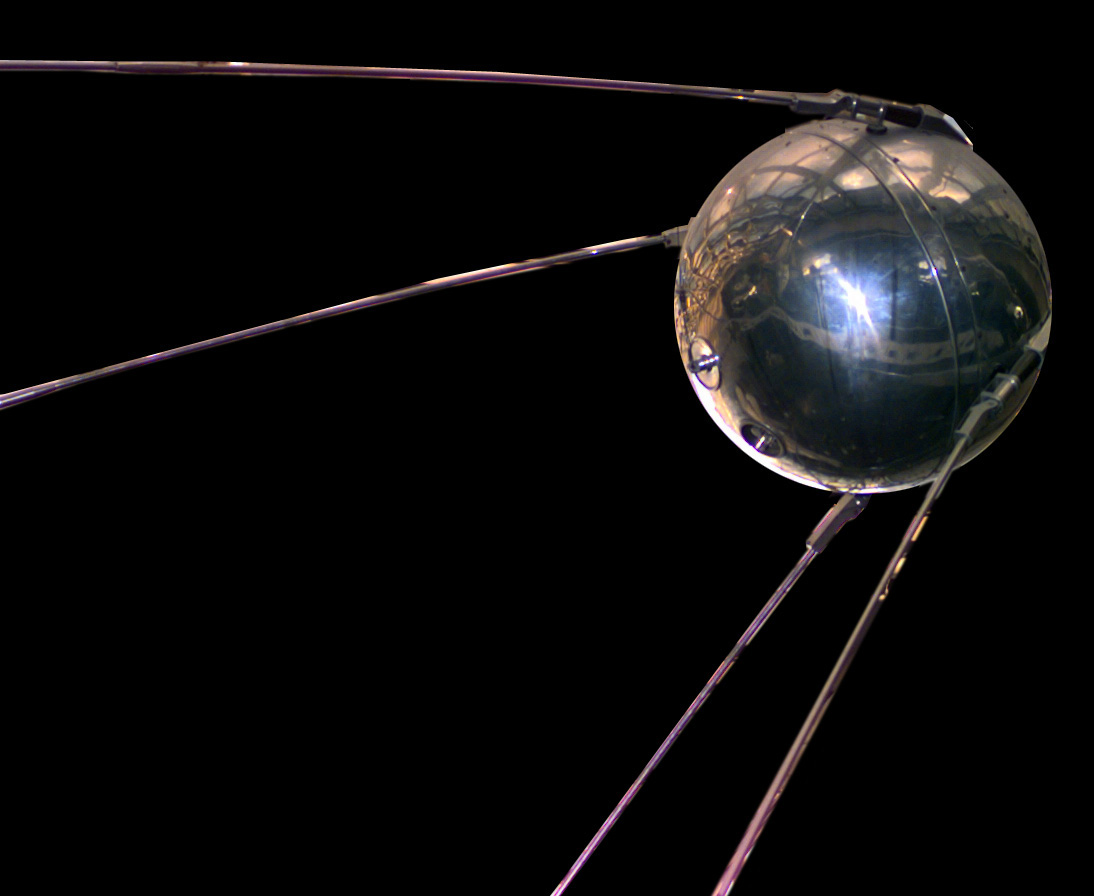
Sputnik 1 was launched during theInternational Geophysical YearfromSite No.1/5, at the 5thTyuratam range, inKazakh SSR(now known as theBaikonur Cosmodrome). The satellite travelled at about 29,000 kilometres per hour (18,000 mph; 8,100 m/s), taking 96.2 minutes to complete each orbit. It transmitted on 20.005 and 40.002MHz,[14] which were monitored by radio operators throughout the world. The signals continued for 21 days until the transmitter batteries ran out on 26 October 1957. Sputnik 1 burned up on 4 January 1958 whilereentering Earth's atmosphere, after three months, 1440 completed orbits of the Earth,[3] and a distance travelled of about 70 million km (43 million mi).[2]^(https://en.wikipedia.org/wiki/Sputnik_1#cite_note-NSSDC-2)
^////^
^///^
"As a technical achievement, Sputnik caught the world's attention and the American public off guard," NASA historians wrote in 2007, in a piece marking the milestone's 50-year anniversary. "Its size was more impressive than Vanguard's intended 3.5-lb. payload. In addition, the public feared that the Soviets' ability to launch satellites also translated into the capability to launch ballistic missiles that could carry nuclear weapons from Europe to the U.S."
///
The launch of Sputnik 1 surprised the American public, and shattered the perception created by American propaganda of the United States as the technological superpower, and the Soviet Union as a backward country.[86]^(https://en.wikipedia.org/wiki/Sputnik_1#cite_note-legacy-86) Privately, however, the CIA and President Eisenhower were aware of progress being made by the Soviets on Sputnik from secret spy plane imagery.[87]^(https://en.wikipedia.org/wiki/Sputnik_1#cite_note-87) Together with the Jet Propulsion Laboratory (JPL), the Army Ballistic Missile Agency built Explorer 1, and launched it on 31 January 1958. Before work was completed, however, the Soviet Union launched a second satellite, Sputnik 2, on 3 November 1957. Meanwhile, the televised failure of *Vanguard TV3* on 6 December 1957 deepened American dismay over the country's position in the Space Race. The Americans took a more aggressive stance in the emerging space race,[88] resulting in an emphasis on science and technological research, and reforms in many areas from the military to education systems.[89]^(https://en.wikipedia.org/wiki/Sputnik_1#cite_note-89) The federal government began investing in science, engineering, and mathematics at all levels of education.[86]^(https://en.wikipedia.org/wiki/Sputnik_1#cite_note-legacy-86)[90]^(https://en.wikipedia.org/wiki/Sputnik_1#cite_note-90) ****An advanced research group was assembled for military purposes.[86]^(https://en.wikipedia.org/wiki/Sputnik_1#cite_note-legacy-86) These research groups developed weapons such as ICBMs and missile defense systems, as well as spy satellites for the U.S.[86]^(https://en.wikipedia.org/wiki/Sputnik_1#cite_note-legacy-86)
^ ^
///
The U.S. soon had a number of successful satellites, including Explorer 1, Project SCORE, and Courier 1B. However, public reaction to theSputnik crisisspurred America to action in the Space Race, leading to the creation of both the ******Advanced Research Projects Agency(renamed the Defense Advanced Research Projects Agency, or DARPA, in 1972),[101]^(https://en.wikipedia.org/wiki/Sputnik_1#cite_note-101)andNASA (through the National Aeronautics and Space Act),[102]^(https://en.wikipedia.org/wiki/Sputnik_1#cite_note-102) as well as increased U.S. government spending on scientific research and education through the National Defense Education Act.[103]^(https://en.wikipedia.org/wiki/Sputnik_1#cite_note-103)
Such worries didn't dissipate after the U.S. launched its first successful satellite, Explorer 1, on Jan. 31, 1958. American officials took several measures to boost the nation's technological capabilities. These included creating the Advanced Research Projects Agency (later renamed the Defense Advanced Research Projects Agency, or DARPA) in February 1958 and NASA in October of that year. (NASA's precursor organization, the National Advisory Committee for Aeronautics, had been around since 1915.)