Chiang Kai Chek 2
See main node
Chiang Kai‐shek (31 October 1887 – 5 April 1975), also known as Jiang Zhongzheng and Jiang Jieshi, was a Chinese politician, revolutionary, and military leader who served as the leader of the Republic of China (ROC) and the Generalissimo from 1928 to his death in 1975 – until 1949 in Mainland China and from then in Taiwan. Following the Kuomintang's defeat by the Chinese Communist Party in the Chinese Civil War, he continued to lead the ROC government in Taiwan until his death.
Born in Zhejiang, Chiang was a member of the Kuomintang (KMT), and a lieutenant of Sun Yat-sen in the revolution to overthrow the Beiyang government and reunify China. With help from the Soviets and the Chinese Communist Party (CCP), Chiang organized the military for Sun's Canton Nationalist Government and headed the Whampoa Military Academy.
As commander-in-chief of the National Revolutionary Army (where he came to be known as a Generalissimo), he led the Northern Expedition from 1926 to 1928, before defeating a coalition of warlords and nominally reunifying China under a new Nationalist government. Midway through the Northern Expedition, the KMT–CCP alliance broke down and Chiang massacred communists and KMT leftists[3] inside the party, triggering a civil war with the CCP, which he eventually lost in 1949.
As the leader of the Republic of China in the Nanjing decade, Chiang sought to strike a difficult balance between modernizing China, while also devoting resources to defending the nation against the CCP, warlords, and the impending Japanese threat. Trying to avoid a war with Japan while hostilities with the CCP continued, he was kidnapped in the Xi'an Incident, and obliged to form an Anti-Japanese United Front with the CCP.
Following the Marco Polo Bridge Incident in 1937, he mobilized China for the Second Sino-Japanese War. For eight years, he led the war of resistance against a vastly superior enemy, mostly from the wartime capital Chongqing. As the leader of a major Allied power, Chiang met with British Prime Minister Winston Churchill and U.S. President Franklin D. Roosevelt in the Cairo Conference to discuss terms for the Japanese surrender.
When the Second World War ended, the Civil War with the communists (by then led by Mao Zedong) resumed. Chiang's nationalists were mostly defeated in a few decisive battles in 1948. In 1949, Chiang's government and army retreated to the island of Taiwan, where Chiang imposed martial law and persecuted critics during the White Terror. Presiding over a period of social reforms and economic prosperity, Chiang won five elections to six-year terms as President of the Republic of China in which he faced minimal opposition or was elected unopposed. Three years into his fifth term as president, and one year before Mao Zedong's death, he died in 1975. He was also director general of the Kuomintang until his death.
One of the longest-serving non-royal heads of state in the 20th century, Chiang was the longest-serving non-royal ruler of China, having held the post for 46 years. Like Mao, he is regarded as a controversial figure. Supporters credit him with playing a major part in unifying the nation and leading the Chinese resistance against Japan, as well as with countering CCP influence and economic development in both Mainland China and Taiwan.
Detractors and critics denounce him as a brutal dictator, and often accuse him of being a fascist at the front of a corrupt authoritarian regime that suppressed civilians and political dissents,[4] as well as flooding the Yellow River that subsequently caused the Henan Famine during the Second Sino-Japanese War. Other historians such as Jay Taylor argued that despite his many faults, Chiang's ideology notably differs from other authoritarian dictators of the 20th century and does not espouse the ideology of fascism. He argued that Chiang made genuine efforts to improve the economic and social conditions of mainland China and Taiwan such as improving women's rights and land reform.[5]
Chiang was also credited with transforming China from a semi-colony of various imperialist powers to an independent country by amending the unequal treaties signed by previous governments,[6] as well as moving various Chinese national treasures and traditional Chinese artworks to the National Palace Museum in Taipei during the 1949 retreat.
- Names
- Early life
- Education in Japan
- Returning to China
- Establishing the Kuomintang's position
- Rising power
- Rule
- Death
- Cult of personality
- Philosophy
- Contemporary public perception
- Family
- Religion and relationships with religious communities
- Honours
- Selected writings
- See also
- References
- External links
...
Relations with United States
[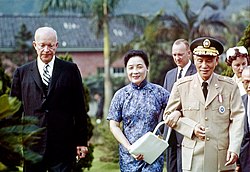
Chiang with US President Dwight D. Eisenhower in June 1960
Chiang was suspicious that covert operatives of the United States were plotting a coup against him.
In 1950, Chiang Ching-kuo became director of the secret police (Bureau of Investigation and Statistics), which he remained until 1965. Chiang Kai-shek was also suspicious of politicians who were overly friendly to the United States and considered them his enemies. In 1953, seven days after surviving an assassination attempt, Wu Kuo-chen lost his position as governor of Taiwan Province to Chiang Ching-kuo. After fleeing to United States the same year, Wu became a vocal critic of Chiang's family and government.[148]
Chiang Ching-kuo, who had been educated in the Soviet Union, initiated Soviet-style military organization in the Republic of China Armed Forces. He reorganized and Sovietized the political officer corps and propagated Kuomintang ideology throughout the military. Sun Li-jen, who had been educated at the American Virginia Military Institute, opposed those practices.[149]
Chiang Ching-kuo orchestrated the controversial court-martial and arrest of General Sun Li-jen in August 1955 for plotting a coup d'état with the American Central Intelligence Agency (CIA) against his father, Chiang Kai-shek, and the Kuomintang. The CIA allegedly wanted to help Sun take control of Taiwan and declare its independence.[148][150]
Death
See also: Cihu Mausoleum

The National Chiang Kai-shek Memorial Hall is a famous monument, landmark, and tourist attraction in Taipei, Taiwan.
In 1975, after Chiang had come to Taiwan 26 years earlier, he died in Taipei at the age of 87.[151][152] He had suffered a heart attack and pneumonia in the foregoing months and died from kidney failure aggravated with advanced heart failure on 5 April. Chiang's funeral was held on 16 April.[153]
A month of mourning was declared. The Chinese music composer Hwang Yau-tai wrote the "Chiang Kai-shek Memorial Song." In mainland China, however, Chiang's death was met with little apparent mourning, and Communist state-run newspapers gave the brief headline "Chiang Kai-shek Has Died". Chiang's body was put in a copper coffin and temporarily interred at his favorite residence in Cihu, Daxi, Taoyuan.
His funeral was attended by dignitaries from many nations, including US Vice President Nelson Rockefeller, South Korean Prime Minister Kim Jong-pil, and two former Japanese prime ministers: Nobusuke Kishi and Eisaku Sato. Chiang Kai-shek Memorial Day [zh] (蔣公逝世紀念日) was established on 5 April. The memorial day was disestablished in 2007.
The response by Japanese media was swift and shaped by a cult of personality around Chiang Kai-shek. Japanese conservatives had long promoted to counter the China policy and the historical narratives of their leftist pro-PRC opponents. The nationalist leader of Taiwan had been trained in Japanese military schools and shared a particular fondness for the Japanese Empire.[154]
When his son, Chiang Ching-kuo, died in 1988, he was entombed in a separate mausoleum in nearby Touliao (頭寮). The hope was to have both of them buried at their birthplace in Fenghua when that would be possible. In 2004, Chiang Fang-liang, the widow of Chiang Ching-kuo, asked for both father and son to be buried at Wuzhi Mountain Military Cemetery in Xizhi, Taipei County (now New Taipei City). Chiang's ultimate funeral ceremony became a political battle between the wishes of the state and those of his family.
Chiang was succeeded as president by Vice President Yen Chia-kan and as Kuomintang party ruler by his son Chiang Ching-kuo, who retired Chiang Kai-shek's title of Director-General and instead assumed the position of chairman. Yen's presidency was interim; Chiang Ching-kuo, who was the Premier, became president after the end of Yen's term three years later.
Cult of personality

Chiang's portrait in Tiananmen Rostrum

Chinese propaganda poster proclaiming "Long Live the President"
Chiang's portrait hung over Tiananmen Square until 1949, when it was replaced with Mao's portrait.[155] Portraits of Chiang were common in private homes and in public on the streets.[156][157][158] After his death, the Chiang Kai-shek Memorial Song was written in 1988 to commemorate Chiang Kai-shek. In Cihu, there are several statues of Chiang Kai-shek.

A Chinese stamp with Chiang Kai-shek
Chiang was popular among many people and dressed in plain, simple clothes, unlike contemporary Chinese warlords who dressed extravagantly.[159]
Quotes from the Quran and Hadith were used by Muslims in the Kuomintang-controlled Muslim publication, the Yuehua, to justify Chiang Kai-shek's rule over China.[160] When the Muslim General and Warlord Ma Lin was interviewed, Ma Lin was described as having "high admiration for and unwavering loyalty to Chiang Kai-shek".[161]
In the Philippines, a school was named in his honour in 1939. Today, Chiang Kai-shek College is the largest educational institution for the Chinoy community in the country.
Philosophy
[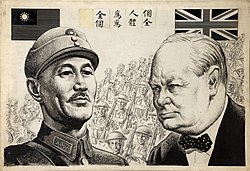
Chiang Kai-shek and Winston Churchill heads, with Nationalist China flag and Union Jack
The Kuomintang used traditional Chinese religious ceremonies, and promulgated martyrdom in Chinese culture. Kuomintang ideology subserved and promulgated the view that the souls of Party martyrs who died fighting for the Kuomintang, the revolution, and the party founder Dr. Sun Yat-sen were sent to heaven. Chiang Kai-shek believed that these martyrs witnessed events on Earth from heaven after their deaths.[162][163][164][165]
Unlike Sun's original Three Principles of the People ideology that was heavily influenced by Western enlightenment theorists such as Henry George, Abraham Lincoln, Bertrand Russell, and John Stuart Mill,[166] the traditional Chinese Confucian influence on Chiang's ideology is much stronger. Chiang rejected the Western progressive ideologies of individualism, liberalism, and the cultural aspects of Marxism. Therefore, Chiang is generally more culturally and socially conservative than Sun Yat-sen. Jay Taylor has described Chiang Kai-shek as a revolutionary nationalist and a “left-leaning Confucian-Jacobinist”.
When the Northern Expedition was complete, Kuomintang Generals led by Chiang Kai-shek paid tribute to Dr. Sun's soul in heaven with a sacrificial ceremony at the Xiangshan Temple in Beijing in July 1928. Among the Kuomintang Generals present were the Muslim Generals Bai Chongxi and Ma Fuxiang.[167]
Chiang Kai-shek considered both Han Chinese and all ethnic minorities of China, the Five Races Under One Union, as descendants of the Yellow Emperor, the mythical founder of the Chinese nation, and belonging to the Chinese Nation Zhonghua Minzu. He introduced this into Kuomintang ideology which was propagated into the educational system of the Republic of China.[168][169][170]
Chiang Kai-shek once said:
If when I die, I am still a dictator, I will certainly go down into the oblivion of all dictators. If, on the other hand, I succeed in establishing a truly stable foundation for a democratic government, I will live forever in every home in China.[171]
Contemporary public perception
[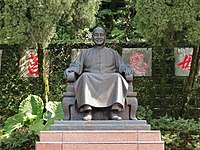
Statue of Chiang Kai-shek in Yangmingshan National Park, Taiwan
Chiang's legacy has been subjected to heated debates because of the different views held about him. For some, Chiang was a national hero who led the victorious Northern Expedition against the Beiyang Warlords in 1927 and helped achieve Chinese unification.
His initial image as the leader of China against Japan's invasion, both before and after the attack on Pearl Harbor, led him to be featured on the cover of Time magazine ten times. Even though China received little American aid compared to Britain and the Soviet Union, it did not fold, as Chiang called on his countrymen to fight to the "bitter end" until their ultimate victory against Japan in 1945.[172]
At the same time, some blamed him for not doing enough against the Japanese forces in the lead-up to and during the Second Sino-Japanese War, merely hoping that the United States would get involved, or preferring to hold back his armies for the eventual resumption of war against the Communists.
Some also see him as a champion of anti-Communism, being a key figure during the formative years of the World Anti-Communist League. During the Cold War, he was also seen as the leader who led Free China and the bulwark against a possible Communist invasion. However, Chiang presided over purges, political authoritarianism, and graft during his tenure in mainland China, and ruled throughout a period of imposed martial law.
His governments were accused of being corrupt even before he even took power in 1928. He also allied with known criminals like Du Yuesheng for political and financial gains. Some opponents charge that Chiang's efforts in developing Taiwan were mostly to make the island a strong base from which to one day return to mainland China, and that Chiang had little regard for the long-term prosperity and well-being of the Taiwanese people, unlike his son Chiang Ching-kuo. Critics of his regime often accused him of fascism.[4]
Unlike Chiang's son, who is respected in Taiwan across the political spectrum, Chiang Kai-shek's image is perceived rather negatively in Taiwan, where he was rated the lowest in two opinion polls about the perception of former presidents.[173][174]
His popularity in Taiwan is divided along political lines, enjoying greater support among Kuomintang (KMT) supporters while being generally unpopular among Democratic Progressive Party (DPP) voters and supporters who blame him for the thousands killed during the February 28 Incident and criticise his subsequent dictatorial rule.[175] For example, the 2009 American film Formosa Betrayed depicts him as a brutal dictator responsible for the casualties caused from the February 28 Incident. In sharp contrast to his son, Chiang Ching-kuo, and to Sun Yat-sen, Chiang's memory is rarely invoked by current political parties, including the Kuomintang.
In contrast, his image has been partially rehabilitated in contemporary Mainland China. Until recently he was portrayed as a villain who fought against the "liberation" of China by the Communists, but since the 2000s, he has been portrayed by the media and popular culture in an only slightly negative manner as compared to the total denunciation in the Mao era as a Chinese nationalist who tried to bring about national unification and resisted the Japanese invasion during World War II.[176]
For example, Chiang is portrayed sympathetically in the 2009 movie sponsored by the Chinese Communist Party, The Founding of a Republic, as a genuine Chinese nationalist with relatively honest if misguided intentions, even akin to a tragic hero, but whose corrupt governance and mistakes still forced him to flee to Taiwan. He was also depicted in the 2015 movie Cairo Declaration as a reasonably competent Chinese leader who was able to resist the Japanese invaders, greatly increase China's international standing and help reclaim some of its sovereignty during the Second World War in negotiations with other anti-Axis world leaders.
However, Chinese textbooks continue to denounce the KMT under Chiang's leadership for betraying Sun Yat-sen's ideals with his anti-communist cleansings. Even though there has been recognition of the war efforts made by the nationalist army since the reform and opening, the CCP continues to insist that it is the pillar of the Sino-Japanese War against the Japanese invasion. This shift is largely in response to current political landscape of Taiwan, in relation to Chiang's commitment to a unified China and his stance against Taiwanese separatism during his rule of the island, along with the recent détente between the Chinese Communist Party (CCP) and Chiang's KMT.[177]
In contrast to efforts to remove his public monuments in Taiwan, his ancestral home in Fenghua, Zhejiang on mainland China has become a commemorative museum and major tourist attraction.[178] Rana Mitter notes that, "The displays inside [Chiang's villa] give plenty of details of Chiang's role as a leader of the resistance against Japan, all of them very positive, and none painting him as a bourgeois reactionary lackey. Of the Communists, there is very little mention. A generation ago, one might have seen this kind of praise for Chiang in Taiwan, but not in the mainland. In the West, the living, breathing legacy of China's wartime experience continues to be poorly understood."[179]
In the United States and Europe, Chiang was often perceived negatively as the one who lost China to the Communists. His constant demands for Western support and funding also earned him the nickname of "General Cash-My-Check". In the West he has been criticized for his poor military skills. He had a record of issuing unrealistic orders and persistently attempting to fight unwinnable battles, leading to the loss of his best troops.[180]
In recent years, there has been an attempt to find a more moderate interpretation of Chiang. Chiang is now increasingly perceived as a man simply overwhelmed by the events in China, having to fight Communists, Japanese, and provincial warlords simultaneously, while having to reconstruct and unify the country. His sincere, albeit often unsuccessful attempts to build a more powerful nation have been noted by scholars such as Jonathan Fenby, Rana Mitter, and biographer Jay Taylor.[181]
Mitter has observed that, ironically, today's China is closer to Chiang's vision than to Mao Zedong's. He argues that the Communists, since the 1980s, have essentially created the state envisioned by Chiang in the 1930s. Mitter concludes by writing that "one can imagine Chiang Kai-shek's ghost wandering round China today nodding in approval, while Mao's ghost follows behind him, moaning at the destruction of his vision".[182]
Liang Shuming opined that Chiang Kai-shek's "greatest contribution was to make the CCP successful. If he had been a bit more trustworthy, if his character was somewhat better, the CCP would have been unable to beat him".[183] Some Chinese historians argue that the main determinants for Chiang's defeat was not corruption or the lack of US support, but Chiang's decision to start the civil war with 70% of government expenditures in the military, the overestimation of the nationalist forces equipped with US arms, and the loss of popularity and morales of soldiers.[184]
Other historians, such as Jay Taylor, Robert Cowley, and Anne W. Carroll, argue that Chiang's failure was largely caused by external factors outside of Chiang's control. Most notably, the refusal of the Truman administration to support Chiang by withdrawing aid, the foisting of an arms embargo by Marshall, the failed pursuit of a détente between the nationalists and the communists, the American push for a coalition government with the CCP, and the USSR's consistent aid and support for the CCP during the Chinese Civil War.[5][185][186][187]
...
Sandbox
Knowledge Web Content (see main node)
Name: Chiang Kai Chek
Achievements: Head of Chinese Nationalist Government in China and in exile in Taiwan
Born: October 31, 1887; Chekiang province, China
Died: April 5, 1975; Taipei, Taiwan (Aged 87)
Field & Discipline: Military; Government; Politics; General; Statesman
Language: Chinese
Father: Chiang Su-an
Mother: Unknown
Siblings: Unknown
Spouse: 1) Mao Fu-mei; 2) Soong Mayling (who became a world figure, known as Madame Chiang Kai-shek); 3) possible 3rd wife
Children: Chiang Ching-kuo (succeeded Chiang Kai-shek)
Education: Pavilion of Literature, Fenghua; Dragon River Middle School, Fenghua; Paoting Military Academy, North China; Military training in Tokyo, Japan
Life & Times:
The son of a salt merchant, Chiang joined the revolutionary forces in 1911 and helped depose Yuan Shih-k'ai, the first president to have imperial ambitions. In 1918, he joined revolutionary leader [worked with] Sun Yat-sen*, leader of the Komintang (the Nationalist Party). To increase his knowledge of revolutionary methods, Chiang visited the Soviet Union in 1923, studying in particular the Red Army. On his return, Sun Yat-sen appointed him commander of a new military academy at Whampoa.
Sun Yat-sen welcomed Soviet advisers into his Central Committee, and after his death, Chiang, now in charge, walked a tightrope, trying to keep on Moscow's good side, but determined to keep the Communists from taking over. He also had to contend with provincial war lords, and in 1926, led his Whampoa army against the war lords of the north. But a year later, in an about-face, he allied himself with the landowning and mercantile classes and, in a bloody coup, expelled the Communists, suppressed their labor unions, leaving the peasant class (almost 90 per cent of the population) without the social reforms he had promised.
In 1928, Chiang marched on Peking (Beijing) and established a central Nationalist government at Nanking. Occupied with bringing China under his control, and still fighting war lords, and Communists who were setting up rural strongholds, Chiang chose not to undertake modernization or economic reforms.
In 1931, Japan seized Manchuria in China's north east and threatened the entire country. Chiang opted not to resist the Japanese, believing the Communists were the greater threat, a decision that angered much of the country, particularly the rural classes. To try to pacify his detractors and unite the country, Chiang in 1934 launched the New Life Movement, making the ideals and morals of Confucius a state cult.
Three years later, war with Japan broke out and Chiang was forced to ally himself with the Communists against the invaders. The Soviet Union gave some military aid, but China fought Japan mainly on her own until the Allied forces joined the battle in 1941 during World War II.
Chiang used America's huge subsidies to prepare to battle the Communists when the War ended. After civil war broke out in 1946, Chiang's rule became more dictatorial and his advisers were appointed with more regard to their personal loyalty to him than to their abilities. He had no ideas with which to counter Communist ideology. By 1949, mainland China was in Communist hands, the People's Republic of China had been established, and Chiang had fled to the island of Taiwan with the remnants of the Nationalist forces.
On Taiwan, Chiang had two objectives: to make his position secure; and to gain recognition for his regime as the legitimate government of all China. His land reforms stabilized the island and boosted the economy. Before long, he was commander in chief of Taiwan's armed forces, director general of the Nationalist Party, and president of the island.
Britain recognized his regime in 1950 and the U.S. again gave massive aid to his Nationalist government. [aided by] Eisenhower* pledged the U.S. would defend Taiwan, but did not encourage Chiang to try to retake mainland China.
In spite of its financial and military ties with the West and its prosperity, Taiwan did not become a beacon of democracy. Chiang and his son, Ching-kuo, who ran the Investigation Bureau, controled everything. It was an authoritarian regime but, unlike [defeated by] Mao Zedong’s* in mainland China, not a totalitarian one. Chiang continued to use his troops (and his American military hardware) to engage in naval and air battles with the People's Republic of China, and to make raids on the mainland. He remained disillusioned that the Americans never sanctioned an invasion, although he accepted the accommodation with China pressed on him by [influenced by] Dulles*
Assessment: His failure to initiate social and economic reforms essentially resulted in the loss of his country
Oneliner: Chiang Kai Chek, Chinese nationalist (pre-communist) leader
Bibliography:
- Crozier, Brian, The Man Who Lost China, Angus & Robertson (UK) Ltd., London, 1977.
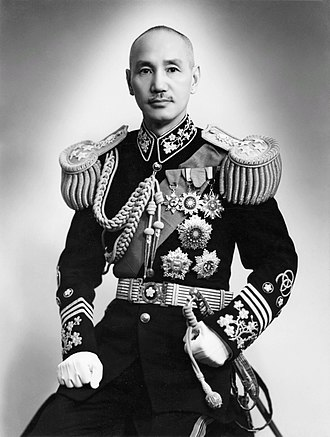
Chiang Kai-shek
Achievements: Head of Chinese Nationalist Government in China and in exile in Taiwan
Born: October 31, 1887; Chekiang province, China
Died: April 5, 1975; Taipei, Taiwan (Aged 87)
Field & Discipline: Military; Government; Politics; General; Statesman
Language: Chinese
Father: Chiang Su-an
Mother: Unknown
Siblings: Unknown
Spouse: 1) Mao Fu-mei; 2) Soong Mayling (who became a world figure, known as Madame Chiang Kai-shek); 3) possible 3rd wife
Children: Chiang Ching-kuo (succeeded Chiang Kai-shek)
Education: Pavilion of Literature, Fenghua; Dragon River Middle School, Fenghua; Paoting Military Academy, North China; Military training in Tokyo, Japan
Life & Times:
The son of a salt merchant, Chiang joined the revolutionary forces in 1911 and helped depose Yuan Shih-k'ai, the first president to have imperial ambitions. In 1918, he joined revolutionary leader [worked with] Sun Yat-sen*, leader of the Komintang (the Nationalist Party). To increase his knowledge of revolutionary methods, Chiang visited the Soviet Union in 1923, studying in particular the Red Army. On his return, Sun Yat-sen appointed him commander of a new military academy at Whampoa.
Sun Yat-sen welcomed Soviet advisers into his Central Committee, and after his death, Chiang, now in charge, walked a tightrope, trying to keep on Moscow's good side, but determined to keep the Communists from taking over. He also had to contend with provincial war lords, and in 1926, led his Whampoa army against the war lords of the north. But a year later, in an about-face, he allied himself with the landowning and mercantile classes and, in a bloody coup, expelled the Communists, suppressed their labor unions, leaving the peasant class (almost 90 per cent of the population) without the social reforms he had promised.
In 1928, Chiang marched on Peking (Beijing) and established a central Nationalist government at Nanking. Occupied with bringing China under his control, and still fighting war lords, and Communists who were setting up rural strongholds, Chiang chose not to undertake modernization or economic reforms.
In 1931, Japan seized Manchuria in China's north east and threatened the entire country. Chiang opted not to resist the Japanese, believing the Communists were the greater threat, a decision that angered much of the country, particularly the rural classes. To try to pacify his detractors and unite the country, Chiang in 1934 launched the New Life Movement, making the ideals and morals of Confucius a state cult.
Three years later, war with Japan broke out and Chiang was forced to ally himself with the Communists against the invaders. The Soviet Union gave some military aid, but China fought Japan mainly on her own until the Allied forces joined the battle in 1941 during World War II.
Chiang used America's huge subsidies to prepare to battle the Communists when the War ended. After civil war broke out in 1946, Chiang's rule became more dictatorial and his advisers were appointed with more regard to their personal loyalty to him than to their abilities. He had no ideas with which to counter Communist ideology. By 1949, mainland China was in Communist hands, the People's Republic of China had been established, and Chiang had fled to the island of Taiwan with the remnants of the Nationalist forces.
On Taiwan, Chiang had two objectives: to make his position secure; and to gain recognition for his regime as the legitimate government of all China. His land reforms stabilized the island and boosted the economy. Before long, he was commander in chief of Taiwan's armed forces, director general of the Nationalist Party, and president of the island.
Britain recognized his regime in 1950 and the U.S. again gave massive aid to his Nationalist government. [aided by] Eisenhower* pledged the U.S. would defend Taiwan, but did not encourage Chiang to try to retake mainland China.
In spite of its financial and military ties with the West and its prosperity, Taiwan did not become a beacon of democracy. Chiang and his son, Ching-kuo, who ran the Investigation Bureau, controled everything. It was an authoritarian regime but, unlike [defeated by] Mao Zedong’s* in mainland China, not a totalitarian one. Chiang continued to use his troops (and his American military hardware) to engage in naval and air battles with the People's Republic of China, and to make raids on the mainland. He remained disillusioned that the Americans never sanctioned an invasion, although he accepted the accommodation with China pressed on him by [influenced by] Dulles*
Assessment: His failure to initiate social and economic reforms essentially resulted in the loss of his country
Oneliner: Chiang Kai Chek, Chinese nationalist (pre-communist) leader
Bibliography:
- Crozier, Brian, The Man Who Lost China, Angus & Robertson (UK) Ltd., London, 1977.