Eisenhower, D
(see main node)
Dwight David "Ike" Eisenhower (/ˈaɪzənhaʊ.ər/ *EYE-zən-how-ər*; born David Dwight Eisenhower; October 14, 1890 – March 28, 1969) was an American military officer and statesman who served as the 34th president of the United States from 1953 to 1961. During World War II, he served as Supreme Commander of the Allied Expeditionary Force in Europe and achieved the five-star rank as General of the Army. Eisenhower planned and supervised two of the most consequential military campaigns of World War II: Operation Torch in the North Africa campaign in 1942–1943 and the D-Day invasion of Normandy in 1944.
Eisenhower was born into a large family of mostly Pennsylvania Dutch ancestry in Denison, Texas, and raised in Abilene, Kansas. His family had a strong religious background, and his mother became a Jehovah's Witness. Eisenhower, however, belonged to no organized church until 1952. He graduated from West Point in 1915 and later married Mamie Doud, with whom he had two sons. During World War I, he was denied a request to serve in Europe and instead commanded a unit that trained tank crews. Following the war, he served under various generals and was promoted to the rank of brigadier general in 1941. After the United States entered World War II, Eisenhower oversaw the invasions of North Africa and Sicily before supervising the invasions of France and Germany. After the war, he served as Army Chief of Staff (1945–1948), as president of Columbia University (1948–1953), and as the first Supreme Commander of NATO (1951–1952).
In 1952, Eisenhower entered the presidential race as a Republican to block the isolationist foreign policies of Senator Robert A. Taft, who opposed NATO and wanted no foreign entanglements. Eisenhower won that election and the 1956 election in landslides, both times defeating Adlai Stevenson II. Eisenhower's main goals in office were to contain the spread of communism and reduce federal deficits. In 1953, he considered using nuclear weapons to end the Korean War and may have threatened China with nuclear attack if an armistice was not reached quickly. China did agree and an armistice resulted, which remains in effect. His New Look policy of nuclear deterrence prioritized "inexpensive" nuclear weapons while reducing funding for expensive Army divisions. He continued Harry S. Truman's policy of recognizing Taiwan as the legitimate government of China, and he won congressional approval of the Formosa Resolution. His administration provided major aid to help the French fight off Vietnamese Communists in the First Indochina War. After the French left, he gave strong financial support to the new state of South Vietnam. He supported regime-changing military coups in Iran and Guatemala orchestrated by his own administration. During the Suez Crisis of 1956, he condemned the Israeli, British, and French invasion of Egypt, and he forced them to withdraw. He also condemned the Soviet invasion during the Hungarian Revolution of 1956 but took no action. He deployed 15,000 soldiers during the 1958 Lebanon crisis. Near the end of his term, a summit meeting with the Soviet leader Nikita Khrushchev was cancelled when a U.S. spy plane was shot down over the Soviet Union. Eisenhower approved the Bay of Pigs Invasion, which was left to John F. Kennedy to carry out.
On the domestic front, Eisenhower governed as a moderate conservative who continued New Deal agencies and expanded Social Security. He covertly opposed Joseph McCarthy and contributed to the end of McCarthyism by openly invoking executive privilege. He signed the Civil Rights Act of 1957 and sent Army troops to enforce federal court orders which integrated schools in Little Rock, Arkansas. His administration undertook the development and construction of the Interstate Highway System, which remains the largest construction of roadways in American history. In 1957, following the Soviet launch of Sputnik, Eisenhower led the American response which included the creation of NASA and the establishment of a stronger, science-based education via the National Defense Education Act. Following the establishment of NASA, the Soviet Union began to reinforce their own space program, escalating the Space Race. His two terms saw unprecedented economic prosperity except for a minor recession in 1958. In his farewell address to the nation, he expressed his concerns about the dangers of massive military spending, particularly deficit spending and government contracts to private military manufacturers, which he dubbed "the military–industrial complex". Historical evaluations of his presidency place him among the upper tier of American presidents.
Family background
Further information: Family of Dwight D. Eisenhower
The Eisenhauer (German for "iron hewer or "iron miner") family migrated from the German village of Karlsbrunn to the Province of Pennsylvania in 1741, initially settling in York, Pennsylvania. The family moved to Kansas in the 1880s.[3] Accounts vary as to how and when the German name Eisenhauer was anglicized to Eisenhower.[4] Eisenhower's Pennsylvania Dutch ancestors, who were primarily farmers, included Hans Nikolaus Eisenhauer of Karlsbrunn, who migrated in 1741 to Lancaster, Pennsylvania.[5]
Hans's great-great-grandson, David Jacob Eisenhower (1863–1942), Eisenhower's father, was a college-educated engineer, despite his own father Jacob's urging to stay on the family farm. Eisenhower's mother, Ida Elizabeth (Stover) Eisenhower, born in Virginia, of predominantly German Protestant ancestry, moved to Kansas from Virginia. She married David on September 23, 1885, in Lecompton, Kansas, on the campus of their alma mater, Lane University.[6] Dwight David Eisenhower's lineage also included English ancestors (on both sides) and Scottish ancestors (through his maternal line).[7][8]
David owned a general store in Hope, Kansas, but the business failed due to economic conditions and the family became impoverished. The Eisenhowers then lived in Texas from 1889 until 1892, and later returned to Kansas, with $24 (equivalent to $724 in 2021) to their name at the time. David worked as a railroad mechanic and then at a creamery.[6] By 1898, the parents made a decent living and provided a suitable home for their large family.[9]
...
senhower attended Abilene High School and graduated with the class of 1909.[22] As a freshman, he injured his knee and developed a leg infection that extended into his groin, which his doctor diagnosed as life-threatening. The doctor insisted that the leg be amputated but Dwight refused to allow it, and surprisingly recovered, though he had to repeat his freshman year.[23] He and brother Edgar both wanted to attend college, though they lacked the funds. They made a pact to take alternate years at college while the other worked to earn the tuitions.[24]
Edgar took the first turn at school, and Dwight was employed as a night supervisor at the Belle Springs Creamery.[25] When Edgar asked for a second year, Dwight consented and worked for a second year. At that time, a friend Edward "Swede" Hazlett was applying to the Naval Academy and urged Dwight to apply to the school, since no tuition was required. Eisenhower requested consideration for either Annapolis or West Point with his U.S. Senator, Joseph L. Bristow. Though Eisenhower was among the winners of the entrance-exam competition, he was beyond the age limit for the Naval Academy.[26] He then accepted an appointment to West Point in 1911.[26]

Eisenhower (third from left) and Omar Bradley (rightmost) were members of the 1912 West Point football team.
At West Point, Eisenhower relished the emphasis on traditions and on sports, but was less enthusiastic about the hazing, though he willingly accepted it as a plebe. He was also a regular violator of the more detailed regulations and finished school with a less than stellar discipline rating. Academically, Eisenhower's best subject by far was English. Otherwise, his performance was average, though he thoroughly enjoyed the typical emphasis of engineering on science and mathematics.[27]
In athletics, Eisenhower later said that "not making the baseball team at West Point was one of the greatest disappointments of my life, maybe my greatest".[28] He made the varsity football team[29][30] and was a starter at halfback in 1912, when he tried to tackle the legendary Jim Thorpe of the Carlisle Indians.[31] Eisenhower suffered a torn knee while being tackled in the next game, which was the last he played; he reinjured his knee on horseback and in the boxing ring,[3][14][32] so he turned to fencing and gymnastics.[3]
...
While Eisenhower was stationed in Texas, he met Mamie Doud of Boone, Iowa.[3] They were immediately taken with each other. He proposed to her on Valentine's Day in 1916.[37] A November wedding date in Denver was moved up to July 1 due to the impending U.S. entry into World War I; Funston approved 10 days of leave for their wedding.[38] The Eisenhowers moved many times during their first 35 years of marriage.[39]
The Eisenhowers had two sons. In late 1917 while he was in charge of training at Fort Oglethorpe in Georgia, his wife Mamie had their first son, Doud Dwight "Icky" Eisenhower (1917–1921), who died of scarlet fever at the age of three.[40] Eisenhower was mostly reluctant to discuss his death.[41] Their second son, John Eisenhower (1922–2013), was born in Denver, Colorado.[42] John served in the United States Army, retired as a brigadier general, became an author and served as U.S. Ambassador to Belgium from 1969 to 1971. Coincidentally, John graduated from West Point on D-Day, June 6, 1944. He married Barbara Jean Thompson on June 10, 1947. John and Barbara had four children: David, Barbara Ann, Susan Elaine and Mary Jean. David, after whom Camp David is named,[43] married Richard Nixon's daughter Julie in 1968.
...
World War I (1914–1918)
See also: Military career of Dwight D. Eisenhower
Eisenhower served initially in logistics and then the infantry at various camps in Texas and Georgia until 1918. When the U.S. entered World War I, he immediately requested an overseas assignment but was again denied and then assigned to Ft. Leavenworth, Kansas.[53] In February 1918, he was transferred to Camp Meade in Maryland with the 65th Engineers. His unit was later ordered to France, but, to his chagrin, he received orders for the new tank corps, where he was promoted to brevet lieutenant colonel in the National Army.[54] He commanded a unit that trained tank crews at Camp Colt – his first command – at the site of "Pickett's Charge" on the Gettysburg Civil War battleground. Though Eisenhower and his tank crews never saw combat, he displayed excellent organizational skills as well as an ability to accurately assess junior officers' strengths and make optimal placements of personnel.[55]
Once again his spirits were raised when the unit under his command received orders overseas to France. This time his wishes were thwarted when the armistice was signed a week before his departure date.[56] Completely missing out on the warfront left him depressed and bitter for a time, despite receiving the Distinguished Service Medal for his work at home.[57] In World War II, rivals who had combat service in the Great War (led by Gen. Bernard Montgomery) sought to denigrate Eisenhower for his previous lack of combat duty, despite his stateside experience establishing a camp, completely equipped, for thousands of troops and developing a full combat training schedule.[58]
In service of generals

Eisenhower (far right) with three friends (William Stuhler, Major Brett, and Paul V. Robinson) in 1919, four years after graduating from West Point
After the war, Eisenhower reverted to his regular rank of captain and a few days later was promoted to major, a rank he held for 16 years.[5] The major was assigned in 1919 to a transcontinental Army convoy to test vehicles and dramatize the need for improved roads in the nation. Indeed, the convoy averaged only 5 miles per hour (8.0 km/h) from Washington, D.C. to San Francisco; later the improvement of highways became a signature issue for Eisenhower as president.[59]
He assumed duties again at Camp Meade, Maryland, commanding a battalion of tanks, where he remained until 1922. His schooling continued, focused on the nature of the next war and the role of the tank in it. His new expertise in tank warfare was strengthened by a close collaboration with George S. Patton, Sereno E. Brett, and other senior tank leaders. Their leading-edge ideas of speed-oriented offensive tank warfare were strongly discouraged by superiors, who considered the new approach too radical and preferred to continue using tanks in a strictly supportive role for the infantry. Eisenhower was even threatened with court-martial for continued publication of these proposed methods of tank deployment, and he relented.[60][61]
From 1920, Eisenhower served under a succession of talented generals – Fox Conner, John J. Pershing, Douglas MacArthur and George Marshall. He first became executive officer to General Conner in the Panama Canal Zone, where, joined by Mamie, he served until 1924. Under Conner's tutelage, he studied military history and theory (including Carl von Clausewitz's On War), and later cited Conner's enormous influence on his military thinking, saying in 1962 that "Fox Conner was the ablest man I ever knew." Conner's comment on Eisenhower was, "[He] is one of the most capable, efficient and loyal officers I have ever met."[62] On Conner's recommendation, in 1925–1926 he attended the Command and General Staff College at Fort Leavenworth, Kansas, where he graduated first in a class of 245 officers.[63][64] He then served as a battalion commander at Fort Benning, Georgia, until 1927....
His primary duty was planning for the next war, which proved most difficult in the midst of the Great Depression.[69] He then was posted as chief military aide to General Douglas MacArthur, Army Chief of Staff. In 1932, he participated in the clearing of the Bonus March encampment in Washington, D.C. Although he was against the actions taken against the veterans and strongly advised MacArthur against taking a public role in it, he later wrote the Army's official incident report, endorsing MacArthur's conduct.[70][71]
Philippine tenure
In 1935, he accompanied MacArthur to the Philippines, where he served as assistant military adviser to the Philippine government in developing their army. MacArthur allowed Eisenhower to handpick an officer whom he thought would contribute much to the mission. Hence he chose James Ord, a fellow classmate of him at West Point Academy. Having been brought up in Mexico, which inculcated into him the Spanish culture in which both the Mexico and the Philippines had similarities, Ord was deemed as the right pick for the job. Eisenhower had strong philosophical disagreements with MacArthur regarding the role of the Philippine Army and the leadership qualities that an American army officer should exhibit and develop in his subordinates. The antipathy between Eisenhower and MacArthur lasted the rest of their lives.[72]
After quite some time, on December of 1935, after realizing that the mission of constructing a well-sound plan for the creation of the Philippine Army was very lagging behind, his optimistic character turned into a bleak state, all the more when in 1936, Eisenhower was entrusted with the responsibility of finding the right officer who would train the fresh recruits; there was simply not enough manpower for potential instructors.
Historians have concluded that this assignment provided valuable preparation for handling the challenging personalities of Winston Churchill, George S. Patton, George Marshall, and Bernard Montgomery during World War II. Eisenhower later emphasized that too much had been made of the disagreements with MacArthur and that a positive relationship endured.[73] While in Manila, Mamie suffered a life-threatening stomach ailment but recovered fully.
Eisenhower was promoted to the rank of permanent lieutenant colonel in 1936. He also learned to fly, making a solo flight over the Philippines in 1937, and obtained his private pilot's license in 1939 at Fort Lewis.[74][75] Also around this time, he was offered a post by the Philippine Commonwealth Government, namely by then Philippine President Manuel L. Quezon on recommendations by MacArthur, to become the chief of police of a new capital being planned, now named Quezon City, but he declined the offer.[76]...
World War II (1939–1945)
After the Japanese attack on Pearl Harbor, Eisenhower was assigned to the General Staff in Washington, where he served until June 1942 with responsibility for creating the major war plans to defeat Japan and Germany. He was appointed Deputy Chief in charge of Pacific Defenses under the Chief of War Plans Division (WPD), General Leonard T. Gerow, and then succeeded Gerow as Chief of the War Plans Division. Next, he was appointed Assistant Chief of Staff in charge of the new Operations Division (which replaced WPD) under Chief of Staff General George C. Marshall, who spotted talent and promoted accordingly.[79]
At the end of May 1942, Eisenhower accompanied Lt. Gen. Henry H. Arnold, commanding general of the Army Air Forces, to London to assess the effectiveness of the theater commander in England, Maj. Gen. James E. Chaney.[80] He returned to Washington on June 3 with a pessimistic assessment, stating he had an "uneasy feeling" about Chaney and his staff. On June 23, 1942, he returned to London as Commanding General, European Theater of Operations (ETOUSA), based in London and with a house on Coombe, Kingston upon Thames,[81] and took over command of ETOUSA from Chaney.[82] He was promoted to lieutenant general on July 7.
Operations Torch and Avalanche
[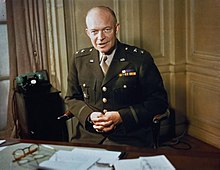
Eisenhower as a major general, 1942
In November 1942, Eisenhower was also appointed Supreme Commander Allied Expeditionary Force of the North African Theater of Operations (NATOUSA) through the new operational Headquarters Allied (Expeditionary) Force Headquarters (A(E)FHQ). The word "expeditionary" was dropped soon after his appointment for security reasons.[failed verification] The campaign in North Africa was designated Operation Torch and was planned in the underground headquarters within the Rock of Gibraltar. Eisenhower was the first non-British person to command Gibraltar in 200 years.[83]...
Operation Torch also served as a valuable training ground for Eisenhower's combat command skills; during the initial phase of Generalfeldmarschall Erwin Rommel's move into the Kasserine Pass, Eisenhower created some confusion in the ranks by some interference with the execution of battle plans by his subordinates. He also was initially indecisive in his removal of Lloyd Fredendall, commanding U.S. II Corps. He became more adroit in such matters in later campaigns.[86] In February 1943, his authority was extended as commander of AFHQ across the Mediterranean basin to include the British Eighth Army, commanded by General Sir Bernard Montgomery. The Eighth Army had advanced across the Western Desert from the east and was ready for the start of the Tunisia Campaign. Eisenhower gained his fourth star and gave up command of ETOUSA to become commander of NATOUSA.
After the capitulation of Axis forces in North Africa, Eisenhower oversaw the invasion of Sicily. Once Mussolini, the Italian leader, had fallen in Italy, the Allies switched their attention to the mainland with Operation Avalanche. But while Eisenhower argued with President Roosevelt and British Prime Minister Churchill, who both insisted on unconditional terms of surrender in exchange for helping the Italians, the Germans pursued an aggressive buildup of forces in the country. The Germans made the already tough battle more difficult by adding 19 divisions and initially outnumbering the Allied forces 2 to 1.[87]
Supreme Allied commander and Operation Overlord
In December 1943, President Roosevelt decided that Eisenhower – not Marshall – would be Supreme Allied Commander in Europe. The following month, he resumed command of ETOUSA and the following month was officially designated as the Supreme Allied Commander of the Allied Expeditionary Force (SHAEF), serving in a dual role until the end of hostilities in Europe in May 1945.[88] He was charged in these positions with planning and carrying out the Allied assault on the coast of Normandy in June 1944 under the code name Operation Overlord, the liberation of Western Europe and the invasion of Germany.

Eisenhower speaks with men of the 502nd Parachute Infantry Regiment (PIR), part of the 101st "Screaming Eagles" Airborne Division, on June 5, 1944, the day before the D-Day invasion. The officer Eisenhower is speaking to is First Lieutenant Wallace Strobel.
Eisenhower, as well as the officers and troops under him, had learned valuable lessons in their previous operations, and their skills had all strengthened in preparation for the next most difficult campaign against the Germans—a beach landing assault. His first struggles, however, were with Allied leaders and officers on matters vital to the success of the Normandy invasion; he argued with Roosevelt over an essential agreement with De Gaulle to use French resistance forces in covert and sabotage operations against the Germans in advance of Operation Overlord.[89]
Admiral Ernest J. King fought with Eisenhower over King's refusal to provide additional landing craft from the Pacific.[90] Eisenhower also insisted that the British give him exclusive command over all strategic air forces to facilitate Overlord, to the point of threatening to resign unless Churchill relented, which he did.[91]
Eisenhower then designed a bombing plan in France in advance of Overlord and argued with Churchill over the latter's concern with civilian casualties; de Gaulle interjected that the casualties were justified in shedding the yoke of the Germans, and Eisenhower prevailed.[92] He also had to skillfully manage to retain the services of the often unruly George S. Patton, by severely reprimanding him when Patton earlier had slapped a subordinate, and then when Patton gave a speech in which he made improper comments about postwar policy.[93]
[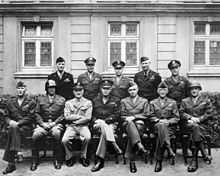
From left, front row includes army officers Simpson, Patton, Spaatz, Eisenhower, Bradley, Hodges and Gerow in 1945
The D-Day Normandy landings on June 6, 1944, were costly but successful. Two months later (August 15), the invasion of Southern France took place, and control of forces in the southern invasion passed from the AFHQ to the SHAEF. Many thought that victory in Europe would come by summer's end, but the Germans did not capitulate for almost a year. From then until the end of the war in Europe on May 8, 1945, Eisenhower, through SHAEF, commanded all Allied forces, and through his command of ETOUSA had administrative command of all U.S. forces on the Western Front north of the Alps. He was ever mindful of the inevitable loss of life and suffering that would be experienced on an individual level by the troops under his command and their families. This prompted him to make a point of visiting every division involved in the invasion.[94] Eisenhower's sense of responsibility was underscored by his draft of a statement to be issued if the invasion failed. It has been called one of the great speeches of history:
Our landings in the Cherbourg-Havre area have failed to gain a satisfactory foothold and I have withdrawn the troops. My decision to attack at this time and place was based on the best information available. The troops, the air and the Navy did all that bravery and devotion to duty could do. If any blame or fault attaches to the attempt, it is mine alone.[95]
Liberation of France and victory in Europe...
Presidential campaign of 1952
Main article: 1952 United States presidential election
See also: Draft Eisenhower movement
[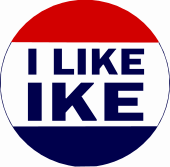
Eisenhower button from the 1952 campaign
President Truman sensed a broad-based desire for an Eisenhower candidacy for president, and he again pressed him to run for the office as a Democrat in 1951. But Eisenhower voiced his disagreements with the Democrats and declared himself to be a Republican.[137] A "Draft Eisenhower" movement in the Republican Party persuaded him to declare his candidacy in the 1952 presidential election to counter the candidacy of non-interventionist Senator Robert A. Taft. The effort was a long struggle; Eisenhower had to be convinced that political circumstances had created a genuine duty for him to offer himself as a candidate and that there was a mandate from the public for him to be their president. Henry Cabot Lodge and others succeeded in convincing him, and he resigned his command at NATO in June 1952 to campaign full-time.[138]
Eisenhower defeated Taft for the nomination, having won critical delegate votes from Texas. His campaign was noted for the simple slogan "I Like Ike". It was essential to his success that Eisenhower express opposition to Roosevelt's policy at the Yalta Conference and to Truman's policies in Korea and China—matters in which he had once participated.[139][140] In defeating Taft for the nomination, it became necessary for Eisenhower to appease the right-wing Old Guard of the Republican Party; his selection of Richard Nixon as the vice-president on the ticket was designed in part for that purpose. Nixon also provided a strong anti-communist reputation, as well as youth to counter Eisenhower's more advanced age.[141]...
Interstate Highway System
Main article: Interstate Highway System
Eisenhower championed and signed the bill that authorized the Interstate Highway System in 1956.[166] He justified the project through the Federal Aid Highway Act of 1956 as essential to American security during the Cold War. It was believed that large cities would be targets in a possible war, so the highways were designed to facilitate their evacuation and ease military maneuvers....
Foreign policy
Main article: Foreign policy of the Dwight D. Eisenhower administration
[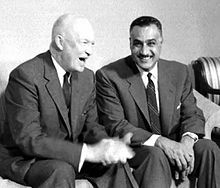
Eisenhower meeting with Egyptian President Gamal Abdel Nasser during Nasser's visit to United Nations in New York, September 1960

Eisenhower visits the Kingdom of Afghanistan and its king Mohammed Zahir Shah in Kabul.

Eisenhower with Indian Prime Minister Jawaharlal Nehru.
[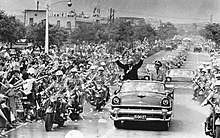
U.S. President Eisenhower visits the Republic of China and its President Chiang Kai-shek in Taipei.

Soviet Premier Nikita Khrushchev during his 11-day U.S. visit as guest of President Eisenhower, September 1959.
In 1953, the Republican Party's Old Guard presented Eisenhower with a dilemma by insisting he disavow the Yalta Agreements as beyond the constitutional authority of the Executive Branch; however, the death of Joseph Stalin in March 1953 made the matter a moot point.[171] At this time, Eisenhower gave his Chance for Peace speech in which he attempted, unsuccessfully, to forestall the nuclear arms race with the Soviet Union by suggesting multiple opportunities presented by peaceful uses of nuclear materials. Biographer Stephen Ambrose opined that this was the best speech of Eisenhower's presidency.[172][173] Eisenhower sought to make foreign markets available to American business, saying that it is a "serious and explicit purpose of our foreign policy, the encouragement of a hospitable climate for investment in foreign nations."[174]
Nevertheless, the Cold War escalated during his presidency. When the Soviet Union successfully tested a hydrogen bomb in late November 1955, Eisenhower, against the advice of Dulles, decided to initiate a disarmament proposal to the Soviets. In an attempt to make their refusal more difficult, he proposed that both sides agree to dedicate fissionable material away from weapons toward peaceful uses, such as power generation. This approach was labeled "Atoms for Peace".[175]...
In 1954, Eisenhower articulated the domino theory in his outlook towards communism in Southeast Asia and also in Central America. He believed that if the communists were allowed to prevail in Vietnam, this would cause a succession of countries to fall to communism, from Laos through Malaysia and Indonesia ultimately to India. Likewise, the fall of Guatemala would end with the fall of neighboring Mexico.[179]
That year, the loss of North Vietnam to the communists and the rejection of his proposed European Defence Community (EDC) were serious defeats, but he remained optimistic in his opposition to the spread of communism, saying "Long faces don't win wars".[180] As he had threatened the French in their rejection of EDC, he afterwards moved to restore West Germany as a full NATO partner.[181] In 1954, he also induced Congress to create an Emergency Fund for International Affairs in order to support America's use of cultural diplomacy to strengthen international relations throughout Europe during the cold war.[182][183][184][185][186][187][188]
With Eisenhower's leadership and Dulles' direction, CIA activities increased under the pretense of resisting the spread of communism in poorer countries;[189] the CIA in part deposed the leaders of Iran in Operation Ajax, of Guatemala through Operation Pbsuccess, and possibly the newly independent Republic of the Congo (Léopoldville).[190] Eisenhower authorized the assassination of Congolese leader Patrice Lumumba in 1960.[191][192][193]
However, the plot to poison him was abandoned.[194][195][196] In 1954, Eisenhower wanted to increase surveillance inside the Soviet Union. With Dulles' recommendation, he authorized the deployment of thirty Lockheed U-2's at a cost of $35 million (equivalent to $353.17 million in 2021).[197] He approved an operation by the Central Intelligence Agency in which they recruited operatives in Cuba to carry out an extensive campaign of terrorism and sabotage, kill civilians, and cause economic damage. The CIA also trained and commanded pilots to bomb civilian airfields.[204] The administration also planned the Bay of Pigs Invasion to overthrow Fidel Castro in Cuba, which John F. Kennedy was left to carry out.[205]
Space Race
Further information: Space Race
[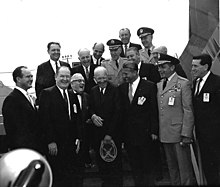
President Eisenhower with Wernher von Braun, 1960

In the 1970s the reverse of the Eisenhower dollar celebrated America's Moon landings, which began 11 years after NASA was created during Eisenhower's presidency
Eisenhower and the CIA had known since at least January 1957, nine months before *Sputnik*, that Russia had the capability to launch a small payload into orbit and was likely to do so within a year.[206] He may also privately have welcomed the Soviet satellite for its legal implications: By launching a satellite, the Soviet Union had in effect acknowledged that space was open to anyone who could access it, without needing permission from other nations.
On the whole, Eisenhower's support of the nation's fledgling space program was officially modest until the Soviet launch of Sputnik in 1957, gaining the Cold War enemy enormous prestige around the world. He then launched a national campaign that funded not just space exploration but a major strengthening of science and higher education. The Eisenhower administration determined to adopt a non-aggressive policy that would allow "space-crafts of any state to overfly all states, a region free of military posturing and launch Earth satellites to explore space".[207] His Open Skies Policy attempted to legitimize illegal Lockheed U-2 flyovers and Project Genetrix while paving the way for spy satellite technology to orbit over sovereign territory,[208] however Nikolai Bulganin and Nikita Khrushchev declined Eisenhower's proposal at the Geneva conference in July 1955.[209] In response to Sputnik being launched in October 1957, Eisenhower created NASA as a civilian space agency in October 1958, signed a landmark science education law, and improved relations with American scientists.[210]
Fear spread through the United States that the Soviet Union would invade and spread communism, so Eisenhower wanted to not only create a surveillance satellite to detect any threats but ballistic missiles that would protect the United States. In strategic terms, it was Eisenhower who devised the American basic strategy of nuclear deterrence based upon the triad of B-52 strategic bombers, land-based intercontinental ballistic missiles (ICBMs), and Polaris submarine-launched ballistic missiles (SLBMs).[211]
NASA planners projected that human spaceflight would pull the United States ahead in the Space Race as well as accomplishing their long time goal; however, in 1960, an Ad Hoc Panel on Man-in-Space concluded that "man-in-space can not be justified" and was too costly.[212] Eisenhower later resented the space program and its gargantuan price tag—he was quoted as saying, "Anyone who would spend $40 billion in a race to the moon for national prestige is nuts."[213]
Korean War, Free China and Red China
....
Southeast Asia
Early in 1953, the French asked Eisenhower for help in French Indochina against the Communists, supplied from China, who were fighting the First Indochina War. Eisenhower sent Lt. General John W. "Iron Mike" O'Daniel to Vietnam to study and assess the French forces there.[224] Chief of Staff Matthew Ridgway dissuaded the President from intervening by presenting a comprehensive estimate of the massive military deployment that would be necessary. Eisenhower stated prophetically that "this war would absorb our troops by divisions."[225]
Eisenhower did provide France with bombers and non-combat personnel. After a few months with no success by the French, he added other aircraft to drop napalm for clearing purposes. Further requests for assistance from the French were agreed to but only on conditions Eisenhower knew were impossible to meet – allied participation and congressional approval.[226]
When the French fortress of Dien Bien Phu fell to the Vietnamese Communists in May 1954, Eisenhower refused to intervene despite urgings from the Chairman of the Joint Chiefs, the Vice President and the head of NCS.[227]...
Eisenhower personally visited Spain in December 1959 to meet dictator Francisco Franco and consolidate his international legitimation.
The Middle East and Eisenhower doctrine

Eisenhower with the Shah of Iran, Mohammad Reza Pahlavi (1959)
Even before he was inaugurated Eisenhower accepted a request from the British government to restore the Shah of Iran (Mohammad Reza Pahlavi) to power. He therefore authorized the Central Intelligence Agency to overthrow Prime Minister Mohammad Mosaddegh.[236] This resulted in increased strategic control over Iranian oil by U.S. and British companies.[237]
In November 1956, Eisenhower forced an end to the combined British, French and Israeli invasion of Egypt in response to the Suez Crisis, receiving praise from Egyptian president Gamal Abdel Nasser. Simultaneously he condemned the brutal Soviet invasion of Hungary in response to the Hungarian Revolution of 1956. He publicly disavowed his allies at the United Nations, and used financial and diplomatic pressure to make them withdraw from Egypt.[238] Eisenhower explicitly defended his strong position against Britain and France in his memoirs, which were published in 1965.[239]
After the Suez Crisis, the United States became the protector of unstable friendly governments in the Middle East via the "Eisenhower Doctrine".[240] Designed by Secretary of State Dulles, it held the U.S. would be "prepared to use armed force ... [to counter] aggression from any country controlled by international communism". Further, the United States would provide economic and military aid and, if necessary, use military force to stop the spread of communism in the Middle East.[241]
...
Knowledge Web Content (see main node)
Name: Dwight David Eisenhower
Nickname/Alias: President Eisenhower; Ike
Achievements: President of the United States; Supreme Commander of Allied Forces in the Second World War
Born: October 14, 1890; Denison, Texas
Died: March 28, 1969; Washington, D.C. (Aged 78)
Field & Discipline: Military; Government; Politics; General; President
Language: English
Father: David Jacob Eisenhower
Mother: Elizabeth Stover
Siblings: Arthur; Earl; Edgar; Milton; Paul; Roy
Spouse: Mamie Geneva Doud
Children: Doud; John
Education: West Point Military Academy, New York State
Major Work:
"Crusade in Europe"
"Mandate for Change"
"Waging Peace"
Life & Times:
After graduating from West Point in 1915, Eisenhower was posted to San Antonio, Texas, as a second lieutenant. During the First World War (1914-18), he was given command of a tank training center and was about to be sent to the front when the war ended.
Serving in the Panama Canal Zone from 1922-24, he made a good impression on Brigadier General Fox Conner, who recommended him for the command and general staff school at Fort Leavenworth. In 1926, Eisenhower graduated at the top of his class and in 1928 graduated from the Army War College.
After a stint in France, Eisenhower returned to the U.S. in 1933 and was made aide to army chief of staff General Douglas MacArthur. He served with MacArthur in the Philippines from 1935, returning when the Second World War broke out in 1939.
He was made a full colonel in March, 1941 and chief of staff of the Third Army three months later. His skill in organizing war games in which some 500,000 troops took part brought him to the attention of the army chief of staff General George C. Marshall, who asked him in 1941 to help plan the Allied invasion of Europe.
In June, 1942, he was selected over some 350 officers senior to him, to command the U.S. troops in Europe.
Eisenhower was put in command of "Operation Torch", the invasion of French North Africa and the first major Allied offensive of the war. The campaign began in November, 1942, and was successfully completed in May 1943. Though he was criticized for working with Admiral Jean-Francois Darlan, a French naval officer who had collaborated with the Germans, he was supported by President [supported by] Franklin D. Roosevelt*.
Now a full general, Eisenhower commanded the amphibious attack on Sicily and the mainland of Italy. At the end of 1943, he was made supreme commander of the Allied Expeditionary Forces, a task that required the tactful handling of the notoriously difficult [had difficulties with] De Gaulle*, leader of the Free French. But he had the full support of British Prime Minister [worked well with] Churchill*.
On June 6, 1944 (D-Day) Eisenhower took advantage of a short break in the bad weather and ordered the invasion of France to proceed. By August, the Allies had taken Paris. After almost another year of extremely tough fighting, the Allies crossed the Rhine in March, 1945. The Germans surrender on May 7. President Harry S. Truman made Eisenhower chief of staff and for the next two years, he presided over the demobilization of the wartime army.
In 1951, Truman appointed Eisenhower supreme commander of the North Atlantic Treaty Organization (NATO), but in June, 1952, Eisenhower resigned and stood as Republican presidential candidate with future president [his Vice President was] Richard M. Nixon* as his running mate. He was elected with a large majority. He antagonized the Republican right by his liberal domestic policies such as increasing the minimum wage and expanding Society Security and Welfare.
He appointed the liberal Chief Justice [appointed] Warren* and supported Warren's expansion of civil rights. In foreign affairs, he worked with secretary of state [Sec. of State was] Dulles* to take a coherent stance against Communist expansion, manifested in the forming of the Southeast Asia Treaty Organization (SEATO) and a treaty with [negotiated with] Chiang Kai-shek’s* Nationalist China in 1954.
At a 1955 summit of the U.S., Britain, France and the Soviet Union, Eisenhower’s proposed that information on atomic weapons be pooled led to the formation of the International Atomic Energy Agency in 1957.
In 1956, Eisenhower was returned with a massive majority for a second term, although the Democrats held both houses of Congress. Opposed to racial segregation, Eisenhower backed the 1957 Civil Rights Act, passed in reaction to the violence at Little Rock, Arkansas, where the governor had obstructed a federal court order to integrate a high school.
Eisenhower's policy of low military expenditure came under fire in 1957, when the Soviet Union launched Sputnik I, the first man-made satellite to orbit the earth. In response, the National Aeronautics and Space Administration (NASA) was established in 1958.
In 1959, Eisenhower began to travel widely on foreign affairs, visiting Europe, Africa, Asia, and Latin America. Soviet premier [invited] Krushchev* accepted his invitation for talks in the U.S.
In 1960, he authorized the secret training and equipping of Cuban exiles in Guatemala after Cuba was taken over by [severed relations with] Castro*.
In 1961, he severed relations with Cuba. In 1963, he retired to his farm in Gettysburg, Pennsylvania, where he wrote his memoirs.
Extra Connections: He was succeeded by President [succeeded by] Kennedy*
He appointed [appointed] Lindberg* to NACA
[surrender offered by] Himmler suggested surrender to him
He worked with [worked with] Folke Bernadottte*
Assessment: His organizational, strategic and diplomatic skills were invaluable in the Second World War. He was less successful as a politician, and his administration has been criticized for lacking vigor.
Oneliner: Eisenhower, American President and WWII General
Bibliography:
- Burk, Robert F., Dwight D. Eisenhower, Hero and Politician, Twayne Publishers, Boston, 1986.