Hertz, HR
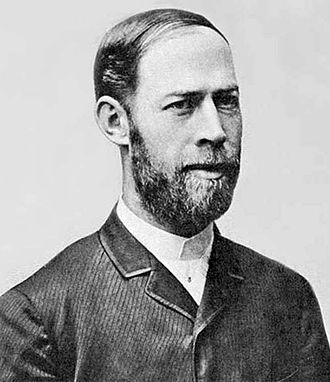
Achievements: Electromagnetic radiation
Born: February 22, 1857; Hamburg, Germany
Died: January 1, 1894; Bonn, Germany. Aged 36
Field & Discipline: Science; Physics; Physicist
Language: German
Father: Gustav F. Hertz
Mother: Anna Elisabeth Pfefferkorn
Siblings: Three younger brothers; one younger sister
Spouse: Elisabeth Doll (m. 1886)
Children: Johanna; Mathilde
Education: Lange Private School (1863-72); Johanneum Gymnasium (1872-75); Dresden Polytechnic (1876); University of Munich (1877-78); University of Berlin (1878-80)
Major Work:
''Electric Waves' (1892)
Life & Times:
After a year at Munich, Hertz moved to the University of Berlin, where he studied physics under [assistant to] Helmholtz*, who recognized his talents and was to have a profound influence on his future career.
At Berlin, Hertz immediately began researching an experimental problem (originally set by Helmholtz) concerning electrical inertia, his solution for which won him the 1879 Berlin Philosophical Faculty prize. For his doctorate he carried out a theoretical study of electromagnetic induction in rotating conductors.
In 1880 he became assistant to Helmholtz in the practical work of the Berlin Physical Institute, a position he held for the next three years. During this time, Hertz published 15 papers (on electromagnetic induction, electrical inertia, residual charge in dielectrics and cathode rays) which he presented at meetings of the Berlin Physical Society and which began to establish his reputation.
In 1883, keen for regular faculty appointment, Hertz accepted the job of unsalaried lecturer in mathematical physics at the University of Kiel, where he was forced to concentrate on theoretical work, publishing three papers, on meteorology, on magnetic and electric units, and on [studied work of] Maxwell's* electrodynamics.
In 1885, Hertz accepted professorship in physics at the Karlsruhe Technische Hochschule (succeeding [succeeded] Braun*) and from November 1886, used the large improved induction coils he found at Karlsruhe to show that dielectric polarization leads to the same electromagnetic effects as conduction currents, and confirmed the validity of the Maxwell's equations concerning the behaviour of electricity.
In 1888, Hertz realized that Maxwell's equations implied that electric waves could be produced and would travel through air, and during the following year he confirmed Maxwell's prediction by constructing an open circuit powered by an induction coil, with an open loop of wire as a receiving circuit.
As a spark was produced by the induction coil, so too was one produced in the open receiving loop, and Hertz established that electric waves ([discovered] electromagnetic radiation*) were travelling from the coil to the loop, creating a current in the loop and causing a spark to form across the gap.
Hertz went on to calculate the velocity of these waves (which later became known as radio waves), and after showing that the velocity was the same as that of light he showed that the waves could be reflected, refracted and diffracted.
One experiment used pitch prisms to demonstrate refraction in the same way that light is refracted by a glass prism, while another (1887) proved that ultraviolet light altered the lowest voltage capable of causing a spark to jump between two metal electrodes, an important stage in the development of photovoltaics, then being researched in the U.S. by [aided work of] Fritts*.
In 1888 Hertz also began to suffer from a serious bone disease and in early 1889 had all his teeth removed in a desperate attempt to cure the condition. Soon afterwards he succeeded [succeeded] Clausius* as professor of physics at the University of Bonn. After spending some time reorganizing the Bonn Physical Institute, Hertz set to work on his electromagnetic research, aided by a group of talented assistants including [assistant was] Bjerknes* and [assistant was] Lenard*.
At Bonn, Hertz continued both his research on the discharge of electricity in rarefied gases and his theoretical study of Maxwell's theory (this resulting in two classic papers on the subject which put forward the theory that electromagnetic phenomena are caused by polarization in a dielectric medium filling otherwise empty space.
In 1891 he returned to the subject of cathode rays, studying their power to penetrate metal foils. During this period he received the Rumford Medal of the Royal Society (1890), for which he travelled to London, where he was entertained by [met] Crookes*, [met] Lodge*, [met] FitzGerald*, [met] Stokes*, William Thomson (Lord [met] Kelvin*) and others.
With increasing ill health, in the spring of 1891 Hertz began the research that would occupy him almost exclusively until his death: a purely theoretical study of the principles of mechanics inspired by Helmholtz's new work (published during the 1880s) on the principle of least action.
Through his work on mechanics, Hertz developed a system with only one law of motion:- that the path of a mechanical system through space is as straight as possible and is travelled with uniform motion. His mechanical theory, translated posthumously as 'The Principles of Mechanics, Presented in a New Form' (1899), refounded the science of mechanics on alternative principles that would provide a natural mechanical basis for electrodynamics as well as for the other parts of physics.
During the early 1890s, Hertz's condition deteriorated to the extent that from 1892 he was in constant pain and was unable to lecture for brief periods. He had several head operations which gave him only temporary relief, and in December 1893, after having sent his book of mechanics to the press, he gave his last lecture. He died of blood poisoning.
Extra Connections: His work related to that of [made possible work of] Hughes* and [made possible work of] Marconi*
He was studied by [studied by] Einstein*
He influenced the work of [influenced] Stribeck*
Assessment: His name is commemorated in the use of the hertz as a unit of frequency.
Oneliner: Heinrich Hertz, discoverer of electromagnetic radiation
Bibliography:
- Dictionary of Scientific Biography.
- Biographical Dictionary of Physicists.
- Encyclopedia Britannica.
- Morrison, Phil and Emily, "Heinrich Hertz", in Scientific American, 197 (1957), 98-106.