Marconi G
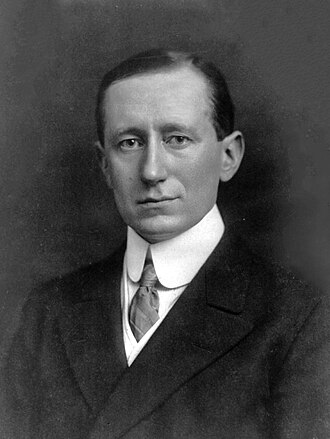

Achievements: Radio
Born: April 25, 1874; Bologna, Italy
Died: July 20, 1937; Rome, Italy. Aged 63
Field & Discipline: Science; Physics; Physicist
Language: Italian; English
Education: Mostly with private tutors; Livorno Technical Insitute
Life & Times:
Marconi’s mother was a member of the Jameson whiskey family.In 1894, while on holiday in the Alps, reading an article about [inspired by] Hertz*, who had just died, Marconi was inspired by the idea of sending messages through the air. He began experimenting as soon as he returned home, concentrating on trying to increase the distance over which transmission could be effected.
A new type of receiver had replaced the small spark-gap receiver Hertz had used. Marconi used the Branly-[used coherer by]
Lodge* coherer (a glass tube filled with iron filings which had an electrical contact at each end). He connected the receiving coil to the tube and when it picked up a signal all the filings cohered. This had the effect of reducing the electrical resistance between transmitter and receiver. The coherer was connected to a battery so the fall in resistance caused a surge in current. This surge could be used to sound a buzzer or - in a Morse code machine - print a symbol. Marconi accidentally discovered that signals could be sent or received by an aerial connected to the earth. This meant he could send much stronger signals over larger distances.
In February 1896 Marconi arrived in England where he secured a patent for his invention and demonstrated it to engineers and government officials on the roof of the Post Office building in London, transmitting to the roof of another building a mile away. In September he gave a demonstration on Salisbury Plain in Wiltshire before officials from the War Office and the Admiralty. In March 1897, Marconi used kites and balloons to lift aerials, and he achieved transmission of over 4.3 miles on Salisbury Plain. In May he transmitted for the first time over water - 8.7 miles across the Bristol Channel.
In June 1897 he demonstrated his invention to the Italian navy, and at the dockyard in Spezia he discovered that wireless messages could still be sent even when a ship was out of sight of land. [arranged communications for] Queen Victoria* immediately asked Marconi to set up communications between her holiday house on the Isle of Wight and her son's yacht. English backers set up "The Wireless Telegraph and Signal Company Limited" and at the age of twenty-three Marconi became rich.
In 1898/9, practical examples of the use of wireless began to emerge. It was used to summon lifeboats, by insurers at Lloyd's of London to get information on the movements of ships, and by The Dublin "Daily Express" who found themselves able to print up-to-the-minute reports of the Kingstown yacht races by engaging a radio boat to follow the yachts.In 1899 the first radio transmission between countries took place over a distance of around 30 miles across the English channel to France. In the same year, British warships were equipped with wireless, followed in 1900 by the first merchant ship, the German liner "Kaiser Wilhelm der Grosse".
Other workers in the field of radio transmission, such as [invention improved by] Fessenden* who was interested in the possibilities of a high-frequency alternator, were experimenting with improved apparatus. Marconi's next step was to persuade his backers that it was possible to transmit across the Atlantic. In 1902 a liner 1,550 miles (2,300 km) out into the ocean received messages from a Marconi transmitter in England.
1907 saw the first commercial transatlantic wireless service and in 1909 Marconi was awarded the Nobel Prize for physics. He became interested in using microwave radiation for detecting ships and aircraft and 1934 he demonstrated the application of this new technology by having the windows on the bridge of his large yacht blacked out and steaming at full speed into the Italian port of Sestri Levante through a dangerous channel. This feat of blind navigation had been accomplished by guidance from an ultra-high-frequency beacon on cliffs above the port.
Marconi was now world famous and in 1933 went on a world tour during which he was entertained by President [entertained by] Theodore Roosevelt* in the United States and by the Emperor of Japan. In the same year, [influenced] Jansky* published his discovery of radio emissions in the Milky Way and kicked off radio astronomy.
Marconi became a Senator in the Italian party and was made a Marquis by [ennobled by] Mussolini*. When Marconi died in 1937, a two-minute radio silence was observed world-wide.
Extra Connections: Inspired [inspired] Braun*.
He influenced [influenced] Eiffel*
[anticipated by] Hughes* prefigured his work.
Led [triggered discovery by] Kenelley* and [triggered discovery by] Heaviside* to postulate the ionosphere.
A rival was [a rival was] De Forest*
Hen was a friend of [a pal of] Swinton*
[employed] Tykociner* worked for him
His work related to that of [work related to] Penzias* & Wilson*
He met [met] Sperry* in Rome
Was an Academy colleague of physicist [colleague of]Fermi*
Assessment: Marconi was the first to develop the discovery of radio waves for use in wireless signals.
Oneliner: Guglielmo Marconi, inventor of radio
Bibliography:
- Dunlap, Orrin E, Marconi, The Man and His Wireless, The Macmillan Company, New York, 1937.
- Tames, Richard,Guglielmo Marconi, Franklin Watts, London, 1990.
Connections II #16 -
Father: Guiseppe Marconi
Mother: Annie Jameson
Siblings: Alfonso
Spouse: 1) Beatrice O'Brien; 2) Cristina Bezzi-Scali
Children: 1 son (by O'Brien); Degna (by O'Brien ); Elettra (by Bezzi-Scala)