Charlemagne 2
Charlemagne (/ˈʃɑːrləmeɪn, ˌʃɑːrləˈmeɪn/ *SHAR-lə-mayn, -MAYN*) or Charles the Great (Latin: Carolus Magnus, Frankish: Karl;[3] 2 April 747[a] – 28 January 814), a member of the Carolingian dynasty, was King of the Franks from 768, King of the Lombards from 774, and the Emperor of the Romans from 800.
Charlemagne succeeded in uniting the majority of western and central Europe and was the first recognized emperor to rule from western Europe after the fall of the Western Roman Empire approximately three centuries earlier.[4] The expanded Frankish state that Charlemagne founded was the Carolingian Empire, which is considered the first phase in the history of the Holy Roman Empire. He was canonized by Antipope Paschal III—an act later treated as invalid—and he is now regarded by some as beatified (which is a step on the path to sainthood) in the Catholic Church.
Charlemagne was the eldest son of Pepin the Short and Bertrada of Laon. He was born before their canonical marriage.[5] He became king of the Franks in 768 following his father's death, and was initially co-ruler with his brother Carloman I until the latter's death in 771.[6] As sole ruler, he continued his father's policy towards protection of the papacy and became its sole defender, removing the Lombards from power in northern Italy and leading an incursion into Muslim Spain. He also campaigned against the Saxons to his east, Christianizing them (upon penalty of death) which led to events such as the Massacre of Verden. He reached the height of his power in 800 when he was crowned Emperor of the Romans by Pope Leo III on Christmas Day at Old St. Peter's Basilica in Rome.
Charlemagne has been called the "Father of Europe" (Pater Europae),[7] as he united most of Western Europe for the first time since the classical era of the Roman Empire, as well as uniting parts of Europe that had never been under Frankish or Roman rule. His reign spurred the Carolingian Renaissance, a period of energetic cultural and intellectual activity within the Western Church. The Eastern Orthodox Church viewed Charlemagne less favourably, due to his support of the filioque and the Pope's preference of him as emperor over the Byzantine Empire's first female monarch, Irene of Athens. These and other disputes led to the eventual split of Rome and Constantinople in the Great Schism of 1054.[8][b]
Charlemagne died in 814 after contracting an infectious lung disease.[9] He was laid to rest in the Aachen Cathedral, in his imperial capital city of Aachen. He married at least four times,[10][2] and three of his legitimate sons lived to adulthood. Only the youngest of them, Louis the Pious, survived to succeed him. Charlemagne is a direct ancestor of many of Europe's royal houses, including the Capetian dynasty,[c] the Ottonian dynasty,[d] the House of Luxembourg,[e] the House of Ivrea[f] and the House of Habsburg.[g]
- Names and nicknames
- Political background
- Rise to power
- Wives, concubines, and children
- Italian campaigns
- Carolingian expansion to the south
- Eastern campaigns
- Imperium
- Administration
- Appearance
- Beatification
- Cultural impact
- Notes
- References...
Cultural impact
See also: Iconography of Charlemagne
Middle Ages
The author of the Visio Karoli Magni written around 865 uses facts gathered apparently from Einhard and his own observations on the decline of Charlemagne's family after the dissensions war (840–43) as the basis for a visionary tale of Charles' meeting with a prophetic spectre in a dream.
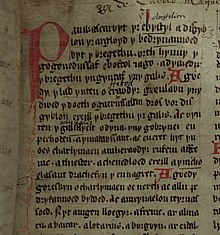
One of a chain of Middle Welsh legends about Charlemagne: Ystorya de Carolo Magno from the Red Book of Hergest (Jesus College, Oxford, MS 111), 14th century
Charlemagne was a model knight as one of the Nine Worthies who enjoyed an important legacy in European culture. One of the great medieval literary cycles, the Charlemagne cycle or the Matter of France, centres on his deeds—the Emperor with the Flowing Beard of Roland fame—and his historical commander of the border with Brittany, Roland, and the 12 paladins. These are analogous to, and inspired the myth of, the Knights of the Round Table of King Arthur's court.[167] Their tales constitute the first chansons de geste.
In the 12th century, Geoffrey of Monmouth based his stories of Arthur largely on stories of Charlemagne.[168] During the Hundred Years' War in the 14th century, there was considerable cultural conflict in England, where the Norman rulers were aware of their French roots and identified with Charlemagne, Anglo-Saxon natives felt more affinity for Arthur, whose own legends were relatively primitive. Therefore, storytellers in England adapted legends of Charlemagne and his 12 Peers to the Arthurian tales.[169]
In the Divine Comedy, the spirit of Charlemagne appears to Dante in the Heaven of Mars, among the other "warriors of the faith".[170]
19th century

Emperor Charlemagne, by Albrecht Dürer, 1511–1513, Germanisches Nationalmuseum
Charlemagne's capitularies were quoted by Pope Benedict XIV in his apostolic constitution 'Providas' against freemasonry: "For in no way are we able to understand how they can be faithful to us, who have shown themselves unfaithful to God and disobedient to their Priests".[171]
Charlemagne appears in Adelchi, the second tragedy by Italian writer Alessandro Manzoni, first published in 1822.[172]
In 1867, an equestrian statue of Charlemagne was made by Louis Jehotte and was inaugurated in 1868 on the Boulevard d'Avroy in Liège. In the niches of the neo-roman pedestal are six statues of Charlemagne's ancestors (Sainte Begge, Pépin de Herstal, Charles Martel, Bertrude, Pépin de Landen and Pépin le Bref).
The North Wall Frieze in the courtroom of the Supreme Court of the United States depicts Charlemagne as a legal reformer.[173]
20th century
The city of Aachen has, since 1949, awarded an international prize (called the Karlspreis der Stadt Aachen) in honour of Charlemagne. It is awarded annually to "personages of merit who have promoted the idea of Western unity by their political, economic and literary endeavours."[174] Winners of the prize include Richard von Coudenhove-Kalergi, the founder of the pan-European movement, Alcide De Gasperi, and Winston Churchill.
In its national anthem, "El Gran Carlemany", the microstate of Andorra credits Charlemagne with its independence.
In 1964, young French singer France Gall released the hit song "Sacré Charlemagne" in which the lyrics blame the great king for imposing the burden of compulsory education on French children.
Charlemagne is quoted by Dr Henry Jones, Sr. in Indiana Jones and the Last Crusade. After using his umbrella to induce a flock of seagulls to smash through the glass cockpit of a pursuing German fighter plane, Henry Jones remarks, "I suddenly remembered my Charlemagne: 'Let my armies be the rocks and the trees and the birds in the sky.'" Despite the quote's popularity since the movie, there is no evidence that Charlemagne actually said this.[175]
21st century
A 2010 episode of QI discussed the mathematics completed by Mark Humphrys that calculated that all modern Europeans are highly likely to share Charlemagne as a common ancestor (see most recent common ancestor).[176]
The Economist featured a weekly column entitled "Charlemagne", focusing generally on European affairs and, more usually and specifically, on the European Union and its politics.[177]
Actor and singer Christopher Lee's symphonic metal concept album Charlemagne: By the Sword and the Cross[178] and its heavy metal follow-up Charlemagne: The Omens of Death feature the events of Charlemagne's life.[179]
In April 2014, on the occasion of the 1200th anniversary of Charlemagne's death, public art Mein Karl by Ottmar Hörl at Katschhof place was installed between city hall and the Aachen cathedral, displaying 500 Charlemagne statues.[180]
Charlemagne features as a playable character in the 2014 Charlemagne expansion for the grand strategy video game Crusader Kings 2.[181]
Charlemagne is a playable character in the Mobile/PC Game Rise of Kingdoms.
In the 2018 video game Fate/Extella Link, Charlemagne appears as a Heroic Spirit separated into two Saint Graphs: the adventurous hero Charlemagne, who embodies the fantasy aspect as leader of the Twelve Paladins, and the villain Karl de Große, who embodies the historical aspect as Holy Roman Emperor.[182][183]
In July 2022, Charlemagne featured as a character in an episode of The Family Histories Podcast, and it references his role as an ancestor of all modern Europeans. He is portrayed here in later life, and is speaking Latin, which is translated by a device. He is returned to 9th Century Aquitaine by the end of the episode after a DNA sample has been extracted.[184]
Knowledge Web Content (see main node)
Name: Charlemagne
Nickname/Alias: Charles the Great; Latin: Carolus Magnus
Achievements: Founder (800) of the medieval “Roman” Empire.
Born: April 2, 747; Aachen, Aix-la-Chapelle, or Liege, France
Died: January 28, 814; Aachen, Aix-la-Chapelle, France (Aged 66)
Field & Discipline: Royalty; Emperor
Language: Old High German;Old French; Latin
Father: Pepin III (or Pepin the Short, d. 768)
Mother: Bertrada Carloman
Siblings: Carloman (751-71)
Spouse: 1) Desiderata (m. 770); 2) Hildegarde (m. 773, d. 783); 3) Fastrada (m. 783)
Children: Pepin (by Desiderata); Charles (by Hildegarde); Louis (Louis of Aquitaine;
Louis the Pious, by Hildegarde)
Education: Unknown
Life & Times:
At the beginning of his reign, Charlemagne turned his attention to the pagan Saxons to the north, who had so far resisted the efforts of missionaries to convert them to Christianity. His first assault was launched in 772, followed by a series of extensive campaigns which culminated in declarations of allegiance by the Saxon nobility and a series of mass baptisms (performed 775-77).
In 773 Charles invaded and conquered Lombardy, in northern Italy. At Easter 774, he travelled to Rome for the first time, and with Pope Hadrian I in St. Peter's Basilica personally renewed the Donation of Pepin (his father), which promised to transfer to papal rule large sections of Italy.
Eager to extend his domains southwards, in the summer of 778 Charles advanced into Spain with a vast army and laid siege to Saragossa (Zaragoza). However, this campaign proved to be one of his few military disasters, as his troops failed to take the city, and his rear guard was attacked and defeated at Roncevalles.
At his capital, Aachen, Charles fostered secular culture, summoning prominent scholars, architects, musicians and astronomers from all parts of his kingdom and from Ireland and England. Among the most important was the great Anglo-Saxon scholar Alcuin. These men helped Charles establish a court library containing the works of the Church Fathers and classical authors, and became informally organized into a "Palace Academy" for the education of young Frankish knights, developing a revival of learning often referred to as the "Carolingian Renaissance.”
Charles himself took an active part in this intellectual court life, receiving lessons in grammar and Greek from Alcuin, a rudimentary knowledge of mathematics and astronomy, and composing Latin verses and a grammar of the German language. He also ordered copied and preserved many texts of the classics, pagan and Christian. Under the guidance of Alcuin, scriptoria were revived or established in monasteries and copying, in the beautiful script now known as Carolingian miniscule, became so widespread that 90 per cent of the classical heritage has come down to modern times in Carolingian manuscripts. The impetus given to learning under Charles lasted for at least a century after his death.
Charles also transformed his kingdom by a variety of measures to improve both its physical and institutional infrastructure. In 787 he ordered all monasteries, cathedrals and bishops' houses across the kingdom to open schools to teach the children of the poor. He ordered the repair and building of roads and bridges, the resettlement of deserted lands and the clearing of new land, the building of palaces and churches and the introduction of more productive agricultural practices.
He constructed a bridge across the Rhine at Mainz, and tried unsuccessfully to dig a canal to connect the Danube and the Rhine. He also standardized the system of weights and measures and reformed the monetary system, dividing the silver coinage into pounds, shillings and pence in a ratio which was still in use in most of the most of the British Commonwealth in the 20th century.
Centralizing his government, he introduced travelling administrators who examined judgements and financial records, investigated complaints against local officials, and punished corruption and dishonesty in local government.
He also established a centralized court, over which he ruled and administered justice throughout his empire. He also fostered good relations with the East, and was sent in 798 by Harun al-Raschid, the caliph of Baghdad, ambassadors and the gift of an elephant. The Carolingian frontier now extended from the North Sea, to Lombardy, and eastward to the Atlantic, and in addition he ruled most of Italy and collected tribute from border provinces as far south as the Pyrenees.
The revival of the Roman Empire of the West was regarded by many as the natural outcome of the vast power he had acquired, and on Christmas Day 800 he reached the culmination of his career when the people of Rome acclaimed him Emperor of the Romans, and Pope Leo III crowned him in St. Peter's basilica as “Carolus Augustus.” This coronation was one result of the close alliance between church and state that had been cultivated by Charles throughout his reign; in particular he forged close ties of friendship with Pope Hadrian I, who tried to develop Italian automony Italy in opposition to the influence of Constantinople.
This desire for papal independence was greatly aided by the “Donation of Constantine,” a forgery dating probably from the first few years of Hadrian's reign and said to legitimize these papal aims in the name of the first Christian Emperor, [involved in forgery regarding] Constantine *.
Charles spent the remaining years of his reign in consolidating this vast empire reaching from the Ebro in nothern Spain to the Elbe, founding bishoprics in the Saxon countries and subjugating many of the Slavs east of the Elbe. His last years, however, were marked by difficulties, not least the failure to win recognition from the Byzantine Emperor, the renewed attacks by the Danes on the northern outposts of his empire, and the deaths (all within a short time) of his wife, his sister, a his sons Pepin and Charles.
The succession devolved on the weakest of his sons, Louis of Aquitaine, who was crowned Charlemagne’s co-emperor and sole successor at Aachen in 813. A few months later, in January 814, Charles developed pleurisy and died.
Assessment: Although this empire survived its founder by only one generation,
the medieval kingdoms of France and Germany derived all their constitutional traditions from Charles's monarchy.
Oneliner: Charlemagne, first medieval “Roman” Emperor
Bibliography:
- Collier's Encyclopedia.
- Collins, Roger, Charlemagne, Macmillan: London, 1998.
- Encyclopedia Britannica.
- New Catholic Encyclopedia.